如何构建替代首批 3 名员工的 AI 智能体团队 (实战教程) ✍ Khairallah AL-Awady🕐 2026-05-06📦 10.2 KB 🟢 已读 𝕏 文章列表 文章针对初创者面临的资源瓶颈,提出利用 Claude 和 MCP 服务器构建三类 AI 智能体来替代首批全职员工的解决方案:负责市场情报的研究 Agent、处理内容全生命周期的内容 Agent 以及管理日常运营的运营 Agent。文章详细拆解了这三者的构建方法、Prompt 架构及工作流,旨在帮助创业者将繁琐工作自动化,从而专注于核心决策。 AI AgentClaudeMCP自动化创业工作流Prompt Engineering运营内容创作 # How to Build a Team of AI Agents That Replace Your First 3 Hires (Full Course) **作者**: Khairallah AL-Awady **日期**: 2026-05-05T09:33:42.000Z **来源**: [https://x.com/eng_khairallah1/status/2051596186851914019](https://x.com/eng_khairallah1/status/2051596186851914019) --- 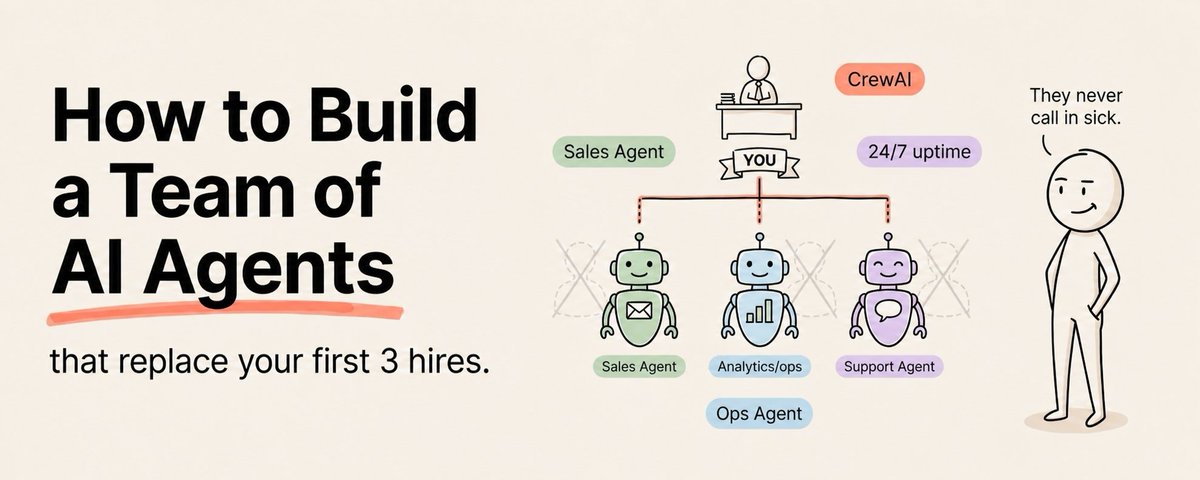 Every solo founder hits the same wall. Save this :) There is more work than one person can do. Revenue is coming in, but not enough to hire three full-time people at $60,000 a year each. So you keep doing everything yourself. Marketing, research, customer support, content, operations, bookkeeping. You become the bottleneck for your own business. In 2026, the smartest solo founders are not hiring their first three employees. They are building them. Not in some far-off theoretical way. Right now, today, using Claude, MCP servers, and agentic workflows, you can build three AI agents that handle the three roles every early-stage business needs. A research agent that handles market intelligence, competitor analysis, and opportunity identification. A content agent that handles ideation, drafting, editing, and repurposing across every channel you publish on. An operations agent that handles email triage, meeting prep, weekly reporting, and administrative tasks that eat your day alive. These are not chatbots. They are systems. Each one has a defined role, a set of tools, a knowledge base, and a workflow that runs with minimal supervision. Here is exactly how to build all three. ## Agent 1: The Research Agent What It Does This agent is your full-time market intelligence analyst. It monitors your competitors, tracks industry trends, identifies opportunities, and delivers weekly briefs that tell you exactly what is changing in your space and what you should do about it. Most founders do research reactively. Something happens and they scramble to understand it. A research agent does it proactively. It watches the landscape continuously and alerts you to changes before your competitors notice them. How to Build It Start with the knowledge base. Feed it everything about your industry. Your top ten competitors. Their products, pricing, positioning, and recent announcements. Your target market. Your ideal customer profile. The industry publications and thought leaders you follow. Then give it tools. An MCP server connected to a web search API so it can monitor the internet for relevant news and updates. A connection to your Google Drive or Notion so it can access your existing research. A connection to your email so it can flag incoming messages that contain competitive intelligence. Finally, give it a workflow. Every Monday morning it runs a sweep. It checks competitor websites, searches for industry news, scans relevant social channels, and compiles everything into a structured brief. The brief lands in your inbox before you start your week. The Prompt Architecture Your research agent needs three prompt layers. The system prompt defines its role, expertise, and output standards. It is an experienced market analyst specializing in your industry who produces concise, actionable intelligence briefs. The workflow prompt defines what it does each cycle. Check these sources. Look for these signals. Compare against last week's brief. Flag anything that changed. Prioritize by potential impact on the business. The output prompt defines the format. Executive summary at the top. Three key developments with context. One recommended action per development. Links to sources. Everything on one page. What to Do - Write the complete system prompt for your research agent - Set up MCP servers for web search, Google Drive, and email access - Build the weekly workflow that runs every Monday - Test it for three weeks and refine based on what it misses or gets wrong - Tune the output format until the brief is genuinely useful, not just long ## Agent 2: The Content Agent What It Does This agent handles the full content lifecycle for your business. Ideation, research, first drafts, editing, formatting, repurposing, and scheduling. It takes your content strategy and turns it into actual published content across every channel you care about. The most time-consuming part of content creation is not the creative work. It is the production work. Formatting posts, writing variations, repurposing across platforms, scheduling, tracking performance. Your content agent handles all of it. How to Build It Start with your voice and brand documents. Every piece of content this agent produces needs to sound like you. Feed it your top 20 best performing posts, your style guide, your audience profile, your content pillars, and your anti-examples. Give it tools. A connection to your CMS or scheduling platform. Web search for research. Access to your analytics so it can see which content performed best and adjust accordingly. Build the workflow. At the beginning of each month, it generates 30 content ideas based on your pillars and current trends. It drafts all 30 pieces. It runs each one through an editing pass that checks against your style guide. It repurposes each long-form piece into short-form variants. It presents everything for your final review. The Critical Difference: Quality Gates The reason most AI content feels generic is that people publish first drafts. Your content agent must have quality gates. After every draft, it scores the output on voice match, hook strength, value density, and originality. Anything below your threshold gets automatically rewritten. This loop runs until every piece meets your standard. Then you do a final human pass. Add personal stories, insider perspectives, and hot takes that only you can provide. The agent handles 80% of the production. You handle 20% of the soul. What to Do - Build your complete voice and brand context document - Set up MCP servers for web search and your publishing platform - Build the monthly content workflow from ideation to final output - Create quality scoring prompts that enforce your standards - Test with ten pieces, refine, then scale to a full month ## Agent 3: The Operations Agent What It Does This is your chief of staff. It handles the operational work that eats hours out of every founder's day. Email triage. Meeting preparation. Weekly reporting. Follow-up tracking. Data collection. Administrative tasks that are important but should not require your best thinking. Most founders spend 1 to 2 hours a day on operational tasks. An operations agent cuts that to 15 minutes of review. How to Build It Give it access to your email, calendar, and project management tools through MCP servers. Build three core workflows. Email triage: Every morning it reads your inbox, categorizes each email by urgency and topic, drafts responses for anything routine, and flags anything that needs your personal attention. You review the flags and approve the drafts. Meeting prep: Before every meeting it pulls the relevant documents, summarizes the last interaction with that person, lists open action items, and creates a one-page brief. You walk into every meeting prepared in 60 seconds. Weekly reporting: Every Friday it compiles your key metrics, summarizes what got done, flags what did not, and identifies the top three priorities for next week. You start every Monday with perfect clarity. What to Do - Set up MCP servers for email, calendar, and your project management tool - Build the email triage workflow with categories and urgency levels specific to your business - Build the meeting prep workflow with templates for different meeting types - Build the weekly reporting workflow with your key metrics defined - Run all three for two weeks and refine based on what needs human judgment and what does not ## How to Make All Three Agents Work Together The real power comes when your agents share information. Your research agent discovers a competitor launched a new feature. It flags this in the weekly brief. Your content agent picks up the flag and creates three pieces of content responding to the competitive move. Your operations agent sends you a prepared email draft reaching out to customers who might be affected. That is not three separate tools. That is a team. Build a shared knowledge base that all three agents can read and write to. When the research agent discovers something, it adds it to the shared base. The content agent and operations agent check the shared base at the start of every workflow. This shared memory is what transforms three independent agents into a coordinated team. ## The Honest Math Three full-time employees at $60,000 a year each costs $180,000 annually plus benefits, management overhead, onboarding time, and all the risk that comes with early-stage hiring. Three AI agents cost your Claude subscription and the time it takes to build them. The agents will not do everything a human would do. They will not have judgment calls, emotional intelligence, or creative breakthroughs. You still need humans eventually. But for the first 12 to 18 months of a business, when every dollar matters and every hour counts, three well-built AI agents can cover 70 to 80 percent of what those three hires would have done. That is the difference between staying stuck as a solo operator and scaling like a funded startup. Build the research agent first. It takes one week. Then build the content agent. Another week. Then the operations agent. Another week. Three weeks from now you either have three agents working for you 24 hours a day. Or you are still doing everything yourself. Follow me @eng_khairallah1 for more automation architectures, workflow designs, and business AI playbooks. hope this was useful for you, Khairallah ❤️ ## 相关链接 - [Khairallah AL-Awady](https://x.com/eng_khairallah1) - [@eng_khairallah1](https://x.com/eng_khairallah1) - [1.5M](https://x.com/eng_khairallah1/status/2051596186851914019/analytics) - [@eng_khairallah1](https://x.com/@eng_khairallah1) - [Upgrade to Premium](https://x.com/i/premium_sign_up) - [5:33 PM · May 5, 2026](https://x.com/eng_khairallah1/status/2051596186851914019) - [1.5M Views](https://x.com/eng_khairallah1/status/2051596186851914019/analytics) - [View quotes](https://x.com/eng_khairallah1/status/2051596186851914019/quotes) --- *导出时间: 2026/5/6 22:15:40* --- ## 中文翻译 # 如何组建一支替代你前三次招聘的 AI 智能体团队(完整课程) **作者**: Khairallah AL-Awady **日期**: 2026-05-05T09:33:42.000Z **来源**: [https://x.com/eng_khairallah1/status/2051596186851914019](https://x.com/eng_khairallah1/status/2051596186851914019) ---  每一位单兵作战的创始人都会碰壁。 把这篇文章收藏起来 :) 工作量不是一个人能搞定的。虽然有收入,但还不足以以每人每年 6 万美元的价格雇佣三名全职员工。所以你只能事必躬亲。营销、调研、客户支持、内容创作、运营、记账。 你自己成了公司的瓶颈。 在 2026 年,最聪明的单兵创始人不再雇佣他们的前三位员工。他们直接“制造”这些员工。 这并非遥不可及的理论。就在此时此刻,利用 Claude、MCP 服务器和智能体工作流,你可以构建三个 AI 智能体来处理每个早期企业都急需的三个角色。 一个负责市场情报、竞品分析和机会识别的**调研智能体**。 一个负责在所有发布渠道进行构思、起草、编辑和内容再利用的**内容智能体**。 一个负责邮件分诊、会议准备、周报以及那些吞噬你的一天的行政任务的**运营智能体**。 这些不是聊天机器人。它们是系统。每一个都有明确的角色、一套工具、一个知识库,以及一个只需极少监管即可运行的工作流。 以下是构建这三个智能体的具体方法。 ## 智能体 1:调研智能体 它的作用 这个智能体是你的全职市场情报分析师。 它监控你的竞争对手,追踪行业趋势,识别机会,并发送每周简报,准确告诉你你的领域发生了什么变化以及你应该采取什么行动。 大多数创始人的调研是被动的。事情发生了,他们才匆忙去理解。调研智能体则是主动的。它持续观察市场环境,并在你的竞争对手注意到变化之前向你发出警报。 如何构建它 从知识库开始。投喂关于你行业的所有信息。你的前十名竞争对手。他们的产品、定价、定位和最新公告。你的目标市场。你的理想客户画像。你关注的行业出版物和意见领袖。 然后给它工具。连接到网络搜索 API 的 MCP 服务器,以便它监控互联网上的相关新闻和更新。连接到你的 Google Drive 或 Notion,以便它访问你现有的研究。连接到你的邮箱,以便它标记包含竞争情报的来信。 最后,给它一个工作流。每个周一早上它进行一次扫描。它检查竞争对手网站,搜索行业新闻,扫描相关的社交媒体频道,并将所有内容汇编成一份结构化简报。这份简报会在你开始一周的工作前发送到你的收件箱。 提示词架构 你的调研智能体需要三层提示词。 **系统提示词**定义其角色、专业知识和输出标准。它是一名专精你所在行业的经验丰富的市场分析师,能产出简明、可执行的情报简报。 **工作流提示词**定义它在每个周期做什么。检查这些来源。寻找这些信号。与上周的简报进行比较。标记任何变化。按对业务的潜在影响优先级排序。 **输出提示词**定义格式。顶部是执行摘要。三个附带背景的关键进展。每个进展对应一项建议行动。来源链接。所有内容浓缩在一页纸内。 做什么 - 为你的调研智能体编写完整的系统提示词 - 设置用于网络搜索、Google Drive 和邮件访问的 MCP 服务器 - 构建每个周一运行的每周工作流 - 测试三周,并根据它遗漏或搞错的地方进行优化 - 调整输出格式,直到简报真正有用,而不仅仅是冗长 ## 智能体 2:内容智能体 它的作用 这个智能体处理你业务的完整内容生命周期。 构思、调研、初稿、编辑、格式化、再利用和排期。它接收你的内容策略,并将其转化为你关心的每个渠道上实际发布的内容。 内容创作中最耗时的部分不是创意工作。而是生产工作。格式化帖子、撰写变体、跨平台再利用、排期、追踪表现。你的内容智能体会处理所有这些。 如何构建它 从你的品牌和声音文档开始。这个智能体产出的每一篇内容都必须听起来像你。投喂你表现最好的 20 篇帖子、你的风格指南、你的受众画像、你的内容支柱以及反面教材。 给它工具。连接到你的 CMS 或排期平台。用于调研的网络搜索。访问你的分析数据,以便它能看到哪些内容表现最好并相应调整。 构建工作流。每个月初,它根据你的支柱和当前趋势生成 30 个内容创意。它起草全部 30 篇。它对照你的风格指南对每一篇进行编辑检查。它将每一篇长文再利用为短文变体。它将所有内容呈现给你做最终审查。 关键区别:质量门槛 大多数 AI 内容感觉平庸的原因在于人们直接发布初稿。 你的内容智能体必须有质量门槛。每一份草稿完成后,它会根据声音匹配度、钩子强度、价值密度和原创性对输出进行打分。任何低于你设定的阈值的内容都会被自动重写。这个循环会一直运行,直到每一篇都达到你的标准。 然后你进行最后的人工润色。添加个人故事、内部视角和只有你能提供的犀利观点。智能体处理 80% 的生产工作。你处理 20% 的灵魂注入。 做什么 - 构建你完整的声音和品牌背景文档 - 设置用于网络搜索和发布平台的 MCP 服务器 - 构建从构思到最终输出的月度内容工作流 - 创建执行你标准的质量打分提示词 - 测试十篇,优化,然后扩展到整整一个月 ## 智能体 3:运营智能体 它的作用 这是你的幕僚长。 它处理那些每天吞噬掉创始人几个小时的运营工作。邮件分诊、会议准备、周报、后续跟进追踪、数据收集。那些重要但不该消耗你顶尖脑力的行政任务。 大多数创始人在运营任务上每天花费 1 到 2 小时。运营智能体将此减少到 15 分钟的审查时间。 如何构建它 通过 MCP 服务器授予它访问你的邮件、日历和项目管理工具的权限。 构建三个核心工作流。 **邮件分诊**:每天早上它读取你的收件箱,按紧急程度和主题对每封邮件进行分类,为任何常规邮件起草回复,并标记任何需要你亲自关注的内容。你审查标记并批准草稿。 **会议准备**:每次会议前,它调取相关文件,总结与该人的上一次互动,列出待处理事项,并创建一份一页纸的简报。你在 60 秒内准备好走进每一次会议。 **周报**:每个周五它汇总你的关键指标,总结已完成的工作,标记未完成的事项,并确定下周的前三项优先事项。你以完美的状态开始每一个周一。 做什么 - 设置用于邮件、日历和项目管理工具的 MCP 服务器 - 构建包含特定于你业务的类别和紧急级别的邮件分诊工作流 - 为不同类型的会议构建带有模板的会议准备工作流 - 构建定义了关键指标的周报工作流 - 运行这三个工作流两周,并根据哪些需要人类判断、哪些不需要进行优化 ## 如何让三个智能体协同工作 真正的力量来自于你的智能体共享信息。 你的调研智能体发现竞争对手推出了一项新功能。它在每周简报中标记了这一点。你的内容智能体接收到这个标记,并创建了三篇回应这一竞争举措的内容。你的运营智能体向你发送一份准备好的邮件草稿,联系可能受到影响的客户。 这就不是三个独立的工具。而是一个团队。 建立一个所有三个智能体都能读写访问的共享知识库。当调研智能体发现某事时,它将其添加到共享库中。内容智能体和运营智能体在每个工作流开始时检查共享库。 这种共享记忆正是将三个独立智能体转变为一个协调团队的关键。 ## 诚实的算账 三名年薪 6 万美元的全职员工,每年成本为 18 万美元,外加福利、管理开销、入职时间,以及早期招聘带来的所有风险。 三个 AI 智能体只需要你支付 Claude 订阅费和构建它们的时间。 智能体无法做到人类能做的所有事情。它们无法进行判断、情感连接或创造性突破。你最终仍然需要人类。 但在企业的前 12 到 18 个月,当每一美元都很重要、每一小时都至关重要时,三个构建良好的 AI 智能体可以覆盖这三次招聘工作量的 70% 到 80%。 这就是作为一个受困的单兵运营商和像获得融资的初创公司一样扩张之间的区别。 先构建调研智能体。这需要一周。然后构建内容智能体。又一周。然后运营智能体。再一周。 三周后,你要么拥有三个每天 24 小时为你工作的智能体。 要么你依然在独自做所有事情。 关注我 @eng_khairallah1 以获取更多自动化架构、工作流设计和商业 AI 实战手册。 希望这对你有用,Khairallah ❤️ ## 相关链接 - [Khairallah AL-Awady](https://x.com/eng_khairallah1) - [@eng_khairallah1](https://x.com/eng_khairallah1) - [1.5M](https://x.com/eng_khairallah1/status/2051596186851914019/analytics) - [@eng_khairallah1](https://x.com/@eng_khairallah1) - [升级到 Premium](https://x.com/i/premium_sign_up) - [2026年5月5日 下午5:33](https://x.com/eng_khairallah1/status/2051596186851914019) - [150万浏览](https://x.com/eng_khairallah1/status/2051596186851914019/analytics) - [查看引用](https://x.com/eng_khairallah1/status/2051596186851914019/quotes) --- *导出时间: 2026/5/6 22:15:40*
如 如何构建替代首批 3 名员工的 AI 智能体团队 本文为独立创业者提供了一份详细的实操指南,介绍如何利用 Claude、MCP 服务器和智能工作流构建三个 AI 智能体(研究、内容、运营),以低成本替代早期企业所需的全职员工,从而解决人力资源瓶颈并提升效率。 技术 › Agent ✍ Khairallah AL-Awady🕐 2026-05-06 AI AgentClaudeMCP创业自动化工作流提示工程LLM效率工具商业应用
如 如何构建一个每日晨间简报的 Claude 研究代理 文章介绍如何利用 Claude、MCP(Filesystem 和 Brave Search)、N8N 及 Obsidian 构建一个全自动的晨间研究代理。该代理能自动监控信息源、过滤噪音、综合关键信息,并生成一份 5 分钟可读完的简报存入 Obsidian,帮助用户从繁杂的信息过载中解放出来,高效开始工作。 技术 › Agent ✍ CyrilXBT🕐 2026-05-25 ClaudeMCPN8N自动化工作流ObsidianBrave Search效率工具AI Agent
如 如何构建在你睡觉时管理整个业务的 Claude Agent 文章详细介绍了如何构建一个基于 Claude 的全自动业务管理 Agent,用于在用户休息时自动处理邮件、生成报告、追踪项目和客户线索。核心架构由 Claude(智能层)、CLAUDE.md(业务上下文层)、MCP Servers(连接层)和 N8N(自动化层)组成。教程包含了具体的上下文配置模板(CLAUDE.md)、MCP 服务器配置(Gmail, Notion, Calendar 等)以及六个核心自动化工作流的实施步骤,旨在将业务运营从个人依赖转变为系统化智能运行。 技术 › Agent ✍ CyrilXBT🕐 2026-05-18 ClaudeAI Agent自动化业务管理MCPN8N工作流LLM生产力工具
如 如何构建一个每月20美元完成5人工作的AI智能体(完整教程) 文章介绍了一套完整的多Agent系统架构,旨在通过构建5个专业化AI智能体(研究、内容、客服、运营、分析),替代初级到中级员工的工作流程。文章详细阐述了每个Agent的Prompt设计、N8N工作流自动化配置及Voice Profile(语音档案)提取方法,强调以专业化分工替代通用AI,实现高效、低成本的业务自动化。 技术 › Agent ✍ CyrilXBT🕐 2026-05-08 AI AgentClaudePrompt Engineering自动化工作流N8NLLM效率工具系统架构多Agent
从 从0到5万美元月收入:如何构建AI驱动的代理机构 本文详细阐述了在2026年利用AI技术(Claude Code, Codex, Openclaw等)构建单人代理机构的新模式。文章对比了2024年与2026年的人力成本差异,提出了以Slack为操作系统的“工具堆栈”取代传统雇佣关系的策略。内容涵盖从0到5万美元月收入的6个阶段,包括细分市场选择、人机分工比例(60% AI/40% 人类)、Slack工作流架构以及冷启动开发策略,强调系统搭建能力是新的瓶颈。 技术 › Agent ✍ Machina🕐 2026-05-06 AI Agent创业Slack自动化商业变现Claude工作流付费社区
V Vibe Marketing 中的循环工程术 文章探讨了将软件工程中的“循环”概念应用于商业营销的趋势。相比传统的构建代码,Ellie 提出将 SEO、广告投放和产品反馈等业务环节自动化。利用 AI Agent 执行“构建-验证-循环”流程,通过客观数据(如搜索排名)自我迭代优化,从而实现低成本、全天候的业务增长。 技术 › Agent ✍ The Startup Ideas Podcast (SIP)🕐 2026-07-14 AI Agent自动化SEO营销创业SaaS循环工程Claude商业模式增长黑客
O Obsidian+AI:如何搭建自动化内容生产线 本文介绍了如何利用 Obsidian 结合 AI(Copilot/Claude)搭建一套高效的内容生产流水线。通过“先积累后分类”的方法,利用本地文件确保数据安全,并借助插件和自动化脚本实现素材的自动归类、整理与选题生成。文章详细阐述了从零开始的安装步骤、避坑指南、实用分类法(PARA/Zettelkasten)以及具体的 AI 工作流配置,帮助内容创作者解决素材管理混乱和选题枯竭的问题。 技术 › 工具与效率 ✍ 宋宋🕐 2026-07-10 ObsidianAI知识管理内容创作DeepSeekClaude工作流笔记法自动化素材库
A AI 循环:Claude、GPT 和 Mira,到底什么才是真正好用的 文章对比了传统单次提示词与“AI循环”工作流的差异,深入解析了循环机制(Discover、Plan、Execute、Verify、Iterate)的核心要素与成本陷阱。作者指出重型循环工程门槛较高,进而介绍了基于 Telegram 的轻量级工具 Mira,它能通过简单的“技能”设定,在无需代码的情况下实现自动化任务执行与多平台内容创作。 技术 › Skill ✍ 淘沙者(TheSandPicker)🕐 2026-07-05 AI Agent工作流自动化MiraClaude提示词工程效率工具
构 构建每日晨间简报的 Claude 研究助手 本文介绍了一个完整的构建方案,利用 Claude Desktop、N8N、Filesystem MCP 和 Brave Search 创建一个自动化研究助手。该助手每天早晨自动读取互联网信息,过滤噪音,并将结构化的 5 分钟简报存入 Obsidian,帮助用户节省时间并获取关键信息。 技术 › Agent ✍ CyrilXBT🕐 2026-05-26 ClaudeMCPN8NObsidian自动化工作流Brave SearchAgent效率开源
5 50 个 Claude 提示词:取代整个团队的秘密 文章介绍了50个结构化、工程化的 Claude 提示词,涵盖内容创作和商业策略等领域。通过设定角色、背景、格式和约束条件,这些提示词能让 AI 的输出达到专业团队的水准,大幅提升工作效率。 技术 › LLM ✍ Khairallah AL-Awady🕐 2026-05-25 ClaudePrompt提示词工程效率内容创作AI工具工作流自动化
我 我把每天刷 4 小时 X 找选题的活完全交给AI,命中率从 15% 飙到 60%+ 文章介绍了作者如何利用 Airtap 这一 AI Agent 工具,将每天 4 小时的社交媒体选题筛选工作自动化。通过部署在云手机上,设定特定阈值和关键词,AI 能够代替人工在 X、小红书等平台筛选高价值信号。这一工作流将选题命中率从 15% 提升至 60% 以上,极大地节省了时间,让创作者能专注于深度写作和判断。 技术 › Agent ✍ AYi🕐 2026-05-24 AI AgentAirtap工作流选题筛选自动化云手机效率提升内容创作Prompt小红书
9 9个Prompt模板:将8小时工作量压缩至47分钟 文章介绍了如何利用9个定制的Claude提示词模板,实现工作流程的自动化。通过将竞争对手扫描、邮件分类、会议准备等任务交给AI在后台执行,作者每周节省了34小时。文章详细列出了包括每日简报、竞品分析、邮件处理在内的具体模板代码,并分享了优化技巧和失败经验。 技术 › 工具与效率 ✍ NeilXbt🕐 2026-05-23 Prompt EngineeringAI自动化Claude效率提升工作流Cowork提示词