# In Search for the World Model Harness for Gaming
**作者**: Alberto Hojel
**日期**: 2026-05-20T20:15:27.000Z
**来源**: [https://x.com/AlbyHojel/status/2057193508822536459](https://x.com/AlbyHojel/status/2057193508822536459)
---
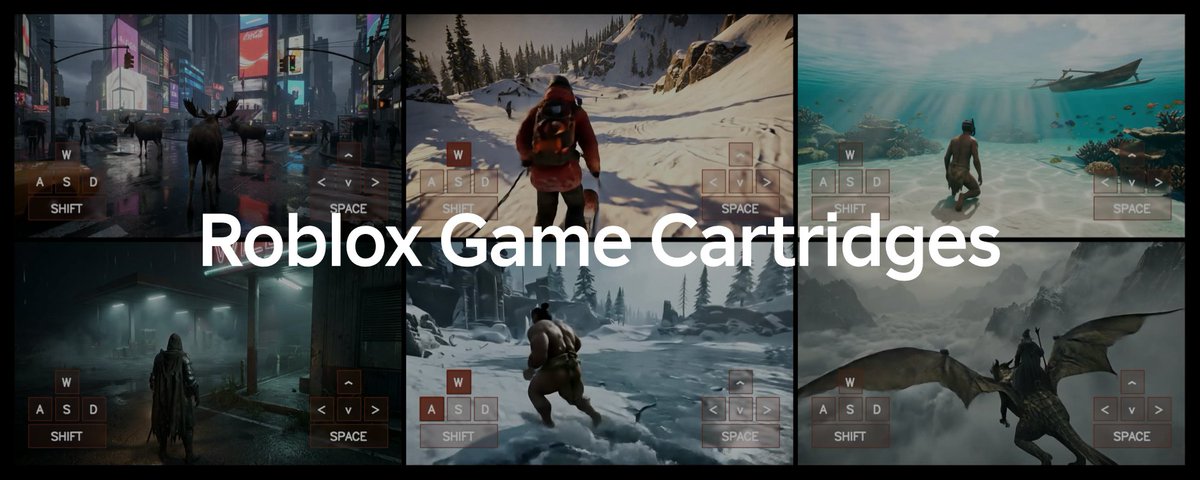
What makes a game fun? And when will world models be “fun”? Can a video world model carry a game that’s actually fun to play?
Try Worlds Research Station for a limited time, with one explorer, a team at Mission Control, and a generated world reacting in real time. Then read on for our approach.
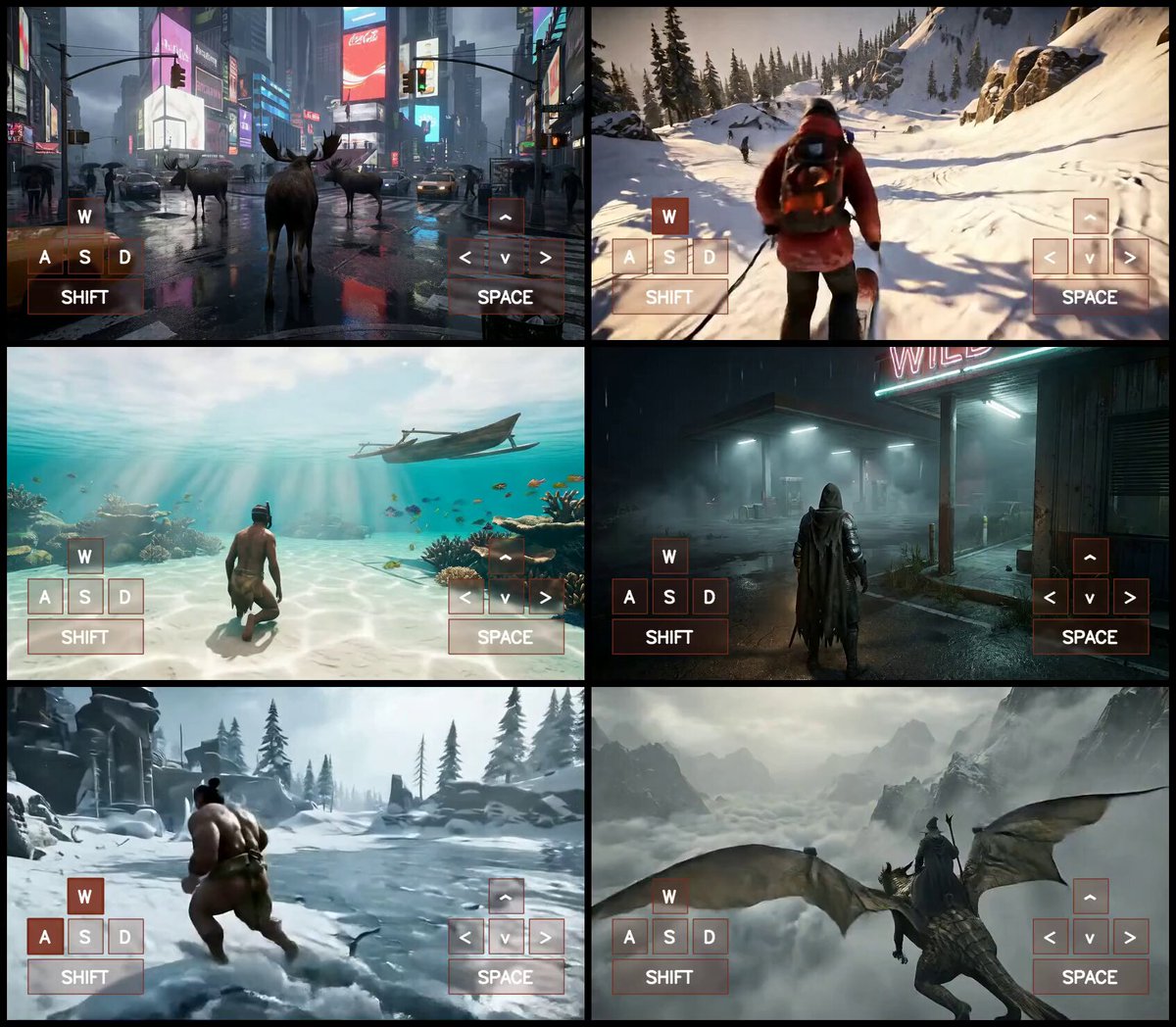
Gameplay from our action-conditioned real-time video model
Video world models already show sparks of what may become a new foundation for interactive experiences. In real time, they can generate scenes with complex real-world physics and lighting, across an almost endless diversity of worlds. These are phenomena that are incredibly hard to simulate with a traditional game engine. These models offer a possible path for visualizing and authoring high-fidelity game-like experiences to a broader category of indie game developers.
> The term “world model” is often used to describe the modeling of state dynamics (aka a forward dynamics model), arguably implying a strong understanding of the world. Action-conditioned video models predict pixels that have the appearance and dynamics of the real and fantastical worlds they are trained on. [1]
However, the initial renditions of interactive video models are often not accepted as traditional “games”. While visuals play a central role in gaming, simpler elements of game design such as goals and rewards are also important.
At Roblox, we set out to see how far we could push video world models, focusing specifically on gameplay and interactions. As the first step, we trained an action-conditioned 14B Text-Image-to-Video (TI2V) video world model that runs at 24fps, and gave it to a team of Roblox game developers to see if they could build a game with it. Along the way, we designed a lightweight harness, which we call a Game Cartridge, that couples the Roblox engine with a real-time Vision Language Model (VLM) observer, allowing the engine to manage abstract game state while the video model generates the world. Here’s what our in-house game developers built, what broke, and why we think world models will need programmable harnesses to become games…
## What unique constraints do games impose?
To build a compelling game we needed to ensure a few levers of control built into our model.
Movement: an agile locomotion control rig.
- 1st and 3rd person
- Diverse actions like jumping, sprinting, swimming, emoting
- Modifiers like wings, vehicles, snowboards
Interactions: the space of actions within games is incredibly large beyond the few degrees of freedom needed for movement.
- Manipulating the world with tools or interacting with objects
- Collecting and equipping/unequipping items
- Responsive reaction from characters and the environment
Scene control: honoring creator intent and editability.
- Changing the scene composition, adding or removing objects
- NPCs with non-trivial behavior
- Physics-level control like the strength of perceived gravity in space or underwater
The baseline conditioning in video models is not suitable for interactive, immersive gaming. A single homogenous text prompt makes it difficult to edit some components without affecting others. To allow for finer control at inference, we decomposed the text conditioning into a few core pieces: Actions (movement), World (for the environment and NPCs), Character (main avatar and equipment), Dynamics (perspective and physics) [2].
Here we showcase a few of those control levers in action:
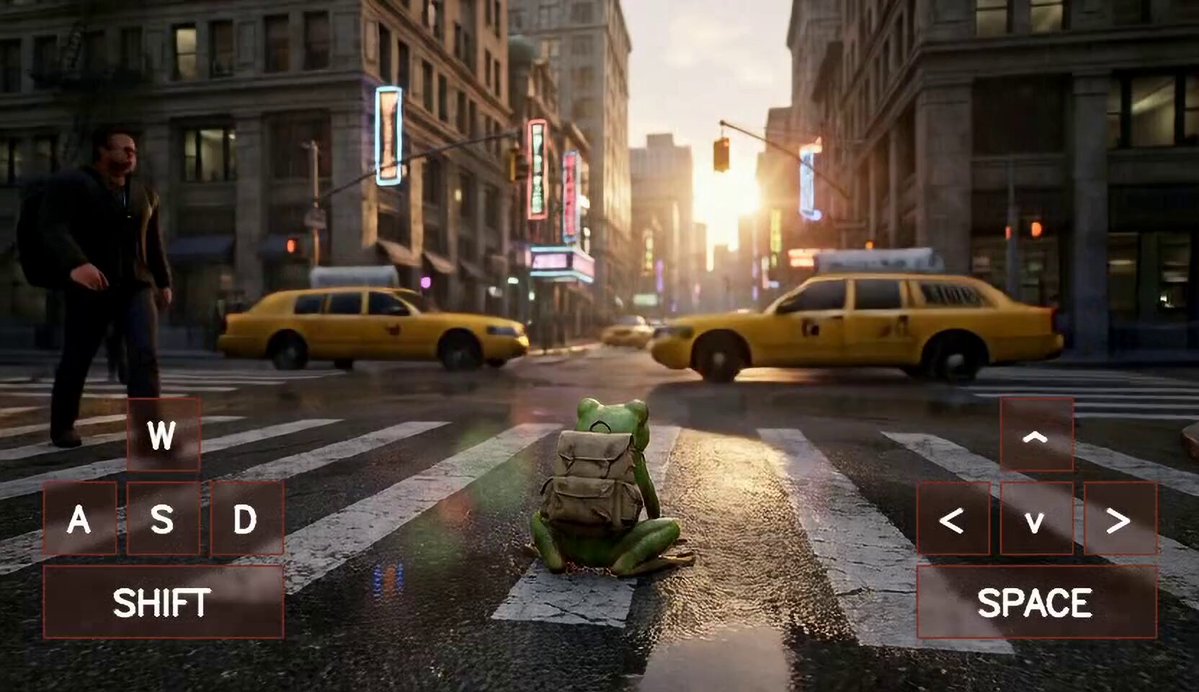
Starting with agile locomotion (sprinting/jumping) and aggressive global scene editing, here we cycle through 7 completely different prompts cleanly morphing between the environments and character rigs. Starting with a frog in a bustling NYC avenue, we can transform into a firefighter in a warehouse, a camel caravan, riding a dragon, to a 1st-person porch in the countryside, to a backpacker in the Himalayas, to a diver underwater, and finally back to almost the same bustling NYC avenue. Notice the taxi traffic behavior responds to the player approaching.
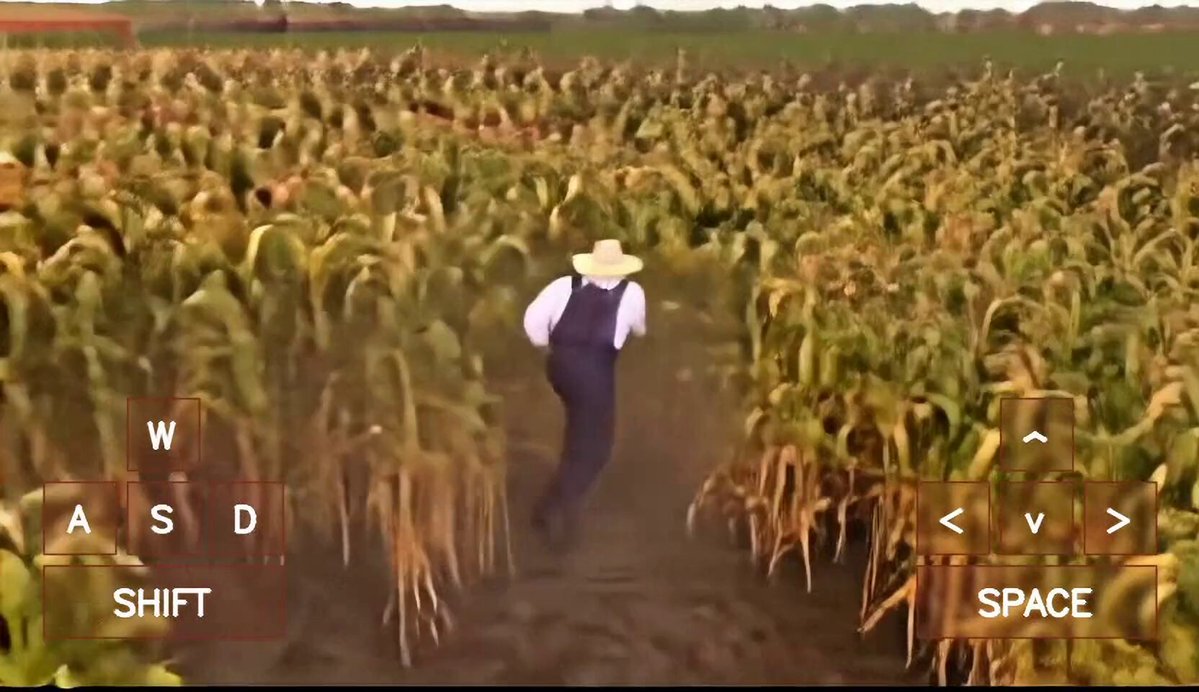
Next, we start with a farmer using a sickle to harvest wheat, emphasizing the manipulation of the environment by use of tools with motion animations. We then show local scene editing by switching the avatar’s equipped item to a firing rifle, then to a flaming torch, which causes a fire to spread.
By orchestrating prompts, we could elicit quite interesting dynamics from our model as shown above. This surface-level interaction paradigm allows the player to serve as a puppeteer or dungeon-master, scheduling and timing the prompts to edit the world under their control and desires. However, a typical game does not expose omnipotent power to the player.
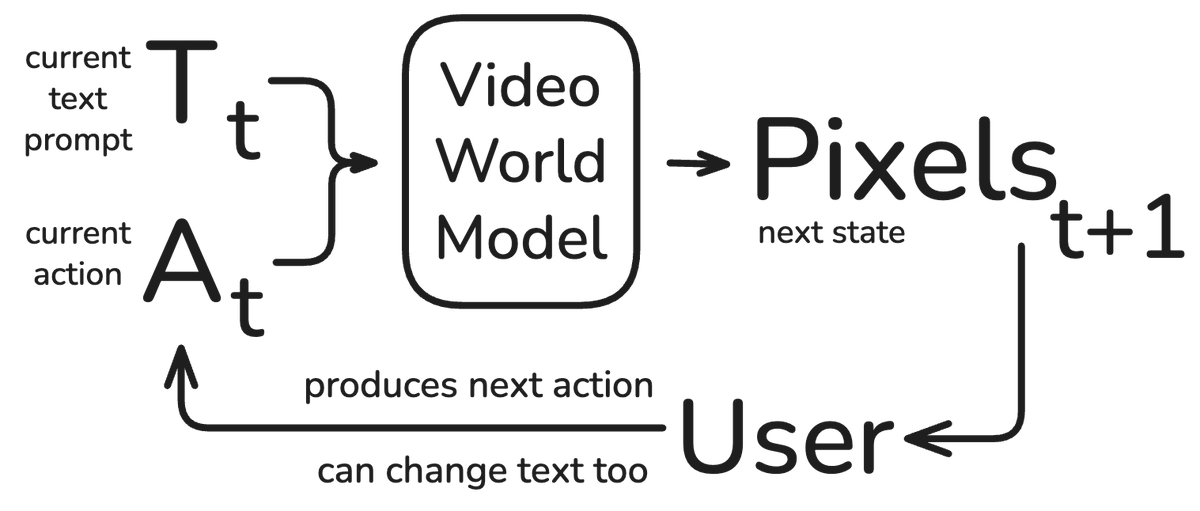
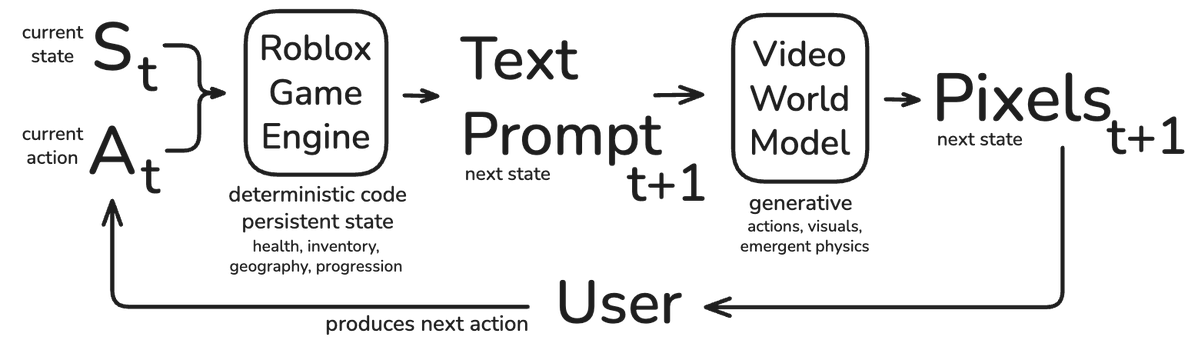
We hypothesized that a system where a developer writes a code harness around the VWM to dynamically select text prompts could enable a few core aspects of gaming that are missing from purely neural world models today: creators, state, and progression. Creators could use it to make immersive worlds that reflect their stylistic vision, with a persistent abstract state that progresses predictably as they play. By dynamically selecting prompts in a controlled fashion as the world is getting generated, we placed control of the scene under the responsibility of the developer’s code allowing us to implement quest progression.
We were inspired by the earliest of games, teletype games, which featured little to no visuals, yet had incredibly deep worlds with rich game logic. Take Zork or Oregon Trail for instance, which are simple text state machines that process text input and produce the next state of the world, allowing you to explore rooms and interact with objects.
## Our Harness
The first component of our system is this programmable code harness running within the Roblox game engine, which we call a Game Cartridge. Here, a developer writes traditional Luau code to define a state machine that tracks variables (like current objects in the world, health, or quest progression) and executes the logic. A sidecar service on the game engine then serializes the data model into text prompts fed to the VWM.
To close the loop, the engine needs to know what is happening in the generated video frames because the action outcomes are ultimately dictated by the VWM. We utilize a VLM as a perception model, observing the generated frames. The developer defines "visual triggers" within their code harness (e.g., querying the VLM, "Has the player collected an energy canister?" alongside the latest frames). The VLM continuously watches the generated pixels for these specific events. When a visual trigger is detected, the VLM fires a callback to the code harness. This synchronizes a primitive sense of positioning and action outcomes [3] to the game engine, which then updates the abstract state (e.g., updating player health and incrementing the score counter) and, in turn, selects the next text prompt (e.g., spawning a portal or taking you to the next scene). This grounds the video model's outputs into playable mechanics. We also tried directly connecting the VLM to write prompts back to the VWM, removing the Roblox game engine entirely, but found greater success allowing the system to store variables and run deterministic code.
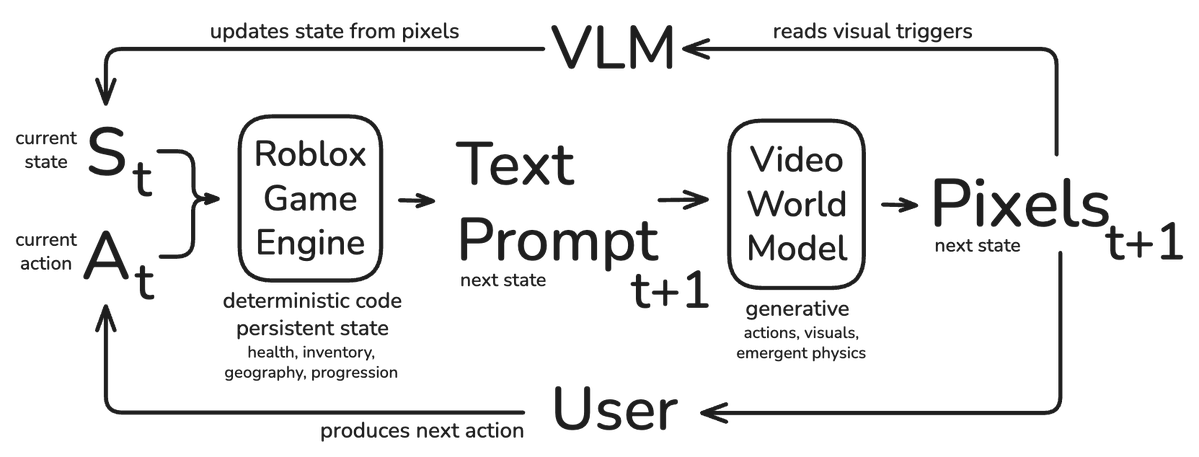
Once we had this simple harness, we were able to define programmable game loops and execute them end-to-end with the video world model. Because this system allows a creator to build an experience, bake it into a repeatable state, and share it with others, it started to show signs of the game-making process many of us are familiar with. Befitting of the name Game Cartridges as they provide the relevant structure to encapsulate an experience powered by a VWM.
# Game Cartridges
Our devs structured the narrative into chapters, defining scenes by images, and driving the state transition logic via Luau code, supplemented by the VLM perception model.
> As one developer noted: “Building a game with this process required learning how to create visuals with the AI model itself, combining prompts and different pictures to create worlds. Then learning how to manipulate those worlds to get things to spawn in, and building a bridge between the model and the actual Roblox game engine which controls the majority of the logic.“
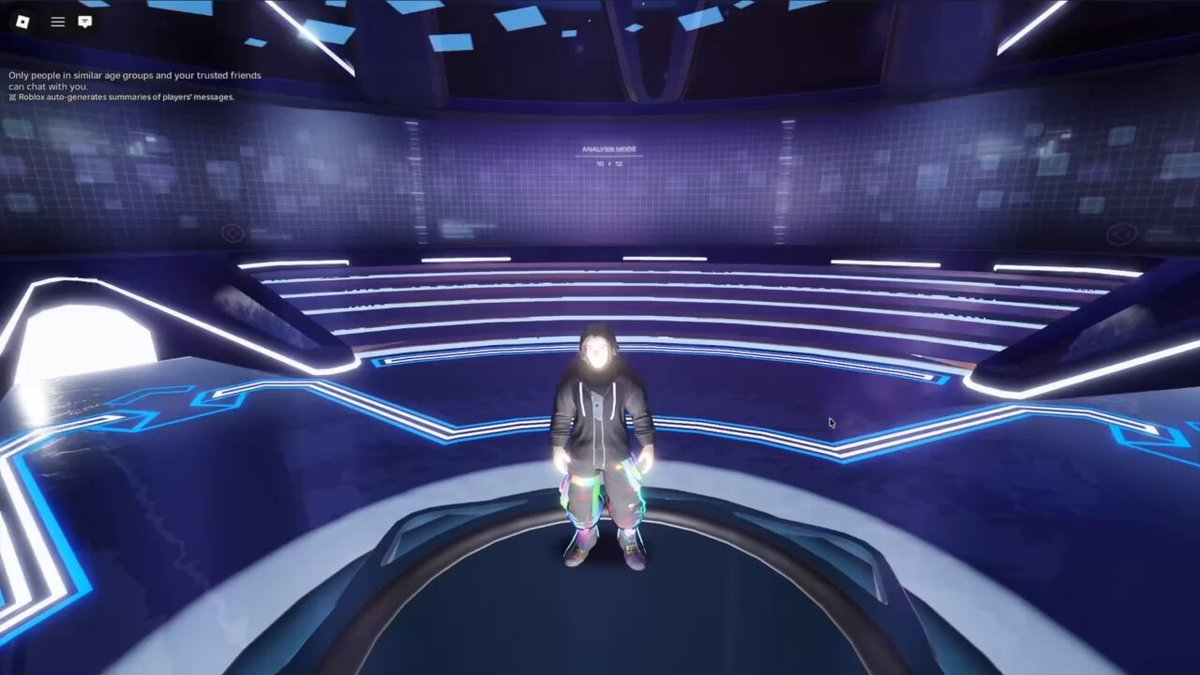
Today we are releasing access for a limited time to “Worlds Research Station,” one of the prototype Game Cartridges built by our developers in Roblox Innovation Studio. This prototype features a tangible, cooperative gameplay loop: one player explores dynamic, generated worlds controlled by their teammates back at Mission Control. As the explorer, you'll need to scavenge for energy cells to replenish your health and survive the elements.
Wanna try it yourself? Play the game here.
Through developer testing, two core limitations emerged that point toward meaningful directions for further research:
## Control and Flexibility:
Targeted placement of objects in the scene felt hard to control with text prompts as their spatial descriptions need to be invariant to player WASD movement. Our current video world model lacked native 3D spatial grounding, making layout design challenging [5]. The prompt “a canister appears in front of the character” can become a conflicting signal if you turn around and walk away, causing new canisters to continuously re-appear. However, a prompt like “a canister appears at the base of the tree” performs better. This perhaps highlights the value of 3D or relative layout information, and how video models can be co-developed with developers in mind to elicit desired mechanics [4].
Because our model was trained on 5-second clips paired with global world captions, its counterfactual understanding wasn’t strong enough to handle long horizon state transitions by itself. Developers observed that during the rollout, models often lost track of which step of the chain the video is currently on, degenerating into looping behavior. For example, if you prompt an autoregressive video model with “a rocket launches from the ground” and roll out for a long horizon, you end up seeing looping behavior where the rocket takes off, lands, and takes off again; in this case, updating the prompt to “a rocket in space” is eventually required to avoid repeating the “launch.” Future endeavors should attempt to instill better counterfactual (conditional mechanics) understanding into the VWM.
## Visual Consistency:
While the code harness effectively manages the abstract state and utilizes serialized text prompts to inject detailed environmental descriptions, a sliding window KV cache alone is insufficient to ensure strict visual consistency (e.g., maintaining a character's exact identity when they turn away from the camera and back). Extending these windows with compression or spatially indexed caches [6] is one path to maintaining visual object permanence. Visual drift in appearances can also be a signal of a lack of proper conditioning, where the text prompt is not specific enough to constrain the generative model. Dynamically injecting reference images into the prompt to ground multiple identities and object appearances on the fly could bridge the gap further (a task potentially well suited for a harness).
# What’s next?
In our mission to become the highest-fidelity, interactive, multiplayer gaming platform, our exploration using Game Cartridges illustrated that by augmenting a Video World Model with a programmable coding harness, a developer could begin to add game-like mechanics to what was previously just an explorable world without objectives. However, it also highlighted the limitations of Video World Models for owning the majority of the visual state, and suggested that more of the underlying game logic and 3D state should be implemented in the Roblox game engine. The video model is then used to uplift the view into high-fidelity or any style desired by the game developer [5].
Game Cartridges also serve as an evaluation harness, helping us benchmark the consistency, coherence, and responsiveness of these models in the pursuit of game making. In the future, when video world models become more robust, we may still desire having programmable code harnesses around them. We similarly envision this becoming a useful pre-visualization tool in the game development lifecycle, helping prototype quick visual aesthetic and gameplay ideas starting from images and text.
# Footnotes
[1] I’ve been interested in world models without knowing it since I was young, when I would wake up without the ability to recall any image of my nightly adventures leading me to believe that I hadn’t dreamt.
Growing up we are often told to dismiss our dreams and our nightmares. This often leads many people to believe that they cannot dream at all or that they did not dream last night. This is not usually true! Humans often dream 6-7+ times, but as soon as we wake up we tell ourselves: “Ah! It was just a dream” and we train ourselves to forget. We actively suppress our memories of dreams; and years of this results in one believing they did not dream because they simply cannot remember.
And thus comes the first tool in an oneironaut’s toolbox: the dream journal. Waking up and immediately jotting down every image you can remember from your nightly adventures that you can recall. And after about a week of actively recalling your dreams, you become surprisingly aware of their behaviors. You start to gain the ability to piece together the boundaries of dreams (aka REM sessions), and you start to notice patterns. This is how I became conscious that I was dreaming during a dream for the first time when I was younger; I realized I had entered a very similar dream I had jotted down in my journal a few days ago. And thus I became lucid for the first time. [A Field Guide to Lucid Dreaming: Mastering the Art of Oneironautics by Dylan Tuccillo, Jared Zeizel, & Thomas Peisel.]
At the behest of my will to dream, I became enthralled by the art of oneironautics: becoming aware that you are asleep experiencing a simulation architected by yourself. A world where by merely thinking you can conjure up whatever your heart desires and even summon and talk to the internal representations you have of the people around you and those you love.
After taking interest in why it is that our brain developed this universal behavior and how it appears across many species, I became interested in the concept of internal world models.
Although the origin of this concept goes all the way back to ancient Greek philosophers [https://people.idsia.ch/~juergen/world-model-boom.html], I like to point to Kenneth Craik who in 1943 questioned how it is that organisms may reason and act intelligently in the real world. He describes an internal world model that allows organisms to play out certain scenarios in their heads, to simulate the outcomes based on their prior experience.
“If the organism carries a “small-scale model” of external reality and of its own possible actions within its head, it is able to try out various alternatives, conclude which is the best of them, react to future situations before they arise, utilise the knowledge of past events in dealing with the present and future, and in every way to react in a much fuller, safer, and more competent manner to the emergencies which face it.” (The Nature of Explanation, Craik 1943)
The predictive power that you and I experience and many other species across the world do too, is not programmed in the sense that a game engine is. Rather it is learned through experience as we interact with our complicated world. Evolution found it useful for agents to be able to simulate other agents in their head in order to predict their responses and take actions that would result in rewards and preserve the chances of survival. And even deeper than that, one doesn’t get a lot of chances to get chased by a lion out in the real world. The first time you do, you better know what to do. And I wonder if that is why we all have nightmares of being chased by lions while we are young.
[2] This scheme avoids spatially coupling the main character within the environment (e.g.,“riding a bicycle on a path” which is not invariant to WASD actions, causes paths to unnaturally reappear when trying to steer off-road). We mapped raw WASD and mouse inputs directly into a structured text action grammar -- for example: “Movement: Forward; Camera: Left; Action: Jump;” -- temporally aligned to the latent frames where those actions occur. This unified text-space action scheme supports custom keybindings during training and inference, where interaction keys like spacebar, shift, E, can be mapped into semantic text actions like E -> “Open door.”
[3] In this case, we are essentially using the VLM as an external reward model to measure whether a certain condition has been met or not. Instead of having a separate perception model, DreamerV4 [https://danijar.com/project/dreamer4/] explicitly predicts the 0->1 reward and value of the state against a particular defined task like “mine_diamonds” across the rollout. Although they ultimately used it to train RL agents, it nonetheless showcases how a reward model can be used to “measure progress against a quest.” One can imagine training this capability into the VWM itself like Dreamer does, removing the need for the VLM observer.
[4] Among many recent works exploring video world models for gaming, one of note is MultiGen [https://ryanpo.com/multigen/] which allows for persistent editable multiplayer worlds via explicit geometry
[5] While in this exploration, the Roblox game engine ultimately only handles abstract variables and game logic, a proper 3D integration is an active area of research and something we hope to demo in the future. https://about.roblox.com/newsroom/2026/04/roblox-reality-hybrid-architecture-democratizing-photorealistic-multiplayer-gaming
[6] We already see video equivalents of RAG in the form of city scale spatial caches that aim to provide persistent lean memory via a 3D-grounded keyframe database allowing the model to condition on the geometry embedded inside of multiview image references [https://seoul-world-model.github.io/]
## 相关链接
- [Alberto Hojel](https://x.com/AlbyHojel)
- [@AlbyHojel](https://x.com/AlbyHojel)
- [58K](https://x.com/AlbyHojel/status/2057193508822536459/analytics)
- [Try Worlds Research Station](https://www.roblox.com/games/137611642510063/Worlds-Research-Station)
- [Play the game here](https://www.roblox.com/games/137611642510063/Worlds-Research-Station)
- [https://people.idsia.ch/~juergen/world-model-boom.html](https://people.idsia.ch/~juergen/world-model-boom.html)
- [https://danijar.com/project/dreamer4/](https://danijar.com/project/dreamer4/)
- [https://ryanpo.com/multigen/](https://ryanpo.com/multigen/)
- [https://about.roblox.com/newsroom/2026/04/roblox-reality-hybrid-architecture-democratizing-photorealistic-multiplayer-gaming](https://about.roblox.com/newsroom/2026/04/roblox-reality-hybrid-architecture-democratizing-photorealistic-multiplayer-gaming)
- [https://seoul-world-model.github.io/](https://seoul-world-model.github.io/)
- [Upgrade to Premium](https://x.com/i/premium_sign_up)
- [4:15 AM · May 21, 2026](https://x.com/AlbyHojel/status/2057193508822536459)
- [58.9K Views](https://x.com/AlbyHojel/status/2057193508822536459/analytics)
- [View quotes](https://x.com/AlbyHojel/status/2057193508822536459/quotes)
---
*导出时间: 2026/5/21 10:05:17*
---
## 中文翻译
# 寻找游戏世界模型的驾驭之道
**作者**: Alberto Hojel
**日期**: 2026-05-20T20:15:27.000Z
**来源**: [https://x.com/AlbyHojel/status/2057193508822536459](https://x.com/AlbyHojel/status/2057193508822536459)
---

是什么让游戏变得有趣?世界模型何时才会变得“有趣”?视频世界模型能否承载一款真正好玩的游戏?
限时试用“世界探索研究站”,体验一名探险家、一个 mission control 团队以及实时生成的动态世界。随后请继续阅读,了解我们的实现方法。

基于我们动作条件实时视频模型的游戏画面
视频世界模型已经展现出成为互动体验新基础的火花。它们能够实时生成具有复杂现实世界物理和光照效果的场景,且世界种类几乎无穷无尽。这些现象使用传统的游戏引擎极难模拟。这些模型为更广泛的独立游戏开发者提供了一条可视化并创作高保真游戏体验的可行路径。
> “世界模型”一词通常被用来描述对状态动力学的建模(也称为前向动力学模型),这暗示了对世界的深刻理解。动作条件视频模型预测出的像素,具有与其训练数据中真实或幻想世界相似的外观和动力学特征。[1]
然而,互动视频模型的最初版本往往不被视为传统的“游戏”。虽然视觉效果在游戏中扮演核心角色,但目标和奖励等简单的游戏设计元素同样重要。
在 Roblox,我们着手探索视频世界模型的极限,特别关注游戏玩法和互动性。作为第一步,我们训练了一个运行帧率为 24fps 的动作条件 14B 文本-图像-视频(TI2V)视频世界模型,并将其交给一支 Roblox 游戏开发团队,看看他们能否用它构建出一款游戏。在此过程中,我们设计了一个轻量级的连接装置,我们称之为“游戏卡带”,它将 Roblox 引擎与实时视觉语言模型(VLM)观察者结合起来,允许引擎管理抽象的游戏状态,同时由视频模型生成世界。以下是我们内部游戏开发者构建的内容、遇到的问题,以及我们认为世界模型为何需要可编程的连接装置才能成为游戏……
## 游戏施加了哪些独特的约束?
为了构建一款引人入胜的游戏,我们需要确保在模型中内置一些控制杠杆。
**移动**:敏捷的运动控制装置。
- 第一人称和第三人称视角
- 跳跃、冲刺、游泳、表情动作等多种动作
- 翅膀、载具、滑雪板等修饰器
**互动**:游戏中除了移动所需的少量自由度外,动作的空间极其巨大。
- 使用工具操纵世界或与物体互动
- 收集及装备/卸下物品
- 角色和环境做出响应式反应
**场景控制**:尊重创作者意图和可编辑性。
- 改变场景构图,添加或移除物体
- 具有非平凡行为的 NPC
- 物理级别的控制,例如太空或水下感知到的重力强度
视频模型中的基线条件设定并不适合互动式、沉浸式的游戏。单一的、同质化的文本提示使得在不影响其他部分的情况下编辑某些组件变得困难。为了在推理时实现更精细的控制,我们将文本条件分解为几个核心部分:动作(移动)、世界(环境和 NPC)、角色(主化身和装备)、动力学(视角和物理)[2]。
在这里,我们展示了其中一些实际运行的控制杠杆:
从敏捷的移动(冲刺/跳跃)和激进的全局场景编辑开始,我们在 7 个完全不同的提示之间循环,在环境和角色装置之间流畅变形。从一只在繁华纽约大道上的青蛙开始,我们可以变身为仓库里的消防员、骆驼商队、骑龙、乡村门廊的第一人称视角、喜马拉雅山的背包客、水下的潜水员,最后回到几乎相同的繁华纽约大道。注意出租车交通行为对玩家靠近的反应。

接下来,我们从一位农民使用镰刀收割小麦开始,强调通过带有运动动画的工具来操纵环境。然后,我们展示了局部场景编辑,将化身的装备物品切换为发射的步枪,然后是燃烧的火炬,这会导致火势蔓延。

通过精心编排提示,我们可以从模型中激发出非常有趣的动力学,如上图所示。这种表层交互范式允许玩家充当木偶师或地下城主,安排提示的时机以根据自己的控制意愿编辑世界。然而,典型的游戏不会赋予玩家这种全能的力量。

我们假设,如果开发人员围绕 VWM 编写一个代码连接装置来动态选择文本提示,就能实现当今纯神经网络世界模型所缺失的几个核心游戏方面:创作者、状态和进程。创作者可以用它来构建反映其风格愿景的沉浸式世界,这些世界具有持久的抽象状态,并随着游戏进程可预测地发展。通过在生成世界的过程中以受控方式动态选择提示,我们将场景的控制权置于开发人员代码的责任之下,从而使我们能够实现任务进程。
我们受到了最早期的游戏——电传打字机游戏的启发,这些游戏几乎没有视觉效果,却拥有极其深邃的世界和丰富的游戏逻辑。以《Zork》或《俄勒冈小道》为例,它们是处理文本输入并产生世界下一个状态的简单文本状态机,允许你探索房间并与物体互动。
## 我们的连接装置
我们系统的第一个组件是这个运行在 Roblox 游戏引擎内的可编程代码连接装置,我们称之为“游戏卡带”。在这里,开发人员编写传统的 Luau 代码来定义一个状态机,用于跟踪变量(如当前世界中的物体、生命值或任务进程)并执行逻辑。游戏引擎上的一个伴车服务随后将数据模型序列化为输入给 VWM 的文本提示。

为了形成闭环,引擎需要知道生成的视频帧中发生了什么,因为动作结果最终由 VWM 决定。我们利用 VLM 作为感知模型来观察生成的帧。开发人员在其代码连接装置中定义“视觉触发器”(例如,查询 VLM “玩家是否收集了能量罐?”并结合最新的帧)。VLM 持续监视生成的像素以寻找这些特定事件。当检测到视觉触发器时,VLM 会向代码连接装置触发回调。这将原始的位置感和动作结果[3]同步到游戏引擎,然后引擎更新抽象状态(例如,更新玩家生命值并增加分数计数器),进而选择下一个文本提示(例如,生成传送门或将你带到下一个场景)。这将视频模型的输出落实为可玩的机制。我们还尝试了直接将 VLM 连接回写提示给 VWM,完全移除 Roblox 游戏引擎,但发现让系统存储变量和运行确定性代码效果更好。

一旦我们有了这个简单的连接装置,我们就能够定义可编程的游戏循环,并使用视频世界模型端到端地执行它们。因为该系统允许创作者构建体验,将其烘焙为可重复的状态,并与他人共享,它开始展现出我们许多人熟悉的游戏制作过程的迹象。称之为“游戏卡带”名副其实,因为它们提供了封装由 VWM 驱动的体验的相关结构。
# 游戏卡带
我们的开发人员将叙事构建为章节,通过图像定义场景,并通过 Luau 代码驱动状态转换逻辑,辅以 VLM 感知模型。
> 正如一位开发人员所指出的:“使用这种流程构建游戏需要学习如何使用 AI 模型本身创建视觉效果,结合提示和不同的图片来创造世界。然后学习如何操纵这些世界以生成物体,并在模型和负责大部分逻辑的实际 Roblox 游戏引擎之间架起桥梁。”
今天,我们限时开放由我们 Roblox 创新工作室的开发人员构建的原型游戏卡带之一——“世界探索研究站”。这个原型具有一个切实的、合作性的游戏循环:一名玩家探索动态生成的世界,而身处 mission control 的队友则进行控制。作为探险家,你需要搜寻能量电池以补充生命值并在恶劣环境中生存。
想亲自试试吗?在这里游玩。

通过开发人员测试,出现了两个核心局限性,这指向了未来有意义的研究方向:
## 控制与灵活性:
通过文本提示在场景中进行目标物体的精确放置感觉很难控制,因为它们的空间描述需要对玩家的 WASD 移动保持不变。我们目前的视频世界模型缺乏原生的 3D 空间锚定,这使得布局设计具有挑战性[5]。如果你转身走开,提示“一个罐子出现在角色面前”可能会变成一个冲突的信号,导致新罐子不断重新出现。然而,像“一个罐子出现在树底”这样的提示效果更好。这也许凸显了 3D 或相对布局信息的价值,以及视频模型如何能与开发人员协同开发以激发所需的机制[4]。
因为我们的模型是在与全局世界标题配对的 5 秒剪辑上训练的,其反事实理解能力不足以自行处理长跨度的状态转换。开发人员观察到,在滚动生成过程中,模型经常忘记视频当前处于链条的哪一步,从而退化为循环行为。例如,如果你用“一枚火箭从地面发射”提示自回归视频模型并进行长跨度滚动,最终你会看到循环行为,火箭起飞、着陆,然后再起飞;在这种情况下,最终需要将提示更新为“一枚火箭在太空中”以避免重复“发射”阶段。未来的努力应尝试将更好的反事实(条件机制)理解灌输到 VWM 中。
## 视觉一致性:
虽然代码连接装置有效地管理了抽象状态,并利用序列化的文本提示注入详细的环境描述,但仅靠滑动窗口 KV 缓存不足以确保严格的视觉一致性(例如,当角色背对镜头再转回来时,保持其确切的身份)。通过压缩或空间索引缓存[6]扩展这些窗口是保持视觉物体恒存性的一条路径。外观上的视觉漂移也可能是缺乏适当调节的信号,即文本提示不够具体,无法约束生成模型。动态地将参考图像注入提示中,以实时锚定多个身份和物体外观,可以进一步缩小这一差距(这项任务可能非常适合连接装置)。
# 下一步是什么?
在我们成为最高保真、互动式、多人游戏平台的使命中,我们利用游戏卡带进行的探索表明,通过为视频世界模型增加可编程的代码连接装置,开发人员可以开始为以前只是没有目标的可探索世界添加类似游戏的机制。然而,这也凸显了视频世界模型在拥有大部分视觉状态方面的局限性,并表明更多的底层游戏逻辑和 3D 状态应在 Roblox 游戏引擎中实现。然后,视频模型被用来将视图提升到高保真度或游戏开发人员想要的任何风格[5]。
游戏卡带还充当评估连接装置,帮助我们在游戏制作过程中基准测试这些模型的一致性、连贯性和响应性。在未来,当视频世界模型变得更加稳健时,我们可能仍然希望拥有围绕它们的可编程代码连接装置。我们同样设想这将成为游戏开发生命周期中一个有用的预可视化工具,帮助从图像和文本开始,快速原型化视觉美学和游戏玩法创意。
# 脚注
[1] 我从年轻时起就对世界模型产生了兴趣,只是当时并不自知,那时我醒来时无法回忆起夜间冒险中的任何画面,导致我相信我并没有做梦。
在成长过程中,我们经常被告知不要在意我们的梦和噩梦。这往往导致许多人认为他们根本不做梦,或者昨晚没有做梦。这通常不是真的!人类经常做梦 6-7 次以上,但一醒来我们就告诉自己:“啊!那只是个梦”,于是我们训练自己去遗忘。我们主动抑制对梦的记忆;多年如此,导致一个人相信自己没有做梦,仅仅是因为他们记不住了。
因此,清醒梦旅行者工具箱里的第一个工具就是:梦境日记。醒来后立即记下你能回忆起的夜间冒险中的每一个画面。大约经过一周主动回忆梦境的练习,你会惊讶地意识到它们的行为模式。你开始获得将梦境边界拼凑起来(即 REM 睡眠阶段)的能力,并开始注意到其中的规律。这就是我年轻时第一次在梦中意识到我在做梦的方式;我意识到我进入了一个与几天前我在日记中记下的非常相似的梦。就这样,我第一次获得了清醒梦。[摘自《清醒梦实地指南:掌握清醒梦航行艺术》,作者 Dylan Tuccillo, Jared Zeizel, & Thomas Peisel。]
受我对做梦渴望的驱使,我迷上了清醒梦航行艺术:意识到自己正处于睡眠状态,体验着由自己构建的模拟。在这个世界里,仅凭思考就能随心所欲地召唤出任何东西,甚至可以召唤并与你周围的人和所爱之人的内部表征进行交谈。
在开始感兴趣为什么我们的大脑会进化出这种普遍行为以及它如何出现在许多物种中之后,我对内部世界模型的概念产生了兴趣。
虽然这个概念的起源一直可以追溯到古希腊哲学家 [https://people.idsia.ch/~juergen/world-model-boom.html],但我喜欢提到 Kenneth Craik,他在 1943 年质疑了生物体如何在现实世界中理性和智能地行动。他描述了一种内部世界模型,允许生物体在脑海中预演某些场景,基于其先前的经验来模拟结果。
“如果生物体在大脑中携带一个外部现实和其自身可能行动的‘小规模模型’,它就能尝试各种替代方案,并得出哪一个是最……”