# 30 Obsidian Workflows, Plugins, and Setups That Most Users Don't Know
**作者**: Khairallah AL-Awady
**日期**: 2026-05-31T09:11:28.000Z
**来源**: [https://x.com/eng_khairallah1/status/2061012675824644161](https://x.com/eng_khairallah1/status/2061012675824644161)
---
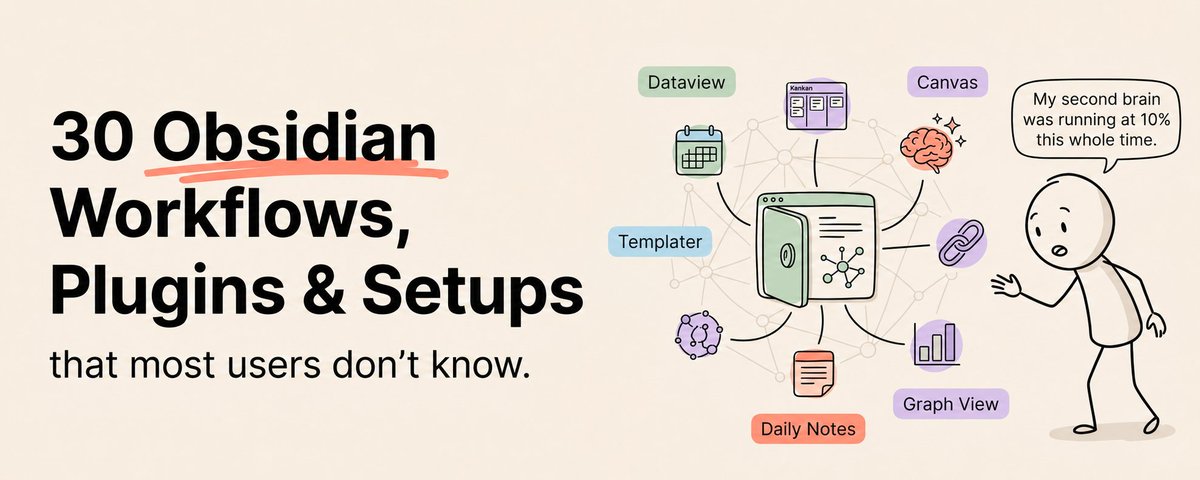
Obsidian has 2,700+ community plugins. Over 100 of them are AI-related.
Save this :)
And the CEO of Obsidian personally published official Claude Skills for the platform - 12,900+ GitHub stars in under three months.
The Obsidian + Claude ecosystem is exploding right now. But most people are still using Obsidian as a basic note app and Claude as a basic chatbot, completely missing the integration layer that connects them into something significantly more powerful.
Here are 30 workflows, plugins, and setups that turn Obsidian + Claude into the most powerful personal knowledge system available in 2026.
## Part 1: The 10 Essential Plugins
01. Smart Connections
The most popular Obsidian AI plugin and the best starting point. Uses RAG (Retrieval Augmented Generation) to let you chat with your entire vault. Ask "What do I know about customer retention?" and it searches every note in your vault, finds the relevant ones, and answers using your own knowledge. Free for local models. Cloud API costs vary by provider.
02. Copilot
RAG-based Q&A for your vault with a clean chat interface inside Obsidian. Supports Claude, GPT, Gemini, and local models. Good for people who want the AI conversation to happen inside Obsidian rather than in a separate app.
03. Templater
Automated note templates that fire when you create specific types of notes. Set up a meeting note template that automatically adds the date, attendee field, action items section, and frontmatter tags. Every note starts structured and AI-ready. Pairs perfectly with Claude because consistent formatting makes AI retrieval dramatically better.
04. Dataview
Turn your vault into a queryable database. "Show me all notes tagged #project-alpha created in the last 30 days" returns a live table. When Claude can access Dataview queries, it can answer questions about your vault using structured data, not just full-text search.
05. Tasks
Full task management inside your notes. Create tasks anywhere in any note with due dates, priorities, and recurrence. Query all tasks across your vault in one view. When Claude reads your vault, it can see every task in every note and help you prioritize, reschedule, and track progress.
06. Obsidian Git
Version control for your vault. Auto-commits changes at set intervals. Your notes have full history - you can see what changed, when, and revert if needed. Essential for anyone whose vault is critical to their work.
07. Calendar
Visual calendar view of your daily notes. Click any date to see or create that day's note. When you maintain daily notes consistently, Claude has a chronological record of your work, ideas, and decisions over time.
08. Kanban
Turn any note into a Kanban board. Track project stages, content pipelines, or task workflows visually. Pairs with Claude for automated status updates and board reviews.
09. Periodic Notes
Automates daily, weekly, monthly, and quarterly note creation with templates. Your vault builds a structured time-based record that Claude can analyze for patterns, trends, and progress over any time period.
10. Obsidian CLI
Released in 2026. Command-line interface for Obsidian. Create notes, search, and manage your vault from the terminal. This is what makes Claude Code + Obsidian integration seamless - Claude Code can call CLI commands to interact with your vault programmatically.
## Part 2: The 10 Must-Know Workflows
11. The Morning Synthesis
Every morning, Claude reads your daily notes from the past three days plus your active project notes. It creates a "Start of Day" note in your daily folder with: where you left off, what is due today, what is overdue, and a suggested focus priority. You read it over coffee and know exactly where to start.
12. The Meeting Processor
After every meeting, you paste raw notes into a new note. Claude reads them, extracts action items with assignees and deadlines, identifies key decisions, links to relevant project notes, and adds appropriate tags. A five-minute brain dump becomes a structured, linked, searchable record.
13. The Research Ingestion Pipeline
Save an article URL or paste a PDF transcript into your Inbox folder. Claude reads it, creates a summary note with key insights, links it to existing notes on the same topic, adds source metadata, and flags any contradictions with your existing knowledge. One command turns raw input into connected knowledge.
14. The Weekly Review Automation
Every Friday, Claude scans all notes created or modified that week. It creates a weekly review note with: accomplishments, decisions made, tasks completed versus planned, patterns noticed, and suggested priorities for next week. Your weekly review takes two minutes to read instead of an hour to create.
15. The Idea Cross-Pollinator
You have an idea in a note. You ask Claude: "Find all notes in my vault that could connect to this idea in a non-obvious way." Claude searches your entire knowledge base and surfaces connections between notes you would never have found on your own. The unexpected links between unrelated topics are where the best insights live.
16. The Project Kickoff Generator
When you start a new project, tell Claude the goals, constraints, and timeline. Claude creates a complete project folder with: a project overview note, a tasks note with milestones, links to all existing vault notes that are relevant to this project, a list of knowledge gaps you need to fill, and a template for weekly project updates.
17. The Vault Health Check
Monthly, Claude audits your vault. It finds: orphan notes with no incoming links, notes with outdated information, projects that have stalled with no updates in two weeks, tags that are used inconsistently, and frontmatter fields that are missing. It creates a maintenance checklist so your vault stays organized without manual effort.
18. The Book Notes System
When you finish reading a book, create a note with your highlights and thoughts. Claude reads it alongside all your existing notes and creates: a summary of the key ideas, connections to your existing knowledge, actionable takeaways specific to your current projects, and a list of other books or topics to explore based on the intersections.
19. The Argument Builder
Working on a presentation, article, or proposal? Give Claude your thesis. It searches your vault for all supporting evidence - data points, past research, quotes from book notes, relevant project outcomes. It then organizes them into a structured argument with the strongest evidence first.
20. The Decision Journal
Before making an important decision, create a decision note with the options and your current thinking. After the decision plays out, go back and record the outcome. Over time, Claude can analyze your decision journal and identify patterns: what types of decisions you tend to get right, where your biases show up, and what you should weigh more heavily in future decisions.
## Part 3: The 10 Advanced Setups
21. Claude Code + Vault as Persistent Memory
In your CLAUDE.md file, define your Obsidian vault as Claude's long-term memory. Claude reads relevant notes before starting any task, writes findings to new notes, and builds on accumulated knowledge across sessions. Your vault becomes Claude's brain between sessions.
22. mcpvault MCP Server
Zero-dependency MCP server that reads your vault without Obsidian running. BM25 search with relevance ranking. Handles frontmatter safely. 14 MCP methods. Works with Claude Desktop, Claude Code, Cursor, and Windsurf. The cleanest MCP option for most users.
23. Steph Ango's Official Obsidian Skills
The CEO of Obsidian built these. Five skills covering markdown notes, canvas files, and the Obsidian CLI. 12,900+ GitHub stars. They follow the open Agent Skills spec so any compatible agent can use them. This is the officially endorsed way to let AI agents work with Obsidian.
24. obsidian-second-brain Skill
31 commands for operating an Obsidian vault as an AI-first second brain. Includes vault management, thinking tools that argue with you using your own notes, scheduled agents, and a research toolkit that pulls live X posts via Grok, web research via Perplexity, and YouTube transcripts directly into structured vault notes. Every note follows AI-first design rules.
25. Multi-Vault Strategy
Separate vaults for separate contexts. A personal vault for life, a work vault for professional projects, a learning vault for courses and study. Claude connects to whichever vault is relevant. No bleed between personal journal entries and work project notes.
26. Obsidian + Claude Code Routines
Set up a Claude Code Routine that runs nightly against your vault. Every night at 2am, Claude scans for new notes in Inbox, files them, adds links, and creates a "processed overnight" summary. You wake up to an organized vault every morning.
27. Graph View Analysis
Obsidian's Graph View shows visual connections between notes. But with hundreds of notes, it becomes noisy. Ask Claude to analyze your graph and identify: which notes are hubs (most connected), which clusters exist (groups of related notes), and where bridges between clusters could be built.
28. Zettelkasten + AI
The Zettelkasten method - atomic notes with unique IDs and explicit links - was designed for human brains. It works even better with AI brains. Claude can follow Zettelkasten link chains to reason through complex topics using your own accumulated knowledge, building on each connected thought.
29. Vault-Powered Claude Projects
Export key sections of your vault as knowledge files for Claude.ai Projects. Your "Marketing" area becomes the knowledge base for your "Content Production" project. Your "Finance" area becomes the knowledge base for your "Budgeting" project. Each Claude Project draws from the relevant slice of your vault.
30. The Feedback Loop System
When Claude produces something using your vault - a summary, an analysis, a recommendation - save the output back into your vault as a new note. Tag it with #ai-generated. Over time, your vault contains both your original thinking and Claude's synthesis of it. Each builds on the other. The knowledge compounds exponentially.
## The Setup I Actually Run
My daily driver stack:
- Obsidian with Smart Connections, Templater, Dataview, Periodic Notes, and Tasks
- mcpvault MCP server connected to Claude Code
- CLAUDE.md configured with vault location and note conventions
- Nightly Routine that processes Inbox and creates a morning summary
- Weekly Review automation every Friday at 4pm Six plugins. One MCP server. Two automations. That is the entire system.
It took an afternoon to set up. It saves me hours every week. And the vault gets more valuable every single day because every note I add connects to everything that came before.
## How to Get Started Today
If this list feels overwhelming, here is the exact order I would follow if I were starting from scratch:
Hour 1: Download Obsidian. Create your vault with the PARA folder structure. Install Templater and create templates for daily notes and meeting notes.
Hour 2: Install Smart Connections. Have your first conversation with your vault. Even with just 5-10 notes, you will immediately see the potential.
Hour 3: Set up one MCP server (mcpvault is the simplest). Connect it to Claude Desktop or Claude Code. Run your first cross-vault query from Claude.
Day 2: Create 10 more notes about your current projects and areas of focus. Make sure every note has frontmatter tags and at least two wikilinks to other notes.
Day 3: Build your first automated workflow - the Morning Synthesis. Set it to run daily.
Week 1: Install Periodic Notes and Dataview. Start building the habit of daily notes and weekly reviews.
Week 2: You are now running an AI-powered second brain. Everything after this is refinement and expansion.
The hardest part is not the technology. The hardest part is the first three hours of setup. After that, the system creates its own momentum.
If you are using Obsidian without AI, you are doing manual labor that a machine can do better. If you are using Claude without Obsidian, you are starting from zero every session when you could be starting from everything you have ever learned.
Connect them. The combination is where the real power lives.
Start today. Install one plugin. Connect one MCP server. Run one workflow. Within a week, you will never go back to using either tool alone.
Follow me @eng_khairallah1 for more AI courses, tools, and workflows. New content every week.
hope this was useful for you, Khairallah ❤️
## 相关链接
- [Khairallah AL-Awady](https://x.com/eng_khairallah1)
- [@eng_khairallah1](https://x.com/eng_khairallah1)
- [20K](https://x.com/eng_khairallah1/status/2061012675824644161/analytics)
- [#project](https://x.com/search?q=%23project&src=hashtag_click)
- [CLAUDE.md](http://claude.md/)
- [Claude.ai](http://claude.ai/)
- [#ai](https://x.com/search?q=%23ai&src=hashtag_click)
- [CLAUDE.md](http://claude.md/)
- [@eng_khairallah1](https://x.com/@eng_khairallah1)
- [Upgrade to Premium](https://x.com/i/premium_sign_up)
- [5:11 PM · May 31, 2026](https://x.com/eng_khairallah1/status/2061012675824644161)
- [20.1K Views](https://x.com/eng_khairallah1/status/2061012675824644161/analytics)
- [View quotes](https://x.com/eng_khairallah1/status/2061012675824644161/quotes)
---
*导出时间: 2026/5/31 22:58:33*
---
## 中文翻译
# 大多数用户不知道的 30 个 Obsidian 工作流、插件和设置
**作者**: Khairallah AL-Awady
**日期**: 2026-05-31T09:11:28.000Z
**来源**: [https://x.com/eng_khairallah1/status/2061012675824644161](https://x.com/eng_khairallah1/status/2061012675824644161)
---

Obsidian 拥有 2700 多个社区插件。其中超过 100 个与 AI 相关。
收藏这篇文章 :)
Obsidian 的首席执行官亲自为该平台发布了官方的 Claude 技能——在不到三个月的时间里就获得了超过 12,900 个 GitHub 星标。
Obsidian + Claude 生态系统正在爆发式增长。然而,大多数人仍然把 Obsidian 当作一个基础笔记应用,把 Claude 当作一个基础聊天机器人,完全忽略了将它们连接起来、使其整合为强大工具的中间层。
以下是 30 个工作流、插件和设置,它们能将 Obsidian + Claude 打造成 2026 年最强大的个人知识系统。
## 第一部分:10 款必备插件
01. Smart Connections
最受欢迎的 Obsidian AI 插件,也是最佳入门选择。使用 RAG(检索增强生成)技术让你可以与整个知识库对话。问“关于客户保留我知道些什么?”,它会搜索你库中的每一条笔记,找到相关内容,并使用你自己的知识来回答。使用本地模型免费。云端 API 成本因提供商而异。
02. Copilot
基于 RAG 的知识库问答工具,在 Obsidian 内提供简洁的聊天界面。支持 Claude、GPT、Gemini 和本地模型。适合那些希望 AI 对话直接在 Obsidian 内部而非在独立应用中进行的人。
03. Templater
自动笔记模板,在创建特定类型的笔记时触发。设置一个会议笔记模板,自动添加日期、参会者字段、行动事项部分和 Frontmatter 标签。每条笔记都以结构化的格式诞生,并为 AI 处理做好准备。与 Claude 搭配使用效果完美,因为统一的格式能显著提升 AI 的检索效果。
04. Dataview
将你的知识库转变为可查询的数据库。“显示过去 30 天内创建的、带有 #project-alpha 标签的所有笔记”会返回一个实时表格。当 Claude 能访问 Dataview 查询时,它就能利用结构化数据,而不仅仅是全文搜索,来回答关于你知识库的问题。
05. Tasks
在你的笔记中进行完整的任务管理。在任何笔记的任何位置创建带有截止日期、优先级和循环周期的任务。在一个视图中查询整个知识库的所有任务。当 Claude 阅读你的知识库时,它能看到每条笔记中的每个任务,并帮助你确定优先级、重新安排进度和跟踪进展。
06. Obsidian Git
知识库的版本控制。按设定的时间间隔自动提交更改。你的笔记拥有完整的历史记录——你可以看到内容在何时发生了什么变化,并在需要时回滚。对于任何将知识库视为工作核心的人来说,这都是必不可少的。
07. Calendar
每日笔记的可视化日历视图。点击任何日期即可查看或创建当天的笔记。当你坚持记录每日笔记时,Claude 就拥有了一份关于你的工作、想法和决策的按时间顺序排列的记录。
08. Kanban
将任何笔记转变为看板。可视化地跟踪项目阶段、内容流水线或任务工作流。与 Claude 配合可实现自动状态更新和看板审查。
09. Periodic Notes
使用模板自动创建每日、每周、每月和每季度笔记。你的知识库构建了一个结构化的基于时间的记录,Claude 可以对其进行分析,以发现任何时间段内的模式、趋势和进展。
10. Obsidian CLI
发布于 2026 年。Obsidian 的命令行界面。从终端创建笔记、搜索和管理你的知识库。这正是实现 Claude Code + Obsidian 无缝集成的关键——Claude Code 可以调用 CLI 命令以编程方式与你的知识库交互。
## 第二部分:10 个必知工作流
11. 晨间综合
每天早晨,Claude 阅读你过去三天的每日笔记以及你当前的项目笔记。它会在你的每日文件夹中创建一份“一日伊始”笔记,内容包括:你上次停在哪里、今天到期的事项、逾期事项,以及建议的优先专注事项。你在喝咖啡时阅读它,就能确切知道从哪里开始。
12. 会议处理器
每次会议后,你将原始笔记粘贴到一个新笔记中。Claude 阅读它们,提取带有负责人和截止日期的行动事项,识别关键决策,链接到相关的项目笔记,并添加适当的标签。五分钟的思维倾倒变成了一条结构化的、相互链接的、可搜索的记录。
13. 研究摄取流水线
将文章 URL 保存或将 PDF 转录粘贴到你的收件箱文件夹中。Claude 阅读它,创建一份包含关键见解的摘要笔记,将其链接到同一主题的现有笔记,添加来源元数据,并标记出与你现有知识相矛盾的地方。一个命令就能将原始输入转化为关联知识。
14. 周回顾自动化
每周五,Claude 扫描该周创建或修改的所有笔记。它创建一份周回顾笔记,内容包括:成就、做出的决策、完成任务与计划任务的对比、注意到的模式,以及下周的建议优先事项。你的周回顾只需两分钟阅读,而不是一小时创建。
15. 想法交叉授粉
你在某条笔记中有一个想法。你问 Claude:“在我的知识库中找出所有能以非显而易见的方式与这个想法建立联系的笔记。”Claude 搜索你的整个知识库,并发现你永远无法靠自己找到的笔记之间的联系。不相关主题之间意想不到的链接,正是最佳见解诞生的地方。
16. 项目启动生成器
当你开始一个新项目时,告诉 Claude 目标、约束条件和时间表。Claude 创建一个完整的项目的文件夹,包含:项目概览笔记、带有里程碑的任务笔记、链接到该项目相关的所有现有知识库笔记、你需要填补的知识空白清单,以及每周项目更新的模板。
17. 知识库健康检查
每月,Claude 审计你的知识库。它会发现:没有入链的孤立笔记、信息过时的笔记、两周没有更新而停滞的项目、使用不一致的标签,以及缺失的 Frontmatter 字段。它创建一份维护清单,让你的知识库无需手动整理即可保持有序。
18. 书籍笔记系统
当你读完一本书时,创建一条包含你的高亮和想法的笔记。Claude 结合你所有现有的笔记阅读它,并创建:关键思想的总结、与你现有知识的联系、针对你当前项目的可行见解,以及基于交叉点探索的其他书籍或主题清单。
19. 论据构建器
正在撰写演示文稿、文章或提案?把你的论点交给 Claude。它会在你的知识库中搜索所有支持证据——数据点、过去的研究、书籍笔记中的引语、相关的项目成果。然后,它将这些内容组织成一个结构化的论证,并将最有力的证据放在最前面。
20. 决策日记
在做出重要决定之前,创建一个包含选项和你当前想法的决策笔记。当决策产生结果后,回头记录结果。随着时间的推移,Claude 可以分析你的决策日记并识别模式:你倾向于做对哪些类型的决策、你的偏见出现在哪里,以及你在未来的决策中应该更重视哪些因素。
## 第三部分:10 个高级设置
21. Claude Code + 知识库作为持久记忆
在你的 CLAUDE.md 文件中,将你的 Obsidian 知识库定义为 Claude 的长期记忆。Claude 在开始任何任务前阅读相关笔记,将发现写入新笔记,并跨会话在积累的知识基础上构建。你的知识库变成了 Claude 在会话之间的大脑。
22. mcpvault MCP 服务器
零依赖的 MCP 服务器,无需运行 Obsidian 即可读取你的知识库。具有相关性排序的 BM25 搜索。安全处理 Frontmatter。包含 14 种 MCP 方法。适用于 Claude Desktop、Claude Code、Cursor 和 Windsurf。对大多数用户来说,这是最简洁的 MCP 选项。
23. Steph Ango 的官方 Obsidian 技能
这些由 Obsidian 的首席执行官构建。涵盖 Markdown 笔记、Canvas 文件和 Obsidian CLI 的五项技能。拥有超过 12,900 个 GitHub 星标。它们遵循开放的 Agent Skills 规范,因此任何兼容的代理都可以使用它们。这是让 AI 代理与 Obsidian 协作的官方背书方式。
24. obsidian-second-brain 技能
31 个用于将 Obsidian 知识库作为 AI 优先的第二大脑运作的命令。包括知识库管理、使用你自己的笔记与你争论的思维工具、定时代理,以及一个研究工具包,可将 X 上的实时帖子(通过 Grok)、网络研究(通过 Perplexity)和 YouTube 字幕直接拉取到结构化的知识库笔记中。每条笔记都遵循 AI 优先的设计规则。
25. 多知识库策略
为不同的上下文分离知识库。一个用于生活的个人知识库,一个用于专业项目的工作知识库,一个用于课程和学习的知识库。Claude 连接到相关的知识库。个人日记条目与工作项目笔记之间互不干扰。
26. Obsidian + Claude Code 例程
设置一个每晚针对你的知识库运行的 Claude Code 例程。每天凌晨 2 点,Claude 扫描收件箱中的新笔记,将它们归档,添加链接,并创建一份“过夜处理”摘要。每天早上醒来,你面对的都是一个井井有条的知识库。
27. 关系图分析
Obsidian 的关系图视图展示了笔记之间的可视化连接。但拥有数百条笔记时,它会变得杂乱无章。让 Claude 分析你的图谱并识别:哪些笔记是枢纽(连接最多)、存在哪些聚类(相关笔记组),以及在哪些地方可以建立聚类之间的桥梁。
28. 纸片盒 + AI
纸片盒方法——带有唯一 ID 和显式链接的原子笔记——是为人类大脑设计的。它与 AI 大脑配合得更好。Claude 可以遵循纸片盒的链接链,利用你自己积累的知识推理复杂主题,并在每个相连的思想基础上构建。
29. 知识库驱动的 Claude 项目
将知识库的关键部分导出为知识文件,供 Claude.ai 项目使用。你的“营销”区域成为“内容生产”项目的知识库。你的“财务”区域成为“预算”项目的知识库。每个 Claude 项目都从知识库的相关部分中汲取信息。
30. 反馈循环系统
当 Claude 使用你的知识库生成内容——摘要、分析、建议——时,将输出作为新笔记保存回你的知识库。用 #ai-generated 标记它。随着时间的推移,你的知识库既包含你原始的思想,也包含 Claude 对其的综合。两者相互构建。知识呈指数级复利增长。
## 我实际运行的设置
我的日常主力栈:
- 安装了 Smart Connections、Templater、Dataview、Periodic Notes 和 Tasks 的 Obsidian
- 连接到 Claude Code 的 mcpvault MCP 服务器
- 配置好知识库位置和笔记约定的 CLAUDE.md
- 处理收件箱并创建早晨摘要的夜间例程
- 每周五下午 4 点运行的周回顾自动化
六个插件。一个 MCP 服务器。两个自动化。这就是整个系统。
它花了一个下午才设置好。它每周为我节省数小时。而且知识库的价值每天都在增长,因为我添加的每一条笔记都与之前的所有内容相连。
## 如何从今天开始
如果这份清单让你感到不知所措,以下是我如果从头开始会遵循的确切顺序:
第 1 小时:下载 Obsidian。使用 PARA 文件夹结构创建你的知识库。安装 Templater 并为每日笔记和会议笔记创建模板。
第 2 小时:安装 Smart Connections。与你的知识库进行第一次对话。即使只有 5-10 条笔记,你也会立即看到其潜力。
第 3 小时:设置一个 MCP 服务器(mcpvault 是最简单的)。将其连接到 Claude Desktop 或 Claude Code。从 Claude 运行你的第一次跨知识库查询。
第 2 天:再创建 10 条关于你当前项目和关注领域的笔记。确保每条笔记都有 Frontmatter 标签和至少两个指向其他笔记的 Wiki 链接。
第 3 天:构建你的第一个自动化工作流——晨间综合。设置为每天运行。
第 1 周:安装 Periodic Notes 和 Dataview。开始养成每日笔记和周回顾的习惯。
第 2 周:你现在运行着一个 AI 驱动的第二大脑。此后的每一步都是优化和扩展。
最难的部分不是技术。最难的部分是最初三个小时的设置。在那之后,系统会产生自己的动力。
如果你在没有 AI 的情况下使用 Obsidian,你就是在做机器能做得更好的体力活。如果你在没有 Obsidian 的情况下使用 Claude,你每次会话都是从零开始,而本可以从你学过的所有知识开始。
把它们连接起来。真正的力量存在于这种组合之中。
从今天开始。安装一个插件。连接一个 MCP 服务器。运行一个工作流。在一周内,你将永远无法回到单独使用其中任何一个工具的状态。
在 @eng_khairallah1 关注我,获取更多 AI 课程、工具和工作流。每周都有新内容。
希望这对你有用,Khairallah ❤️
## 相关链接
- [Khairallah AL-Awady](https://x.com/eng_khairallah1)
- [@eng_khairallah1](https://x.com/eng_khairallah1)
- [20K](https://x.com/eng_khairallah1/status/2061012675824644161/analytics)
- [#project](https://x.com/search?q=%23project&src=hashtag_click)
- [CLAUDE.md](http://claude.md/)
- [Claude.ai](http://claude.ai/)
- [#ai](https://x.com/search?q=%23ai&src=hashtag_click)
- [CLAUDE.md](http://claude.md/)
- [@eng_khairallah1](https://x.com/@eng_khairallah1)
- [Upgrade to Premium](https://x.com/i/premium_sign_up)
- [5:11 PM · May 31, 2026](https://x.com/eng_khairallah1/status/2061012675824644161)
- [20.1K Views](https://x.com/eng_khairallah1/status/2061012675824644161/analytics)
- [View quotes](https://x.com/eng_khairallah1/status/2061012675824644161/quotes)
---
*导出时间: 2026/5/31 22:58:33*