# Context Windows Are Not Memory: What AI Agent Developers Need to Understand
**作者**: beamnxw ./
**日期**: 2026-08-13T13:39:50.000Z
**来源**: [https://x.com/beamnxw/status/2087896913865478152](https://x.com/beamnxw/status/2087896913865478152)
---
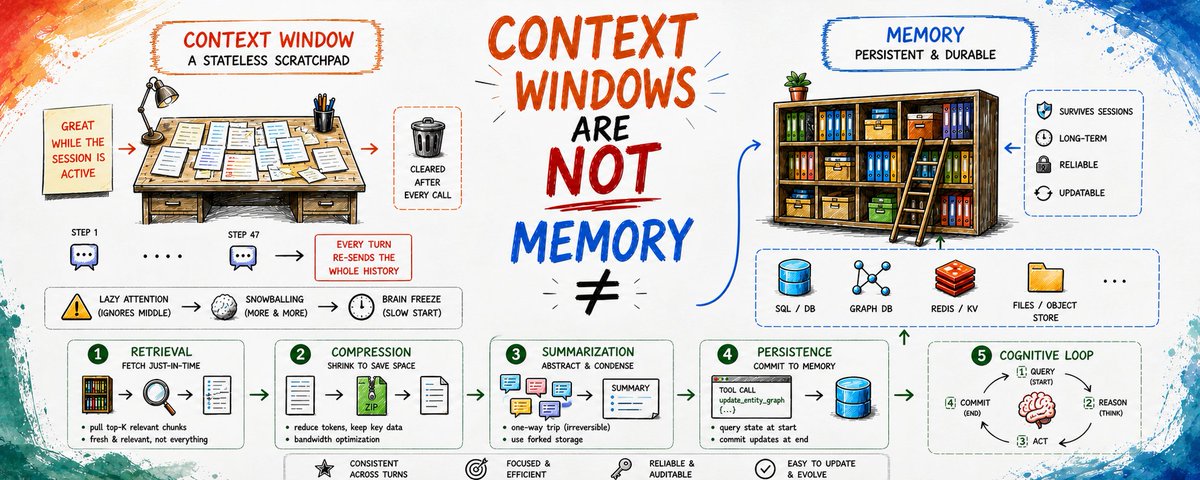
In this article, you will learn why a large context window is not the same thing as agent memory, and how techniques like retrieval, compression, and summarization fit together in an agent’s cognitive stack
Topics we will cover include:
- Why a context window behaves like a stateless scratchpad rather than persistent memory
- How retrieval-augmented generation, compression, and summarization each play a distinct role in managing what enters that scratchpad
- How agents can achieve genuine memory persistence by acting as a database administrator rather than as the database itself
# Introduction
Context windows are a key aspect of modern AI models, particularly language models, whereby these models can attend to and utilize a limited amount of input and prior conversation, typically measured as a number of tokens, at once when producing a response
When an AI lab releases a model with a 2-million token context window, it is no surprise some developers instinctively think like this: "Let’s shove the whole codebase into the prompt! Memory issues sorted!"
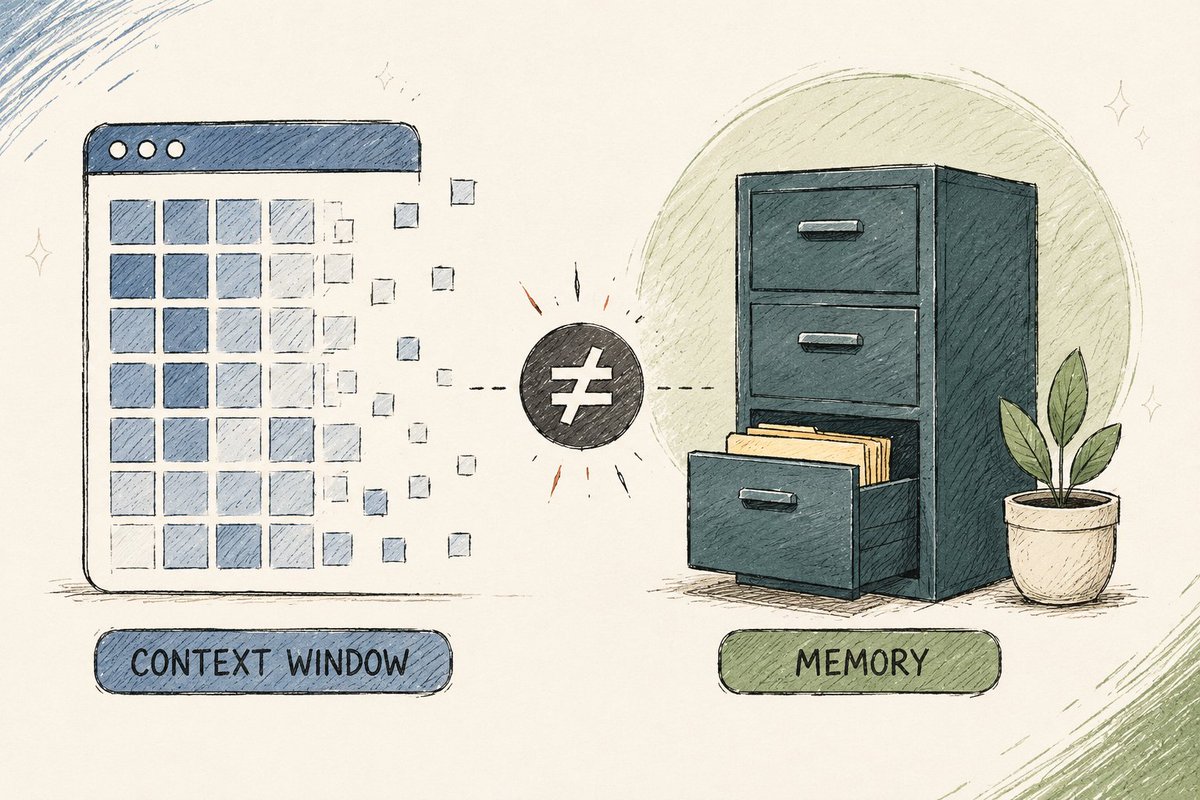
However, there is a caveat. Deeming a huge context window as "memory" is, in architectural terms, similar to buying a 25-foot-wide office desk because you are reluctant to acquire a filing cabinet. Sure, you can have all your documents laid in front of you, but as soon as the working session ends, the entire desk’s documents are wiped out (by cleaning staff!)
> To clarify this distinction and demystify other related concepts, this article offers a conceptual breakdown of multiple layers in AI agents cognitive stack. We will use several, mostly office-related metaphors to facilitate a better understanding of these concepts
# Context Window
A context window in an AI model, particularly agent-based ones with underlying language models, is like a desk surface or a stateless scratchpad. It is important to note that models are inherently fully stateless. No matter what, every API call to a model starts at step zero
When passing an agent a conversation history spanning over 200K tokens (large context window), it isn’t remembering what happened at a previous step in time. Instead, it is quickly re-reading "its universe" from scratch in a matter of milliseconds. In the long-run, relying on this strategy in agent-based environments may introduce several dangerous (if not fatal) traps:
- AI models act like a lazy student, who pays close attention to the initial and final parts of a massive prompt, but utterly glosses over ideas and facts buried deep in the middle parts
- There is a snowballing effect: as the conversation grows, the agent must re-send and re-read the entire history at every single step, including the earliest, often irrelevant turns
- In terms of latency, there is a brain freeze effect, so that against a huge wall of text, the model will take some time until starting to generate the very first word in its response
To make this concrete, consider what a single API call actually looks like under the hood. Because the model holds no memory between calls, every prior turn must be resent in full just to ask one new question:
```
model.generate(
messages=[
{"role": "user", "content": "Step 1: Let's call this variable `session_id`."},
{"role": "assistant", "content": "Got it, I'll use `session_id` going forward."},
# ... every intervening turn must be resent, every single time ...
{"role": "user", "content": "Step 47: What variable name did we agree on back in step 1?"}
]
)
```
Step 47 alone forces the entire desk => all 46 prior turns => back onto the table, just to answer a question about step 1. That is the snowballing effect described above, made concrete
# Retrieval
Retrieval-augmented generation (RAG) systems are like a big bookshelf across the office room, that helps fetch static, existing data relevant to the current step in a "Just-In-Time" fashion. RAG systems pull the top-K relevant document chunks into the scratchpad (the context window) as the user asks a certain question: the retrieved documents are, of course, the ones determined as most semantically relevant to the user’s question or prompt
When agents are in the loop, things are not that easy, however, as vector similarity (the type of similarity measure and data representation used in RAG systems) is not necessarily equivalent to semantic truth in certain cases. For example, suppose a user tells their scheduling agent to move a meeting to Friday, and later says "Cancel Thursday, Alice is sick". A vector search engine may retrieve both statements from a document base, even though they contradict each other. The agent and its associated language model must be able to act as accountants capable of determining which statement better reflects the current reality
A naive RAG pipeline simply concatenates whatever it retrieves and leaves the model to guess which instruction still holds. A more reliable pattern resolves the conflict before generation ever happens, for example by favoring the most recently recorded statement:
```
retrieved_chunks = [
{"text": "Move meeting to Friday", "timestamp": "2025-01-10T09:00:00"},
{"text": "Cancel Thursday, Alice is sick", "timestamp": "2025-01-12T14:30:00"}
]
# Reconcile contradictory chunks before they ever reach the prompt
latest_relevant = max(retrieved_chunks, key=lambda chunk: chunk["timestamp"])
```
That one line of reconciliation logic is the difference between an agent that confidently restates a stale instruction, and one that correctly knows the meeting was cancelled
# Compression
This is an easy one to understand if you are familiar with compressing into ZIP files. In the context of agents and language models, this entails some algorithmic token reduction: keeping the key underlying data intact, while its physical footprint inside a prompt at a certain step is shrunk. There are techniques like stripping stop-words, passing raw text to a specific compression model like LLMLingua, or Prompt Caching, to do this. This is, in essence, a bandwidth optimization play to be used in situations like squeezing a 15K-token JSON payload down to 5K, thus leaving enough scratchpad space in the model to do its main job
In practice, this might look as simple as routing a large payload through a compression model before it ever reaches the main prompt:
```
raw_payload = json.dumps(large_api_response) # roughly 15,000 tokens
compressed_payload = compress_with_llmlingua(
raw_payload,
target_token_count=5000
)
prompt = f"Given this data: {compressed_payload}\n\nAnswer the user's question."
```
The underlying facts survive the trip intact; only their footprint on the desk shrinks
# Summarization
Unlike compression, summarization removes the original data and replaces it with an abstraction. It must be treated as what it is: a one-way trip that is inherently irreversible. A good, nearly imperative practice when applying context summarization, therefore, is to use forked storage: dumping raw transcripts into cheap storage like S3 buckets or basic SQL tables, then passing just the synthesized summary into the active prompt
That forked-storage pattern can be expressed simply as a two-step write, one to cold storage and one to the active prompt:
```
def summarize_turn(raw_transcript, session_id, turn_id):
# 1. Persist the raw, unabridged transcript to cold storage
s3_client.put_object(
Bucket="agent-transcripts",
Key=f"{session_id}/turn_{turn_id}.json",
Body=raw_transcript
)
# 2. Generate a compact summary for the active prompt
summary = summarizer_model.generate(raw_transcript)
# 3. Only the summary re-enters the context window
return summary
```
If a later step needs the original detail, it can always be retrieved from S3. Summarization, unlike compression, never needs to be reconstructed from inside the active prompt itself
# Memory Persistence as a State Machine
Memory persistence in agents is taken for granted more often than not, particularly by junior developers. But to give an agent genuine memory, it must not act as the database, but rather as the database administrator. Suppose a user says, "My dog’s name is Goofy, but we might rename him Pluto"
Then the agent should be able to explicitly trigger a tool-call like this:
```
{
"tool": "update_entity_graph",
"params": {
"subject": "User_Dog",
"attribute": "Name",
"value": "Goofy",
"notes": "Considering Pluto"
}
}
```
It is irrelevant whether it is backed by a standard SQL table, a knowledge graph, or Redis: either way, the agent should be taught to query the state machine at the start of every turn, and commit to it at the end of that turn. As a loop, this query-then-commit discipline looks like:
```
def agent_turn(user_message, entity_graph):
# Query existing state at the START of every turn
current_state = entity_graph.query(subject="User_Dog")
response = model.generate(
messages=[{"role": "user", "content": user_message}],
context=current_state
)
# Commit any updates at the END of every turn
for call in response.tool_calls:
entity_graph.update(**call.params)
return response
```
# Wrapping Up
Through these concepts, you should now have a clearer picture of the elements that play a role in context management for agents built on language models. The lesson is a simple one: stop trying to buy a huge, 10-million-token desk. Instead, just get a normal desk, give your agent a sharp pencil, and teach it how to open the filing cabinet and optimally leverage its contents to do its job
Save this so you don't lose it
Follow @beamnxw for more technical posts :)
my telegram channel
<video controls preload="metadata" poster="/doc/4415/image/img_72bbbb652f0f.jpg" src="/videos/0072.mp4"></video>
## 相关链接
- [beamnxw ./](https://x.com/beamnxw)
- [@beamnxw](https://x.com/beamnxw)
- [30K](https://x.com/beamnxw/status/2087896913865478152/analytics)
- [@beamnxw](https://x.com/@beamnxw)
- [my telegram channel](https://t.me/beamnxw11)
- [Upgrade to Premium](https://x.com/i/premium_sign_up)
- [9:39 PM · Aug 13, 2026](https://x.com/beamnxw/status/2087896913865478152)
- [30.5K Views](https://x.com/beamnxw/status/2087896913865478152/analytics)
- [View quotes](https://x.com/beamnxw/status/2087896913865478152/quotes)
---
*导出时间: 2026/8/15 21:27:51*
---
## 中文翻译
# 上下文窗口不是记忆:AI 智能体开发者需要理解的事
**作者**: beamnxw ./
**日期**: 2026-08-13T13:39:50.000Z
**来源**: [https://x.com/beamnxw/status/2087896913865478152](https://x.com/beamnxw/status/2087896913865478152)
---

在本文中,你将了解到为什么大上下文窗口不等同于智能体记忆,以及检索、压缩和摘要等技术如何在智能体的认知栈中协同工作
我们将涵盖的主题包括:
- 为什么上下文窗口表现得像一个无状态的便签本,而非持久化记忆
- 检索增强生成、压缩和摘要各自在管理进入该便签本的内容时扮演什么独特角色
- 智能体如何通过扮演数据库管理员的角色(而非数据库本身)来实现真正的记忆持久化

# 引言
上下文窗口是现代 AI 模型(尤其是语言模型)的一个关键方面,这些模型在生成响应时,能够同时关注并利用有限的输入和先前的对话内容,通常以 token 数量来衡量
当一家 AI 实验室发布一个拥有 200 万 token 上下文窗口的模型时,一些开发者本能地会这样想:“让我们把整个代码库塞进提示词里!记忆问题解决了!”
然而,这里有一个需要注意的地方。在架构层面,将巨大的上下文窗口视为“记忆”,类似于因为不想买文件柜而买了一张 25 英尺宽的办公桌。诚然,你可以把所有文件都摊在面前,但一旦工作会话结束,整张桌子上的文件都会被(清洁人员!)清空
> 为了澄清这一区别并揭开其他相关概念的神秘面纱,本文对 AI 智能体认知栈中的多个层次进行了概念性拆解。我们将使用几个(主要是办公室相关的)隐喻来帮助更好地理解这些概念
# 上下文窗口
AI 模型(尤其是基于语言模型的智能体)中的上下文窗口,就像桌面或一个无状态的便签本。需要注意的是,模型本质上完全是无状态的。无论如何,每次对模型的 API 调用都是从零开始的
当你向智能体传递一段超过 20 万 token 的对话历史(大上下文窗口)时,它并不是在“记住”之前某个时间点发生的事情。相反,它是在几毫秒内从头快速“重读”它的“世界”。从长远来看,在基于智能体的环境中依赖这种策略可能会引入几个危险(甚至致命)的陷阱:
- AI 模型就像一个懒惰的学生,对庞大提示词的开头和结尾部分非常关注,却完全忽略了深埋在中间部分的想法和事实
- 存在滚雪球效应:随着对话的增长,智能体必须在每一步都重新发送并重读整个历史记录,包括最早的那些通常不相关的轮次
- 在延迟方面,存在“大脑冻结”效应,面对巨大的文本墙,模型需要一段时间才能开始生成响应的第一个词
为了具体说明这一点,考虑一下一次 API 调用在底层实际上是什么样的。由于模型在调用之间不保留记忆,仅仅为了提出一个新问题,每一轮先前的对话都必须完整地重新发送:
```
model.generate(
messages=[
{"role": "user", "content": "第 1 步:让我们把这个变量命名为 `session_id`。"},
{"role": "assistant", "content": "好的,我以后会使用 `session_id`。"},
# ... 每一轮中间的对话都必须重新发送,每次都一样 ...
{"role": "user", "content": "第 47 步:我们在第 1 步中商定的变量名是什么?"}
]
)
```
仅仅为了回答关于第 1 步的问题,第 47 步就迫使整张桌子 => 所有 46 轮先前的对话 => 重新放回桌面上。这就是上面描述的滚雪球效应的具体体现
# 检索
检索增强生成(RAG)系统就像办公室里的一个大书架,它有助于以“即时”的方式获取与当前步骤相关的静态、已有数据。当用户提出某个问题时,RAG 系统会将 top-K 个相关的文档块拉入便签本(上下文窗口):当然,被检索到的文档是那些被判定为与用户问题或提示词语义最相关的内容
然而,当智能体参与其中时,事情就没那么简单了,因为向量相似度(RAG 系统中使用的相似度度量和数据表示类型)在某些情况下并不一定等同于语义事实。例如,假设用户告诉他们的日程安排智能体将会议改到周五,之后又说“取消周四的会议,爱丽丝生病了”。向量搜索引擎可能会从文档库中同时检索到这两条陈述,尽管它们相互矛盾。智能体及其关联的语言模型必须能够像会计师一样,判断哪条陈述更能反映当前现实
一个简单的 RAG 流程只是将检索到的内容拼接起来,然后让模型去猜测哪条指令仍然有效。一个更可靠的模式是在生成发生之前就解决冲突,例如优先采用最近记录的陈述:
```
retrieved_chunks = [
{"text": "将会议改到周五", "timestamp": "2025-01-10T09:00:00"},
{"text": "取消周四的会议,爱丽丝生病了", "timestamp": "2025-01-12T14:30:00"}
]
# 在冲突内容到达提示词之前就进行协调
latest_relevant = max(retrieved_chunks, key=lambda chunk: chunk["timestamp"])
```
这一行协调逻辑,就是区分一个自信地重述过时指令的智能体,与一个正确知道会议已被取消的智能体的关键所在
# 压缩
如果你熟悉压缩成 ZIP 文件,这个概念就很容易理解。在智能体和语言模型的语境下,这涉及到某种算法性的 token 缩减:保持关键底层数据完整,同时缩小其在特定步骤提示词中的物理占用空间。有各种技术可以实现这一点,比如去除停用词、将原始文本传递给像 LLMLingua 这样的特定压缩模型,或者使用提示词缓存。本质上,这是一种带宽优化策略,用于诸如将 15K token 的 JSON 负载压缩到 5K 这样的场景,从而为模型的主要工作留出足够的便签本空间
在实践中,这可能简单到在大型负载进入主提示词之前,先通过一个压缩模型进行路由:
```
raw_payload = json.dumps(large_api_response) # 大约 15,000 tokens
compressed_payload = compress_with_llmlingua(
raw_payload,
target_token_count=5000
)
prompt = f"根据这些数据:{compressed_payload}\n\n回答用户的问题。"
```
底层的事实完好无损地通过了这次传输;只是它们在桌面上的占用空间变小了
# 摘要
与压缩不同,摘要会移除原始数据,并用一个抽象概括来替代它。必须正视它的本质:这是一条本质上不可逆的单行道。因此,在应用上下文摘要时,一个良好且近乎强制的最佳实践是使用分叉存储:将原始记录转储到廉价存储(如 S3 存储桶或基本 SQL 表)中,然后只将综合后的摘要传入活动的提示词中
这种分叉存储模式可以简单地表示为两步写入,一步写入冷存储,一步写入活动提示词:
```
def summarize_turn(raw_transcript, session_id, turn_id):
# 1. 将原始的、未删减的记录持久化到冷存储
s3_client.put_object(
Bucket="agent-transcripts",
Key=f"{session_id}/turn_{turn_id}.json",
Body=raw_transcript
)
# 2. 为活动提示词生成一个紧凑的摘要
summary = summarizer_model.generate(raw_transcript)
# 3. 只有摘要重新进入上下文窗口
return summary
```
如果后续步骤需要原始细节,随时可以从 S3 中检索。与压缩不同,摘要永远不需要从活动提示词内部进行重建
# 记忆持久化作为状态机
智能体的记忆持久化经常被认为是理所当然的,尤其是初级开发者。但要赋予智能体真正的记忆,它必须不充当数据库,而是充当数据库管理员。假设用户说:“我的狗叫高飞,但我们可能会给它改名为普鲁托”
那么智能体应该能够显式地触发这样的工具调用:
```
{
"tool": "update_entity_graph",
"params": {
"subject": "User_Dog",
"attribute": "Name",
"value": "Goofy",
"notes": "Considering Pluto"
}
}
```
无论底层是由标准 SQL 表、知识图谱还是 Redis 支持,都无关紧要:无论哪种方式,智能体都应该被教导在每一轮开始时查询状态机,并在该轮结束时提交更改。作为一个循环,这种“先查询后提交”的纪律看起来像这样:
```
def agent_turn(user_message, entity_graph):
# 在每一轮开始时查询现有状态
current_state = entity_graph.query(subject="User_Dog")
response = model.generate(
messages=[{"role": "user", "content": user_message}],
context=current_state
)
# 在每一轮结束时提交任何更新
for call in response.tool_calls:
entity_graph.update(**call.params)
return response
```
# 总结
通过这些概念,你现在应该对基于语言模型的智能体在上下文管理中所涉及的元素有了更清晰的认识。道理很简单:不要试图去买一张巨大的、1000 万 token 的桌子。相反,找一张普通的桌子,给你的智能体一支削尖的铅笔,教它如何打开文件柜,并最优地利用其中的内容来完成工作
保存这篇文章,以免丢失
关注 @beamnxw 获取更多技术文章 :)
我的 Telegram 频道
<video controls preload="metadata" poster="/doc/4415/image/img_72bbbb652f0f.jpg" src="/videos/0072.mp4"></video>
## 相关链接
- [beamnxw ./](https://x.com/beamnxw)
- [@beamnxw](https://x.com/beamnxw)
- [30K](https://x.com/beamnxw/status/2087896913865478152/analytics)
- [@beamnxw](https://x.com/@beamnxw)
- [my telegram channel](https://t.me/beamnxw11)
- [Upgrade to Premium](https://x.com/i/premium_sign_up)
- [9:39 PM · Aug 13, 2026](https://x.com/beamnxw/status/2087896913865478152)
- [30.5K Views](https://x.com/beamnxw/status/2087896913865478152/analytics)
- [View quotes](https://x.com/beamnxw/status/2087896913865478152/quotes)
---
*导出时间: 2026/8/15 21:27:51*