2026年非CS背景成为AI工程师的指南 ✍ Khairallah AL-Awady🕐 2026-06-29📦 13.3 KB 🟢 已读 𝕏 文章列表 文章指出,成为AI工程师无需计算机学位,作品集比文凭更重要。AI工程师是连接大模型与现实产品的构建者。文章提供了为期9个月的四阶段自学路径:掌握Python编程、精通LLM API(含工具调用)、构建RAG系统以及开发Agent。强调实战部署和解决实际问题的能力,而非深奥的数学研究。 AI工程师学习路线PythonRAGAgentLLM API自学职业发展 # How To Become An AI Engineer in 2026 (Without a CS Degree) **作者**: Khairallah AL-Awady **日期**: 2026-06-23T08:48:54.000Z **来源**: [https://x.com/eng_khairallah1/status/2069341916798369801](https://x.com/eng_khairallah1/status/2069341916798369801) --- 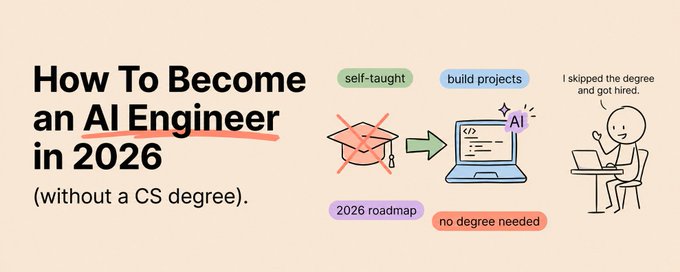 Most people think you need a computer science degree to work in AI. Save this :) A small group of people figured out that the highest-paid building role in tech right now doesn't care what your diploma says. It cares what you've shipped. The difference between those two groups is not credentials. It is a portfolio. An AI engineer is the person who builds the systems that connect large language models to real products. The support bot that actually resolves the ticket. The internal search that finds the answer buried in ten thousand documents. The agent that runs a multi-step workflow without a human babysitting it. This is not research. It is not training models from scratch. It is building production software with AI at the core, and it is one of the most in-demand jobs in the entire market. Here is the part nobody told you. For the majority of these roles, a portfolio of shipped projects carries more weight than a degree. Hiring managers will tell you plainly that they've watched self-taught engineers run circles around PhD holders, because shipping is a different skill than studying. The credential gate is mostly an illusion, and the people who realize it early get years ahead of the people still waiting for permission. This is the path. No degree required. Here's exactly what it looks like. ## First, Understand What This Job Actually Is Before you learn anything, get the role clear in your head, because most people aim at the wrong target. There are two roles people confuse. The machine learning researcher invents new models and trains them. That work genuinely benefits from advanced degrees and heavy math, and it's a small slice of the market. The AI engineer takes models that already exist and builds useful things with them. That work rewards software skill, product sense, and shipping discipline far more than academic credentials. The vast majority of open roles and the ones you can break into without a degree are the second kind. You're aiming to become the engineer who builds with AI, not the scientist who builds the AI. That distinction will save you from wasting months on math you don't need yet. The role sits at the intersection of three things: software engineering, a working understanding of how language models behave, and product thinking. You don't need to be elite at all three on day one. You need to be competent and improving, and you need proof. ## Phase 1 (Months 1–3): Learn to Code Properly This is the step you cannot skip, and the step most people try to skip. You must be able to write real, working code before anything else makes sense. Python is the language. Almost every AI library, framework, and tool is built for Python first, so this is not a preference, it's the standard. Spend these months getting genuinely comfortable. Not "I watched a tutorial" comfortable. "I can build a small program from a blank file without looking up basic syntax" comfortable. Variables, data types, control flow, functions, working with files, calling APIs, handling errors, and reading other people's code. Learn how to use Git and put everything on GitHub from day one, because your GitHub is the first half of your portfolio. If the math worry is nagging at you, set it down. You need comfort with basic statistics and a feel for how numbers behave. You do not need to master linear algebra and calculus to start building with LLMs. The deep math matters for research; you're building. Pick it up later if a specific project demands it. What to Do This Phase - Complete a structured Python course and write code every single day, even thirty minutes - Build five tiny programs from scratch: a calculator, a file organizer, a script that calls a public API, a simple data cleaner, a command-line note taker - Learn Git fundamentals and push all five projects to a public GitHub - Join one community of people doing the same thing so you're not learning in a vacuum ## Phase 2 (Months 3–5): Master the LLM API Now you start working with the thing that defines the job. The chat interface is the consumer product. AI engineers work through the API, sending requests from their own code and handling the responses programmatically. This is where the real leverage lives, and getting fluent here is the moment you stop being a user and start being a builder. Learn to send messages to a model from your own script. Learn to handle streaming responses, manage conversation history, control output format, and deal with rate limits and errors gracefully. Learn the difference between a prompt that gets a decent answer and a prompt that gets a precise, repeatable, production-ready answer every time, because in a real product "usually right" is a bug. This is also where you learn tool use, sometimes called function calling. This is how you let a model take actions: call a function, query a system, fetch data. The moment you understand tool use, the whole world of agents opens up, because agents are just models with tools and a loop. What to Do This Phase - Get an API key and make your first call from a Python script in your first hour - Build a command-line tool that takes any text you paste and does something useful with it - Build a chatbot with memory that remembers earlier parts of the conversation - Implement tool use: give the model one function it can call, and make it call it correctly ## Phase 3 (Months 5–7): Build RAG Systems This is the skill that gets people hired, because it's what most real AI products are actually doing under the hood. RAG stands for retrieval-augmented generation, and the idea is simple once you see it. A model only knows what it was trained on and what you put in front of it. RAG is the technique of fetching the right information from your own data and putting it in front of the model so it answers accurately about things it was never trained on. Your company's documents. A product manual. A knowledge base. You'll learn to break documents into chunks, turn those chunks into embeddings (numerical representations of meaning), store them in a vector database, and retrieve the most relevant ones for any given question. Then you feed those to the model and get a grounded, sourced answer instead of a confident guess. Building one RAG application that actually works, end to end, with real documents, puts you ahead of a huge share of people who only talk about AI. This is portfolio project number one. What to Do This Phase - Learn how embeddings and vector databases work, conceptually first, then in code - Build a RAG app over a real document set: your own notes, a set of PDFs, a wiki - Add proper retrieval evaluation: is it actually finding the right chunks, or just nearby ones? - Deploy it somewhere a stranger can use it, even a simple hosted version ## Phase 4 (Months 7–9): Build Agents Now you build the thing everyone is talking about and few can actually deliver. An agent is a model that can take a goal, break it into steps, use tools to complete each step, and decide what to do next based on what happened. A RAG app answers a question. An agent gets a job done. You already learned tool use in Phase 2. Now you learn to put it in a loop with a goal, give the agent multiple tools, and handle the messy reality that agents sometimes go in circles, call the wrong tool, or get stuck. Learning to build agents that are reliable, not just impressive in a demo, is exactly the skill the market is starving for. The honest part: a demo agent is easy and a reliable agent is hard. The gap between the two is failure handling, clear tool design, and evaluation. Spend your effort there, because that gap is precisely what separates a hireable engineer from someone with a flashy video. What to Do This Phase - Build a single-agent system that uses several tools to complete a real multi-step task - Build a small multi-agent system where two or more agents collaborate or check each other - Add explicit failure handling: what the agent does when a tool fails or returns nothing - Make this portfolio project number two: a multi-agent system that solves a real problem ## Phase 5 (Months 9–11): Learn Evaluation and Deployment This is the boring phase that makes you employable, and it's the one amateurs skip entirely. Anyone can get an AI feature to work once. Companies pay for things that work the ten-thousandth time. The skills that prove you can do that are evaluation and deployment. Evaluation means building a way to measure whether your system is actually good, and whether a change made it better or worse. For generation tasks you'll measure things like factual accuracy, relevance, and consistency against reference answers, sometimes using another model to score outputs, sometimes using human review. An engineer who builds evals is an engineer who can be trusted with production. Deployment means getting your system out of your laptop and into the world: hosting it, monitoring it, handling load, watching costs, and catching failures before users do. This cluster of skills is sometimes called MLOps, and even a basic grasp of it makes you dramatically more hireable than someone who can only build on their own machine. What to Do This Phase - Build an evaluation suite for one of your earlier projects with a set of test cases and scoring - Take one project and deploy it properly with monitoring and basic cost tracking - Make this portfolio project number three: a deployed system with evaluation and monitoring - Document what you measured and how you'd improve it, because thinking out loud is a hireable signal ## Phase 6 (Months 11–12): Get Hired The final phase isn't about new technical skills. It's about making sure the right people see what you've built. By now you have three real projects: a RAG application with evaluation, a multi-agent system that solves a real problem, and a deployed system with monitoring. That portfolio opens more doors than a master's degree for most AI engineering roles. The work now is positioning. Write up each project as a clear case study: the problem, your approach, what you measured, what you'd do differently. Build in public, share your process, and post your breakdowns. The field is moving so fast that visible, consistent builders get noticed quickly. Then apply, and apply to the right tier. The realistic entry path is often an AI-augmented software engineering role first, then a full AI engineer role, with salaries commonly landing somewhere from roughly $120K at entry up past $200K with experience, depending heavily on company and location. When the interview asks you to "reason about how an agent should handle a tool failure" or "explain how you'd evaluate a RAG system," you won't be reciting theory. You'll be describing what you actually did. That's the whole game. What to Do This Phase - Write a clear case study for each of your three portfolio projects - Publish at least one technical breakdown showing how you built something hard - Apply broadly, including AI-augmented software roles as a realistic first step - In interviews, talk about what you shipped and what you'd improve, not what you memorized ## The Honest Truth About This Path Twelve months is a real timeline, and it only works if you're building the entire time. Reading about AI engineering is not becoming an AI engineer. Watching tutorials is not building a portfolio. The people who come out of this employed are the ones who shipped something every single phase and weren't precious about it being perfect. The ones who stay stuck are the ones who kept "preparing" and never put anything in front of a real user. And here's the question on everyone's mind, so let's answer it: if AI writes so much code now, why learn this at all? Because someone has to design the system, integrate it, evaluate whether the output is correct, and decide what to build. AI tools make a skilled AI engineer more valuable, not obsolete. The person who can direct these tools and judge their output is exactly the person the market is paying for. You're not learning to compete with the tools. You're learning to command them. The credential gate that's keeping most people out is one most companies have already stopped enforcing. A year from today you can either still be telling yourself you need a degree first. Or you can be the engineer with three shipped projects that prove you never did. The only thing standing between you and Phase 1 is opening a blank file today. If you found this useful, follow me @eng_khairallah1 for more AI content like this. I post breakdowns, courses, and tools every week. hope this was useful for you, Khairallah ❤️ ## 相关链接 - [Khairallah AL-Awady](https://x.com/eng_khairallah1) - [@eng_khairallah1](https://x.com/eng_khairallah1) - [1.6M](https://x.com/eng_khairallah1/status/2069341916798369801/analytics) - [@eng_khairallah1](https://x.com/@eng_khairallah1) - [Upgrade to Premium](https://x.com/i/premium_sign_up) - [4:48 PM · Jun 23, 2026](https://x.com/eng_khairallah1/status/2069341916798369801) - [1.6M Views](https://x.com/eng_khairallah1/status/2069341916798369801/analytics) - [View quotes](https://x.com/eng_khairallah1/status/2069341916798369801/quotes) --- *导出时间: 2026/6/29 17:08:32* --- ## 中文翻译 # 2026年如何成为人工智能工程师(无需计算机学位) **作者**: Khairallah AL-Awady **日期**: 2026-06-23T08:48:54.000Z **来源**: [https://x.com/eng_khairallah1/status/2069341916798369801](https://x.com/eng_khairallah1/status/2069341916798369801) ---  大多数人认为,从事 AI 工作必须拥有计算机学位。 收藏这篇文章 :) 有一小部分人已经发现,当今科技界薪酬最高的构建型岗位,并不在乎你的文凭写的是什么。它在乎的是你构建出了什么。 这两群人的区别不在于资历。 而在于作品集。 AI 工程师是构建将大型语言模型连接到真实产品的系统的人。是真正能解决工单的客服机器人。是能在成万份文档中找到答案的内部搜索。是能在无人看守的情况下运行多步工作流的智能体。这不是科研。这不是从头训练模型。这是构建以 AI 为核心的生产级软件,也是整个市场需求最旺盛的工作之一。 这是没人告诉过你的部分。对于绝大多数这类岗位,一套包含已交付项目的作品集比学位更有分量。招聘经理会坦率地告诉你,他们见过自学成才的工程师把博士生甩在身后,因为“交付”是一项与“学习”不同的技能。学历门槛大多是一种错觉,而那些早点意识到这一点的人,会比仍在等待许可的人领先数年。 这就是路径。不需要学位。具体情况如下。 ## 首先,弄清楚这份工作到底是什么 在学习任何东西之前,先在脑海中明确这个角色,因为大多数人的目标都瞄错了。 人们容易混淆两个角色。机器学习研究员发明新模型并训练它们。这项工作确实得益于高等学位和深厚的数学功底,但这只是市场上的一小部分。AI 工程师获取已有的模型并用它们构建有用的东西。这项工作看重的是软件技能、产品感和交付纪律,远胜过学术资历。绝大多数开放的岗位,以及那些你能没有学位就切入的岗位,都是第二种。 你的目标是成为一名使用 AI 进行构建的工程师,而不是构建 AI 的科学家。这种区分能让你免于在目前不需要的数学上浪费数月时间。 这个角色位于三者的交汇点:软件工程、对语言模型运作机制的实际理解,以及产品思维。你不需要在第一天就在这三方面都达到精英水平。你需要的是能力过硬、持续进步,并且需要证明。 ## 第一阶段(第 1-3 个月):正规学习编程 这是你不能跳过、也是大多数人试图跳过的一步。 在其他一切变得有意义之前,你必须能够编写真实、可运行的代码。Python 是这门语言。几乎每一个 AI 库、框架和工具都是首先为 Python 构建的,所以这不是偏好问题,而是标准。 花这几个月让自己真正感到舒适。不是“我看完了教程”那种舒适。而是“我可以在不查阅基本语法的情况下,从空白文件开始构建一个小程序”的那种舒适。变量、数据类型、控制流、函数、处理文件、调用 API、处理错误以及阅读别人的代码。学习如何使用 Git,从第一天开始就把所有东西放到 GitHub 上,因为你的 GitHub 是你作品集的前半部分。 如果数学的担忧让你烦恼,先把它放一边。你需要熟悉基础统计学,并对数字的行为有感觉。你不需要掌握线性代数和微积分也能开始用 LLM 做开发。深奥的数学对科研很重要;而你是在做构建。如果以后有特定项目需要,再去捡起它。 本阶段要做的事 - 完成一套系统的 Python 课程,并且每天写代码,哪怕只有三十分钟 - 从零开始构建五个微型程序:一个计算器、一个文件整理器、一个调用公共 API 的脚本、一个简单的数据清洗器、一个命令行笔记工具 - 学习 Git 基础并将所有五个项目推送到公开的 GitHub 上 - 加入一个正在做同样事情的社区,这样你就不会在真空中学习 ## 第二阶段(第 3-5 个月):掌握 LLM API 现在你开始接触定义这份工作的东西。 聊天界面是消费者产品。AI 工程师通过 API 工作,从自己的代码发送请求并程序化地处理响应。这就是真正的杠杆所在,在这里变得流利意味着你不再是一个用户,而开始成为一个构建者。 学习从你自己的脚本向模型发送消息。学习处理流式响应、管理对话历史、控制输出格式,以及优雅地处理速率限制和错误。学习“能得到一个不错答案的提示词”和“每次都能得到精确、可重复、可用于生产的答案的提示词”之间的区别,因为在真实产品中,“通常正确”就是一个 Bug。 这也是你学习工具使用的地方,有时称为函数调用。这是你让模型采取行动的方式:调用函数、查询系统、获取数据。当你理解工具使用的那一刻,整个智能体的世界就打开了,因为智能体只是拥有工具和循环的模型。 本阶段要做的事 - 获取一个 API 密钥,并在第一小时内从 Python 脚本发出你的第一次调用 - 构建一个命令行工具,接收你粘贴的任何文本并对其做有用的事 - 构建一个具有记忆功能的聊天机器人,能记住对话的早期部分 - 实现工具使用:给模型一个它可以调用的函数,并让它正确调用 ## 第三阶段(第 5-7 个月):构建 RAG 系统 这是让人能被雇用的技能,因为大多数真实的 AI 产品在底层实际上就是在做这个。 RAG 代表检索增强生成,一旦你明白了它,思路就很简单。模型只知道它训练过的东西和你放在它面前的东西。RAG 是一种从你自己的数据中获取正确信息并将其放在模型面前的技术,这样它就能准确地回答它从未训练过的内容。比如公司的文档、产品手册、知识库。 你将学习如何将文档分块,将这些块转化为嵌入(embedding,即意义的数值表示),将它们存储在向量数据库中,并为任何给定问题检索最相关的部分。然后你将这些内容提供给模型,得到一个有依据、有来源的答案,而不是一个自信的猜测。 构建一个真正端到端工作的 RAG 应用,使用真实的文档,这会让你领先于绝大多数只谈论 AI 的人。这是作品集项目一号。 本阶段要做的事 - 从概念上学习嵌入和向量数据库是如何工作的,然后在代码中学习 - 在一个真实的文档集上构建一个 RAG 应用:你自己的笔记、一组 PDF、一个 Wiki - 添加适当的检索评估:它是否真的找到了正确的块,还是仅仅是附近的块? - 把它部署到一个陌生人可以使用的地方,即使是一个简单的托管版本 ## 第四阶段(第 7-9 个月):构建智能体 现在你构建一个人人都在谈论但很少有人能真正交付的东西。 智能体是一个可以获取目标、将其分解为步骤、使用工具完成每一步,并根据发生的情况决定下一步做什么的模型。RAG 应用回答一个问题。智能体完成一项工作。 你已经在第二阶段学习了工具使用。现在你学习将其放入一个带有目标的循环中,给智能体多个工具,并处理混乱的现实:智能体有时会陷入循环、调用错误的工具或卡住。学习构建可靠的、而不仅仅是在演示中令人印象深刻的智能体,正是市场极度渴求的技能。 诚实的一面:演示级智能体很容易,可靠级智能体很难。两者之间的差距在于故障处理、清晰的工具设计和评估。把精力花在这里,因为这个差距正是区分可雇用工程师和拥有花哨视频的人的关键。 本阶段要做的事 - 构建一个使用多种工具来完成真实多步任务的单智能体系统 - 构建一个小型的多智能体系统,其中两个或更多智能体协作或相互检查 - 添加明确的故障处理:当工具失败或返回空时智能体该做什么 - 把这作为作品集项目二号:一个解决真实问题的多智能体系统 ## 第五阶段(第 9-11 个月):学习评估和部署 这是枯燥但让你能被雇用的阶段,也是业余者完全跳过的阶段。 任何人都能让一个 AI 功能运行一次。公司是为能运行第一万次的东西买单。能证明你能做到这一点的技能是评估和部署。 评估意味着构建一种方法来衡量你的系统是否真的好,以及某个改动是让它变好了还是变坏了。对于生成任务,你将根据参考答案衡量事实准确性、相关性和一致性,有时使用另一个模型对输出打分,有时使用人工审查。一个构建评估系统的工程师是可以被信任负责生产环境的工程师。 部署意味着让你的系统走出笔记本电脑,进入世界:托管它、监控它、处理负载、关注成本以及在用户之前捕获故障。这组技能有时称为 MLOps,即使是对其基础知识的掌握,也会让你比那些只能在自家机器上构建的人更有雇佣价值。 本阶段要做的事 - 为你之前的一个项目构建一个评估套件,包含一组测试用例和打分机制 - 将一个项目正确部署,包含监控和基本的成本跟踪 - 把这作为作品集项目三号:一个带有评估和监控的已部署系统 - 记录你衡量了什么以及你会如何改进它,因为大声思考是一种可雇佣的信号 ## 第六阶段(第 11-12 个月):找到工作 最后阶段不涉及新的技术技能。它在于确保对的人看到你构建的东西。 现在你拥有三个真实的项目:一个带评估的 RAG 应用、一个解决真实问题的多智能体系统,以及一个带监控的已部署系统。对于大多数 AI 工程岗位,这套作品集比硕士学位更能打开大门。现在的工作是定位。 把每个项目写成清晰的案例研究:问题、你的方法、你衡量了什么、你会做哪些不同的处理。公开构建,分享你的过程,发布你的拆解分析。这个领域发展太快,可见、持续的构建者会很快受到关注。然后申请,申请到正确的层级。现实的进入路径通常是先从事 AI 增强的软件工程角色,然后是全职 AI 工程师角色,薪资通常起薪大约在 12 万美元,随经验增长超过 20 万美元,具体取决于公司和地点。 当面试让你“推理智能体应该如何处理工具故障”或“解释你将如何评估 RAG 系统”时,你不会在背诵理论。你会在描述你实际做过的事情。这就是游戏的全部。 本阶段要做的事 - 为你的三个作品集项目各写一份清晰的案例研究 - 至少发布一篇技术拆解,展示你是如何构建某个复杂东西的 - 广泛申请,包括 AI 增强的软件角色,作为现实的第一步 - 在面试中,谈论你交付了什么以及你会如何改进,而不是你记住了什么 ## 关于这条路径的实话 十二个月是一个真实的时间表,只有当你全程都在构建时它才有效。 阅读关于 AI 工程的内容不是成为 AI 工程师。看教程不是构建作品集。那些在这个过程中找到工作的人,是在每个阶段都交付了东西的人,而且不纠结于是否完美。那些原地踏步的人,是一直在“准备”却从未把任何东西摆在真实用户面前的人。 这里是每个人都在想的问题,所以我们来回答它:既然 AI 现在写这么多代码,为什么还要学这个?因为总得有人设计系统、集成系统、评估输出是否正确,以及决定构建什么。AI 工具让熟练的 AI 工程师变得更有价值,而不是过时。能够指挥这些工具并判断其输出的人,正是市场愿意付费的人。你不是在为了与工具竞争而学习。你是在为了指挥它们而学习。 阻挡大多数人进入的学历门槛,是大多数公司已经不再执行的东西。 一年后的今天,你既可以继续告诉自己你需要先拿个学位。 你也可以成为一名拥有三个已交付项目、证明你从未需要过它的工程师。 挡在你和第一阶段之间的唯一障碍,就是今天打开一个空白文件。 如果你觉得这有用,请关注我 @eng_khairallah1 以获取更多此类 AI 内容。我每周发布拆解、课程和工具。 希望这对你有用,Khairallah ❤️ ## 相关链接 - [Khairallah AL-Awady](https://x.com/eng_khairallah1) - [@eng_khairallah1](https://x.com/eng_khairallah1) - [1.6M](https://x.com/eng_khairallah1/status/2069341916798369801/analytics) - [@eng_khairallah1](https://x.com/@eng_khairallah1) - [升级到 Premium](https://x.com/i/premium_sign_up) - [4:48 PM · Jun 23, 2026](https://x.com/eng_khairallah1/status/2069341916798369801) - [1.6M 观看](https://x.com/eng_khairallah1/status/2069341916798369801/analytics) - [查看引用](https://x.com/eng_khairallah1/status/2069341916798369801/quotes) --- *导出时间: 2026/6/29 17:08:32*
如 如何在 2026 年成为AI工程师 文章指出 2026 年 AI 工程师的门槛已变,不再看重学历,而是看重作品集与交付能力。作者拆解了 AI 工程师的三个核心能力:软件工程、LLM 使用及产品思维,并规划了一份为期 12 个月的六阶段实战路线图,涵盖 Python 基础、LLM API、RAG、Agent 系统开发、评估部署及求职准备。 技术 › LLM ✍ 路飞 AI 研究员🕐 2026-07-08 AI工程师职业发展学习路线RAGAgentLLMPythonPrompt实战指南求职
2 2026 年,如何成为一名 AI 工程师(不卡学历) 本文提供了 2026 年成为 AI 工程师的 12 个月路线图。作者区分了模型研究员与 AI 工程师,强调后者更看重实战能力而非高学历。路线图涵盖 Python 基础、大模型 API 调用、RAG 系统构建、Agent 开发以及 MLOps 评估与部署。通过完成三个核心项目(RAG 应用、多 Agent 系统、带监控的上线系统),建立能胜任工作的作品集,即使没有 CS 学位也能入行。 技术 › Agent ✍ 老白(每日 AI 干货)🕐 2026-07-02 AI工程师学习路线RAGLLMPython职业发展AgentMLOps编程实战教程
如 如何在6个月内从零成为AI工程师(2026版) 本文针对2026年的行业现状,驳斥了通过传统机器学习理论入行的误区,提出了6个月速成AI工程师的实战路线图。作者强调无需深奥数学,而应从Python和API调用起步。核心路径涵盖:深入掌握LLM原理与提示工程,精通RAG(检索增强生成)及语义分块、重排序等进阶技术,最终构建结合Agent与生产级思维的复杂AI系统。文章指出,唯有动手解决实际问题、构建高可用系统,而非单纯考取证书,才是成为合格AI工程师的关键。 技术 › LLM ✍ Suryansh Tiwari🕐 2026-04-28 AI工程师职业发展LLMRAGAgent学习路线PythonOpenAIClaude教程
A AI 工程师学习路线图:从核心技能到生产实践 文章基于 2000 余份职位描述,规划了一条务实的 AI 工程师学习路径。重点指出 AI 工程并非从零训练模型,而是构建以 LLM 为核心的系统。核心技能包括 LLM 基础、RAG 检索增强、Agent 智能体、测试评估及监控部署。此外,文章还梳理了 Python、Web 开发、云原生及数据库等支撑性技能,并推荐了学习优先级与主流技术栈,旨在帮助开发者构建可靠、可落地的生产级 AI 系统。 技术 › AI工程 ✍ Luffytaro🕐 2026-04-27 AI工程师学习路线LLMRAGAgent职业发展PythonLangChain评估体系生产部署
H How to Become an LLM Engineer 本文是2026年成为LLM工程师的实用指南,涵盖核心技能(RAG、Agents、生产部署)、学习路线、推荐工具及项目构建建议,帮助读者系统掌握大模型应用开发与工程化能力。 技术 › LLM ✍ Swati Gupta🕐 2026-07-16 LLM工程师RAGAgent学习路线项目实战LangChainPython职业发展AI技能
2 2026年AI工程师全攻略(无CS学位) 本文阐述了在2026年如何无需计算机学位成为一名AI工程师。文章指出,当前的招聘市场更看重实际构建能力而非学历背景,并明确区分了AI工程师(系统集成与落地)与机器学习研究员(模型训练)的区别。作者提供了一套完整的学习路径(技术栈),包括Python、SQL、API集成、向量搜索、RAG及Agent框架等,并建议通过构建RAG应用、工具使用Agent及全栈部署产品这三个具体项目来证明能力,从而获得工作机会。 技术 › LLM ✍ CyrilXBT🕐 2026-07-06 AI工程师学习路径RAGAgent职业发展PythonAPI集成LLM技能提升项目管理
2 2026年如何成为AI工程师(无需CS学位) 文章指出2026年AI工程师角色已分化为机器学习工程师和应用AI工程师。对于非CS学位求职者,后者是主要机会。文章详细列出了必备技能(Python、LLM行为、RAG系统、评估观测),并提出了三个能替代学历证明的实战项目建议。 技术 › LLM ✍ Harman🕐 2026-07-24 AI工程师职业发展RAGLLMAgentPrompt无学位
如 如何在6个月内成为代理AI工程师 本文提供了一个为期6个月的12阶段AI工程师学习路线图。文章首先阐述了代理工程师的核心是构建能自主决策的系统,而非编写固定逻辑。前两个阶段重点介绍了Python异步编程的基础(解决API调用阻塞问题)和LLM的基本原理(如上下文限制、成本控制和模型路由)。随后详细讲解了工具调用与结构化输出的实现方法,强调使用Pydantic验证数据及构建可恢复的Agent循环。 技术 › Agent ✍ Rahul🕐 2026-07-12 AIAgentLLMPython异步编程教程职业发展工具调用Pydantic学习路线
2 2026年AI开发者从零到英雄的完整路线图 这是一份针对2026年AI开发者的完整学习指南。文章指出,成为AI开发者不再需要计算机学位,通过正确的路线图,个人即可构建AI应用和SaaS产品。指南分为十个阶段:首先理解AI生态系统的基本概念(AI、ML、LLM、Agent等);接着掌握Python基础、API调用及Git工具;然后通过现有AI工具(如OpenAI API、LangChain)快速动手实践;最后深入学习前端技术、提示工程、LLM原理(RAG、微调)及应用部署。文章强调“学习-构建-分享”的循环策略,并指出AI智能体、自动化及RAG系统是当前的高价值技能。 技术 › LLM ✍ Shabnam Parveen🕐 2026-05-23 AI开发学习路线图LLMAgentAutomationRAGPythonPrompt Engineering职业发展
从 从零到 AI 工程师——没人真正讲清楚的路线图 本文为 AI 初学者提供了一份为期 14 周的实战路线图,旨在通过免费资源将新手培养成具备构建生产级 AI 系统能力的工程师。路线图包含六个阶段:环境搭建、AI 基础、机器学习基础、深度学习、现代 LLM 工程以及 Agent 与部署。文章强调动手实践,推荐了 OpenAI、Anthropic 官方教程及 GitHub 优质开源仓库,帮助学习者避开盲目刷证书的误区,真正掌握 AI 开发技能。 技术 › LLM ✍ 土豆本豆🕐 2026-05-18 AI工程师学习路线图LLMAgent深度学习RAGPython实战教程机器学习AI基础
Z Zero to AI Engineer — The Roadmap Nobody Explains Properly 本文提供了一个为期14周的实战型AI工程师学习路线图,旨在解决初学者“只学不做”的困境。文章从环境搭建开始,详细列出了从AI基础、机器学习、深度学习到现代LLM工程及Agent开发的最佳免费资源(如OpenAI/Anthropic官方课程、Karpathy的教程等)。路线强调通过GitHub项目实践来理解原理,最终掌握部署与评估技能,真正从零开始构建可用的AI系统。 技术 › LLM ✍ Shruti Codes🕐 2026-05-17 AI工程师学习路线LLMAgent深度学习RAG实战教程机器学习OpenAIAnthropic
C Crawl4AI:7万星开源神器把网页秒变LLM能吃的干净Markdown 文章介绍了一款名为 Crawl4AI 的开源爬虫工具,GitHub 星标超 7 万。该工具专为 RAG 和 Agent 设计,能将网页快速转换为干净的结构化 Markdown 数据。其特点包括零 API Key、异步浏览器池、智能去噪、支持 CLI/Docker 部署以及强大的反爬策略,被视为构建 LLM 数据管道的利器。 技术 › LLM ✍ 开发者Hailey🕐 2026-07-10 Crawl4AI爬虫开源RAGAgent数据处理Python工具推荐