# Mixture of Experts (MoE): Scaling AI with Specialized Models
**作者**: Jayanth
**日期**: 2026-05-06T15:40:17.000Z
**来源**: [https://x.com/JayanthSanku01/status/2052050827142131787](https://x.com/JayanthSanku01/status/2052050827142131787)
---

Artificial Intelligence models have grown dramatically in scale over the last decade. Early neural networks contained thousands of parameters. Modern large language models contain billions or even trillions of parameters. While larger models often achieve better performance, they also introduce major challenges related to computational cost, training time, and energy consumption.
A powerful architectural strategy known as Mixture of Experts (MoE) addresses this problem by allowing models to scale massively while keeping the computation per input manageable. Instead of activating the entire neural network for every input, MoE systems activate only a small set of specialized sub-networks called experts.
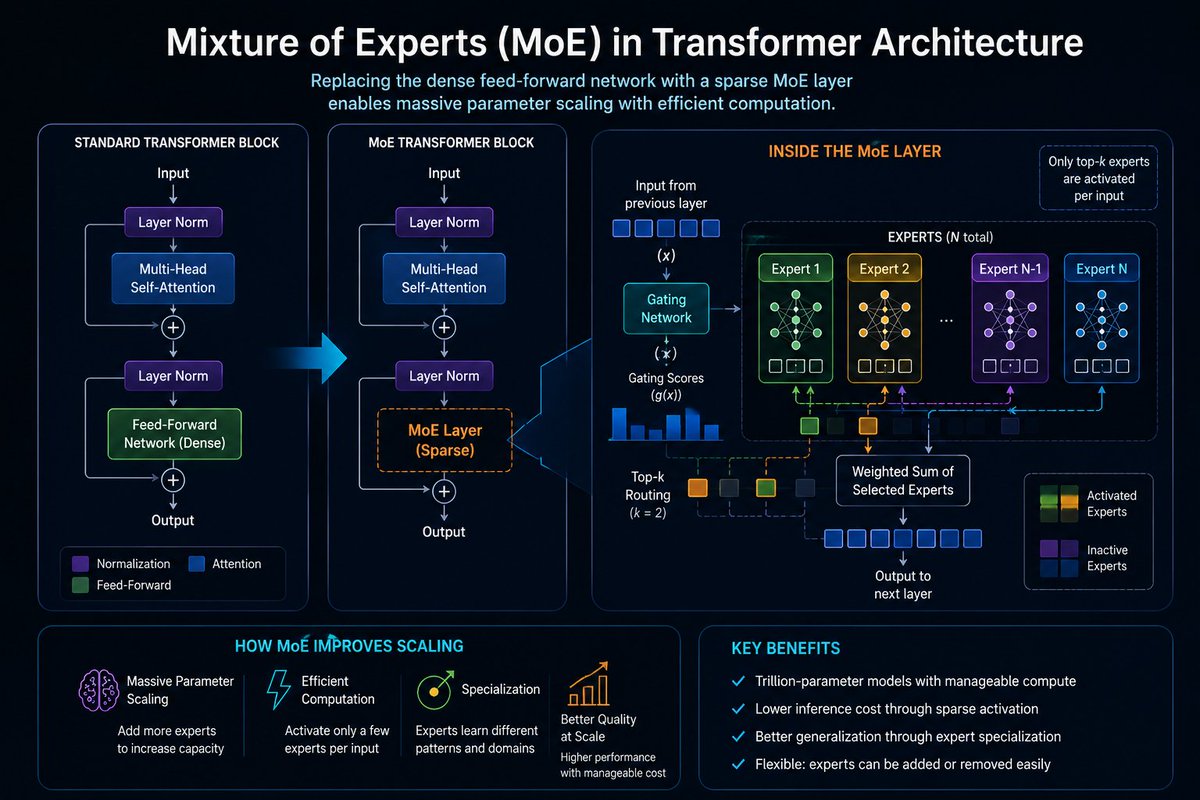
This idea allows AI systems to grow in capacity without requiring proportional increases in compute.
> The next leap in artificial intelligence will come not only from larger models but from architectures that use computation intelligently.
# Historical Background
The concept of Mixture of Experts originates from research in the early 1990s. One of the foundational works was introduced by Ronald Jacobs, Michael Jordan, Steven Nowlan, and Geoffrey Hinton in 1991.
Their goal was to divide complex problems into smaller sub-problems handled by specialized networks. Each expert would learn a different region of the input space, while a gating network would decide which expert should respond to a particular input.
This approach is closely related to the broader machine learning principle called divide and conquer, where large problems are decomposed into smaller ones.
Since then, MoE architectures have evolved significantly and are now used in modern large-scale AI systems.
# Conceptual Overview
A Mixture of Experts model consists of several independent neural networks called experts and a gating network that determines which experts should process an input.
The process works as follows:
1. An input vector is given to the gating network.
2. The gating network calculates importance scores for each expert.
3. The highest scoring experts are selected.
4. Selected experts process the input.
5. Their outputs are combined to produce the final result.
This mechanism enables conditional computation, meaning the model dynamically decides which components should be active.
Instead of one large network doing everything, the model behaves more like a team of specialists.
# Structure of Experts
Each expert is typically implemented as a feed-forward neural network layer. In transformer models, MoE layers often replace the standard feed-forward network inside each transformer block.
Experts are trained simultaneously, but over time they naturally specialize. For example:
- One expert may focus on syntax patterns
- Another may specialize in numbers
- Another may learn semantic relationships
This specialization emerges automatically during training.
Core Components of Mixture of Experts
```
| Component | Function | Explanation |
| ----------------- | --------------------------- | --------------------------------------------------- |
| Experts | Specialized neural networks | Each expert learns different patterns from the data |
| Gating Network | Decision mechanism | Selects which experts process the input |
| Sparse Routing | Efficient computation | Only a few experts are activated per input |
| Aggregation Layer | Combines results | Produces the final output from expert responses |
```
# Mathematical Formulation
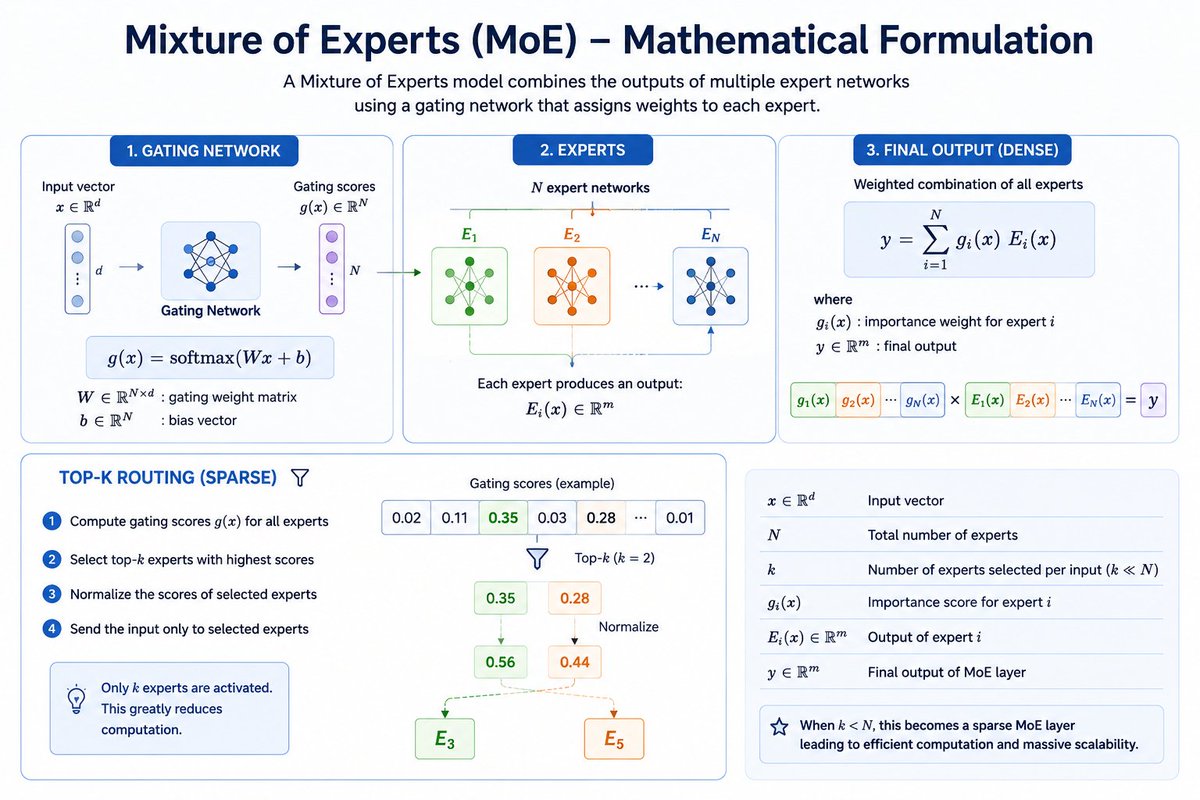
Let the input vector be:
Assume we have N experts:
Each expert produces an output vector:
The gating network calculates weights for each expert.
Where:
- W is the gating weight matrix
- b is a bias vector
The probability assigned to expert (i) is:
The final output of the Mixture of Experts model is:
However, large MoE systems typically use Top-k routing, where only the highest scoring experts are activated.
If (k = 2), only the two most relevant experts process the input.
# Sparse Routing Mechanism
Sparse routing is one of the most important innovations in MoE systems.
Consider a model with:
- 128 experts
- Only 2 experts activated per input
This means 126 experts remain inactive, which drastically reduces computation.
This property allows models to scale to extremely large parameter counts while maintaining manageable inference cost.
Sparse routing is often implemented using top-k gating.
Steps involved:
1. Compute gating scores for all experts
2. Select top-k experts
3. Normalize their scores
4. Send the input only to selected experts
# Load Balancing in MoE
One major training challenge is expert imbalance.
Without constraints, the gating network might route most inputs to only a few experts. This leads to:
- Overloaded experts
- Underutilized experts
- Poor training efficiency
To solve this, MoE models use auxiliary load balancing losses.
These losses encourage the gating network to distribute inputs more evenly across experts.
The load balancing objective often minimizes:
Where:
- Importance measures how often an expert is selected
- Load measures how many tokens are routed to the expert
This encourages balanced expert utilization.
Dense Models vs Mixture of Experts
```
| Property | Dense Neural Networks | Mixture of Experts |
| --------------- | ----------------------------- | --------------------------------- |
| Parameter Usage | All parameters used per input | Only selected experts used |
| Computation | High for large models | Reduced due to sparse activation |
| Scalability | Limited | Extremely high |
| Specialization | Shared representations | Expert specialization |
| Efficiency | Lower for large models | Higher due to conditional routing |
```
# MoE in Transformer Architectures
Modern large language models frequently integrate MoE layers into transformer architectures.
In a standard transformer block, the feed-forward network is replaced by a Mixture of Experts layer.
Typical transformer block:
```
Input
↓
Self Attention
↓
Feed Forward Network
↓
Output
```
MoE transformer block:
```
Input
↓
Self Attention
↓
Mixture of Experts Layer
↓
Output
```
This modification dramatically increases the number of parameters without significantly increasing computation.
# Advantages of Mixture of Experts
- Massive Parameter Scaling : MoE allows models to reach trillions of parameters.
- Efficient Computation : Only a small portion of the network is activated.
- Natural Specialization : Experts learn different representations.
- Flexible Architecture : Experts can be added or removed without redesigning the entire system.
# Limitations and Challenges
Despite its advantages, MoE introduces new complexities.
Communication Overhead : Experts may be distributed across multiple GPUs or machines, requiring high communication bandwidth.
Training Instability : Routing decisions can fluctuate early in training.
Memory Requirements : Although computation is reduced, total parameter storage is still large.
Implementation Complexity : MoE models require specialized frameworks for efficient routing and distributed training.
# Real World Applications
Mixture of Experts has been successfully used in many large-scale AI systems.
Applications include:
Large Language Models : MoE layers allow language models to scale to massive parameter sizes.
Machine Translation : Experts can specialize in different languages or grammatical structures.
Recommendation Systems : Different experts can specialize in user behavior patterns.
Multimodal Systems : Experts may specialize in text, images, or audio.
# Future of Mixture of Experts
Research on MoE is still evolving. Several promising directions include:
- Dynamic expert creation
- Hierarchical expert routing
- Adaptive expert pruning
- Hybrid dense sparse architectures
These developments aim to make MoE systems even more efficient and scalable.
> Intelligence at scale requires not only more knowledge but better organization of knowledge.
# Conclusion
Mixture of Experts represents one of the most important architectural ideas in modern machine learning. By dividing a large model into specialized experts and activating only the necessary components, MoE systems achieve a powerful balance between scale and efficiency.
This architecture allows models to grow to enormous sizes while keeping computation manageable. As AI systems continue to expand, Mixture of Experts is expected to play a central role in building the next generation of intelligent systems.
In the future, large AI models may resemble networks of specialized experts working together, rather than a single monolithic neural network.
## 相关链接
- [Jayanth](https://x.com/JayanthSanku01)
- [@JayanthSanku01](https://x.com/JayanthSanku01)
- [5.7K](https://x.com/JayanthSanku01/status/2052050827142131787/analytics)
- [Upgrade to Premium](https://x.com/i/premium_sign_up)
- [11:40 PM · May 6, 2026](https://x.com/JayanthSanku01/status/2052050827142131787)
- [5,721 Views](https://x.com/JayanthSanku01/status/2052050827142131787/analytics)
---
*导出时间: 2026/5/7 21:42:58*
---
## 中文翻译
# 混合专家:利用专业模型扩展人工智能
**作者**: Jayanth
**日期**: 2026-05-06T15:40:17.000Z
**来源**: [https://x.com/JayanthSanku01/status/2052050827142131787](https://x.com/JayanthSanku01/status/2052050827142131787)
---

在过去十年中,人工智能模型的规模急剧增长。早期的神经网络包含数千个参数,而现代的大型语言模型则包含数十亿甚至数万亿个参数。虽然较大的模型通常能实现更好的性能,但它们也带来了与计算成本、训练时间和能源消耗相关的重大挑战。
一种被称为混合专家的强大架构策略解决了这个问题,它允许模型大规模扩展,同时保持每个输入的计算量可控。MoE 系统不是为每个输入激活整个神经网络,而是只激活一小部分称为“专家”的专门子网络。

这种想法允许人工智能系统在不要求计算能力成比例增加的情况下提升容量。
> 人工智能的下一次飞跃不仅将来自更大的模型,还将来自能够智能利用计算的架构。
# 历史背景
混合专家的概念起源于 20 世纪 90 年代初的研究。基础性工作之一是由 Ronald Jacobs、Michael Jordan、Steven Nowlan 和 Geoffrey Hinton 在 1991 年提出的。
他们的目标是将复杂问题分解为由专门网络处理的较小的子问题。每个专家将学习输入空间的不同区域,而一个门控网络将决定哪个专家应该响应特定的输入。
这种方法与更广泛的称为“分而治之”的机器学习原则密切相关,即将大问题分解为小问题。
自那时起,MoE 架构已显著演变,并现在被用于现代大规模人工智能系统中。
# 概念概述
混合专家模型由几个称为专家的独立神经网络和一个确定哪些专家应处理输入的门控网络组成。
该过程的工作原理如下:
1. 输入向量被提供给门控网络。
2. 门控网络计算每个专家的重要性分数。
3. 选取得分最高的专家。
4. 选定的专家处理输入。
5. 它们的输出被组合以产生最终结果。
这种机制启用了条件计算,意味着模型动态决定哪些组件应该是活跃的。
模型的表现不再像一个无所不能的巨型网络,而更像是一个专家团队。
# 专家的结构
每个专家通常被实现为前馈神经网络层。在 Transformer 模型中,MoE 层通常替换每个 Transformer 块内的标准前馈网络。
专家同时接受训练,但随着时间的推移,它们会自然地形成专长。例如:
- 一个专家可能专注于句法模式
- 另一个可能专门处理数字
- 还有一个可能学习语义关系
这种专业化是在训练过程中自动涌现的。
混合专家的核心组件
```
| 组件 | 功能 | 说明 |
| ---------------- | --------------------------- | --------------------------------------------------- |
| 专家 | 专门的神经网络 | 每个专家从数据中学习不同的模式 |
| 门控网络 | 决策机制 | 选择哪些专家处理输入 |
| 稀疏路由 | 高效计算 | 每个输入只激活少量专家 |
| 聚合层 | 组合结果 | 根据专家的响应产生最终输出 |
```

# 数学公式
设输入向量为:
假设我们有 N 个专家:
每个专家产生一个输出向量:
门控网络计算每个专家的权重。
其中:
- W 是门控权重矩阵
- b 是偏置向量
分配给专家 的概率为:
混合专家模型的最终输出为:
然而,大型 MoE 系统通常使用 Top-k 路由,其中只有得分最高的专家被激活。
如果,则只有两个最相关的专家处理输入。
# 稀疏路由机制
稀疏路由是 MoE 系统最重要的创新之一。
考虑一个具有以下特征的模型:
- 128 个专家
- 每个输入仅激活 2 个专家
这意味着 126 个专家保持不活跃状态,从而大幅减少了计算量。
这一特性允许模型扩展到极大的参数数量,同时保持可控的推理成本。
稀疏路由通常使用 top-k 门控来实现。
涉及的步骤:
1. 计算所有专家的门控分数
2. 选择 top-k 个专家
3. 归一化它们的分数
4. 仅将输入发送给选定的专家
# MoE 中的负载均衡
一个主要的训练挑战是专家不平衡。
如果没有约束,门控网络可能会将大多数输入仅路由到少数几个专家。这会导致:
- 专家过载
- 专家利用不足
- 训练效率低下
为了解决这个问题,MoE 模型使用辅助负载均衡损失。
这些损失鼓励门控网络更均匀地在专家之间分配输入。
负载均衡目标通常最小化:
其中:
- 重要性衡量专家被选中的频率
- 负载衡量路由到该专家的 Token 数量
这鼓励均衡的专家利用率。
密集模型 vs 混合专家
```
| 属性 | 密集神经网络 | 混合专家 |
| --------------- | ----------------------------- | --------------------------------- |
| 参数使用情况 | 每个输入使用所有参数 | 仅使用选定的专家 |
| 计算 | 大型模型计算量较高 | 由于稀疏激活,计算量降低 |
| 可扩展性 | 受限 | 极高 |
| 专业化 | 共享表示 | 专家专业化 |
| 效率 | 对于大型模型较低 | 由于条件路由,效率较高 |
```
# Transformer 架构中的 MoE
现代大型语言模型经常将 MoE 层集成到 Transformer 架构中。
在标准的 Transformer 块中,前馈网络被混合专家层取代。
典型的 Transformer 块:
```
输入
↓
自注意力机制
↓
前馈网络
↓
输出
```
MoE Transformer 块:
```
输入
↓
自注意力机制
↓
混合专家层
↓
输出
```
这种修改在不显著增加计算量的情况下,大幅增加了参数数量。
# 混合专家的优势
- 大规模参数扩展:MoE 允许模型达到数万亿个参数。
- 高效计算:只有网络的一小部分被激活。
- 自然专业化:专家学习不同的表示。
- 灵活的架构:可以添加或删除专家,而无需重新设计整个系统。
# 局限性与挑战
尽管有其优势,MoE 也带来了新的复杂性。
通信开销:专家可能分布在多个 GPU 或机器上,需要高通信带宽。
训练不稳定性:训练早期的路由决策可能会波动。
内存需求:虽然计算量减少了,但总参数存储量仍然很大。
实现复杂性:MoE 模型需要专门的框架来实现高效的路由和分布式训练。
# 现实世界应用
混合专家已成功用于许多大规模人工智能系统。
应用包括:
大型语言模型:MoE 层允许语言模型扩展到巨大的参数规模。
机器翻译:专家可以专门研究不同的语言或语法结构。
推荐系统:不同的专家可以专门研究用户行为模式。
多模态系统:专家可以专门研究文本、图像或音频。
# 混合专家的未来
关于 MoE 的研究仍在不断演变。几个有前景的方向包括:
- 动态专家创建
- 分层专家路由
- 自适应专家剪枝
- 混合密集稀疏架构
这些发展旨在使 MoE 系统更加高效和可扩展。
> 规模化智能不仅需要更多的知识,还需要更好的知识组织。
# 结论
混合专家代表了现代机器学习中最重要的架构思想之一。通过将大型模型划分为专门的专家,并仅激活必要的组件,MoE 系统在规模和效率之间实现了强大的平衡。
这种架构允许模型增长到巨大的规模,同时保持计算的可控性。随着人工智能系统的不断扩展,混合专家有望在构建下一代智能系统中发挥核心作用。
在未来,大型人工智能模型可能类似于协同工作的专门专家网络,而不是单一的单体神经网络。
## 相关链接
- [Jayanth](https://x.com/JayanthSanku01)
- [@JayanthSanku01](https://x.com/JayanthSanku01)
- [5.7K](https://x.com/JayanthSanku01/status/2052050827142131787/analytics)
- [升级至高级版](https://x.com/i/premium_sign_up)
- [2026年5月6日 晚上11:40](https://x.com/JayanthSanku01/status/2052050827142131787)
- [5,721次观看](https://x.com/JayanthSanku01/status/2052050827142131787/analytics)
---
*导出时间: 2026/5/7 21:42:58*