# How to Vibe Code Your First Product Using Claude (Full Course)
**作者**: Khairallah AL-Awady
**日期**: 2026-05-18T09:14:06.000Z
**来源**: [https://x.com/eng_khairallah1/status/2056302296884220316](https://x.com/eng_khairallah1/status/2056302296884220316)
---
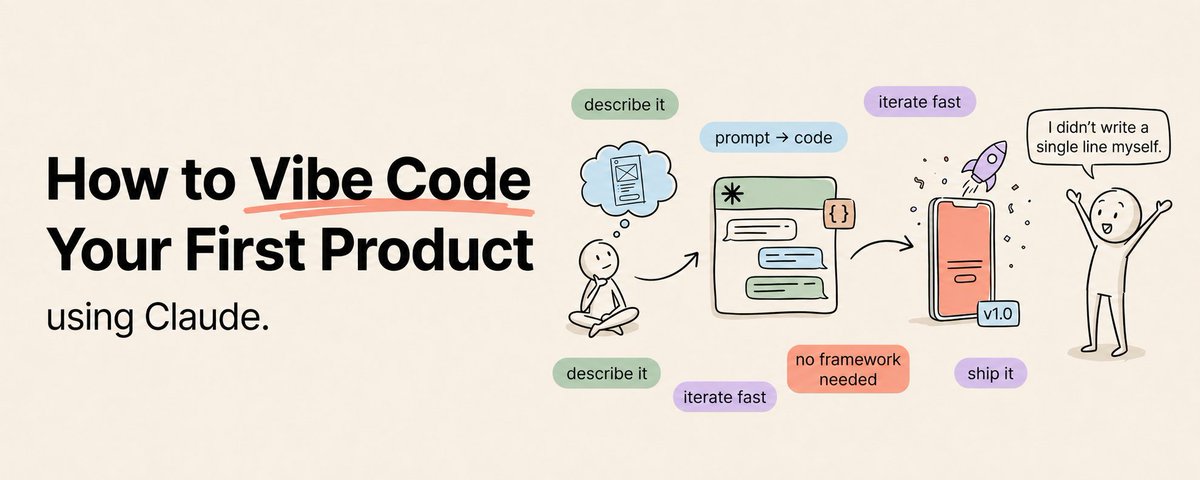
Collins Dictionary named it Word of the Year.
Save this :)
Merriam-Webster added it to the dictionary.
MIT Technology Review listed it as one of the 10 Breakthrough Technologies of 2026.
Vibe coding is not a trend anymore. It is how software is being built right now.
And the part most people miss is that you do not need to know how to code to do it. That is literally the entire point.
Andrej Karpathy, the former head of AI at Tesla, coined the term in February 2025. His definition: "There's a new kind of coding where you fully give in to the vibes, embrace exponentials, and forget that the code even exists."
Fourteen words. That tweet got 4.5 million views. And now 41% of all code written globally is AI-generated.
Here is the reality: if you can explain what you want in clear English, you can build a working app. Today. Without writing a single line of code yourself.
This article walks you through the entire process from idea to deployed app. No prior experience required.
## What Vibe Coding Actually Is
Vibe coding is describing what you want to build in plain language and letting AI write the code for you.
You do not need to understand syntax. You do not need to know what React is. You do not need to know the difference between frontend and backend. You describe the outcome. The AI handles the implementation.
Here is what that looks like in practice.
You open Claude and type: "Build me a personal finance tracker. I want to log expenses by category, see a monthly summary chart, and set budget limits that turn red when I go over. Use a clean, modern design with dark mode."
Claude writes the code. You see the result. You say what to change. Claude updates it. You repeat until it is exactly what you want.
That is vibe coding. The code exists, but you never need to see it or understand it.
## Why Claude Is the Best Tool for Vibe Coding Right Now
There are dozens of vibe coding tools in 2026. Cursor, Lovable, Bolt, Replit, v0 — all of them work.
But Claude has three advantages that matter for complete beginners.
First, you already know how to use it. If you can have a conversation, you can use Claude. There is no new interface to learn. No IDE to configure. No terminal to open. You type what you want in the chat window or Cowork tab and Claude builds it.
Second, Claude creates artifacts directly in the conversation. When you ask Claude to build something, it generates a working interactive preview right in the chat. You can see it, click on it, test it — immediately. No deployment step. No waiting. You see the result the moment Claude finishes building it.
Third, Opus 4.7 is the strongest coding model available right now. It scores 87.6% on SWE-bench, which measures real-world coding ability. It does not just write code that looks right — it writes code that actually works.
## Step 1: Start With an Idea You Actually Care About
The number one reason people fail at vibe coding is that they try to build something they do not actually want.
"Build a to-do list" is the default tutorial project. It is also the most boring thing you could possibly build. You will lose interest in ten minutes.
Instead, think about a problem you actually have.
Do you want a tool that tracks your gym workouts and shows progress over time? Build that.
Do you want a personal dashboard that shows your daily schedule, the weather, and your task list on one screen? Build that.
Do you want a tool that helps you calculate and split expenses with your roommates? Build that.
Do you want a flashcard app that helps you study for a specific exam? Build that.
The best first project is something you will actually use. That motivation is what carries you through the inevitable moment where something does not work perfectly and you need to iterate.
## Step 2: Describe Your App in Plain English
Before you open Claude, write a description of what you want. Not code. Not technical specs. Just a clear explanation of:
What the app does. "It helps me track my daily expenses and shows me where my money is going."
Who uses it. "Just me, on my phone and laptop."
What the user sees. "A screen where I can quickly add an expense with a category (food, transport, entertainment, bills). A dashboard that shows a pie chart of spending by category this month. A list view of all expenses sorted by date."
What makes it useful. "I can set a monthly budget for each category. If I am close to the limit, the category turns yellow. If I go over, it turns red."
What it looks like. "Clean and minimal. Dark mode. Modern design with rounded corners and soft shadows."
That description is your prompt. That is all Claude needs to start building.
## Step 3: Build the First Version
Open Claude. Paste your description. Add one line at the beginning:
"Build me a complete working app based on this description. Make it interactive and functional."
Claude will generate a React artifact right in the conversation. You will see a working preview of your app within seconds.
This is the moment that changes everything for most people. The first time you describe something in English and see a working app appear in front of you — that is when vibe coding clicks.
Your first version will not be perfect. It never is. That is completely normal and completely fine.
## Step 4: Iterate Until It Is Right
This is where vibe coding becomes a skill.
Look at what Claude built. What works? What does not? What is close but not quite right?
Tell Claude exactly what to change. Be specific.
Bad feedback: "Make it better." Good feedback: "The pie chart colors are too similar. Use distinctly different colors for each category. Also, the 'Add Expense' button is too small on mobile. Make it larger and pin it to the bottom of the screen."
Bad feedback: "I don't like the layout." Good feedback: "Move the dashboard chart to the top of the page. Put the recent expenses list below it. Add a header that shows my total spending this month versus my total budget."
The more specific your feedback, the faster Claude converges on exactly what you want.
Most people need three to five rounds of iteration to get from "rough first version" to "this is actually good." Some complex apps take ten rounds. The key is to keep going. Each iteration gets you closer.
## Step 5: Add the Features That Make It Yours
Once the basic app works, start adding the features that make it genuinely useful for your specific situation.
"Add a recurring expenses feature. I want to mark rent, subscriptions, and utilities as recurring so they automatically show up each month without me entering them again."
"Add an export button that lets me download my expenses as a CSV file so I can import them into a spreadsheet."
"Add a search bar so I can quickly find specific expenses by name or category."
"Add a 'split expense' feature where I can mark an expense as shared and track who owes what."
Each feature is a single prompt. Claude adds it to the existing app. You test it. You refine it. You move on.
## Step 6: Save and Share Your App
Once your app is where you want it, you have several options:
Keep it as a Claude artifact. It lives in your conversation and you can access it anytime. Good for personal tools you use occasionally.
Download the code. Claude can give you the source code as an HTML file that you can open in any browser. Good for tools you want to use offline.
Deploy it to the web. If you want other people to use your app, Claude can walk you through deploying it to a free hosting service like Vercel or Netlify. This gives your app a real URL that anyone can visit.
If you are using Claude Cowork, Claude can save the files directly to your computer. If you want a standalone app, ask Claude to package everything into a single HTML file.
## The Seven Mistakes That Kill Vibe Coding Projects
After watching hundreds of people try vibe coding for the first time, these are the patterns that lead to failure:
Mistake 1: Starting too big. Your first app should be simple enough to build in one session. A personal expense tracker. A workout logger. A recipe organizer. Not a social network. Not a marketplace. Not a project management tool with 50 features. Start small, finish something, then build bigger.
Mistake 2: Vague prompts. "Build me something cool" produces garbage. "Build me a workout tracker that lets me log exercises by muscle group, tracks my progress over time with line charts, and has a dark blue theme with white text" produces something useful. Specificity is the skill.
Mistake 3: Changing everything at once. When you give feedback, change one or two things per iteration. Not ten. If you try to change the layout, the colors, the features, and the data structure all in one prompt, Claude will get confused and you will get frustrated.
Mistake 4: Not testing in the moment. Every time Claude updates your app, actually click through it. Test every button. Try edge cases. Enter weird data. Find the problems now, not after you have added five more features on top.
Mistake 5: Giving up after the first error. Something will break. A button will not work. A chart will display the wrong data. This is normal. Tell Claude what is broken and it will fix it. The difference between people who ship apps and people who quit is persistence through the first few bugs.
Mistake 6: Not describing the visual design. If you do not tell Claude what you want the app to look like, it will use defaults. And defaults look generic. Spend one sentence on colors, one on layout, one on typography. "Modern dark theme, rounded corners, blue accent color, clean sans-serif font" transforms the output.
Mistake 7: Trying to understand the code. This is counterintuitive but important for beginners. You do not need to read the code. You do not need to understand it. You need to evaluate the result. Does the app do what you want? Does it look right? Does it work? That is all that matters. The code is Claude's problem, not yours.
## What You Can Build Right Now
Here are ten app ideas ranked from easiest to hardest, all buildable with Claude by a complete beginner:
1. A personal journal with daily entries and a mood tracker
2. A recipe organizer that saves and searches your favorite recipes
3. A habit tracker with streaks and daily check-ins
4. A personal finance dashboard with expense logging and charts
5. A flashcard study app with spaced repetition
6. A workout logger that tracks exercises, sets, and progress over time
7. A bookmark manager that saves links by category with notes
8. A portfolio website showcasing your work with a clean, professional design
9. An invoice generator that creates formatted PDF invoices
10. A simple CRM that tracks contacts, notes, and follow-up dates
Start with number 1 or 2. Get a feel for the process. Then work your way up.
## The Bigger Picture
Vibe coding is not a fad. It is the future of how most software gets built.
Microsoft reports that AI writes roughly 30% of its code. Google says more than a quarter. Shopify is targeting 90% autonomous coding by Q3 2026. Mercado Libre's 23,000 engineers are already using Claude Code as a core part of their workflow.
The question is not whether AI will build your software. It already does.
The question is whether you know how to direct it.
That skill — explaining clearly what you want and iterating until you get it — is the most valuable skill in tech right now. And you do not need a computer science degree to learn it. You need a clear idea and the patience to iterate.
The people who learn to vibe code now, while it is still early and most people are still skeptical, are the ones who will have a massive advantage as this becomes the default way all software is built.
Most people will read this and think "I should try that sometime." The ones who open Claude right now and describe their first app will have a working product by tonight.
Follow me @eng_khairallah1 for more AI courses and breakdowns. I post content like this every week.
hope this was useful for you, Khairallah ❤️
## 相关链接
- [Khairallah AL-Awady reposted](https://x.com/eng_khairallah1)
- [Khairallah AL-Awady](https://x.com/eng_khairallah1)
- [@eng_khairallah1](https://x.com/eng_khairallah1)
- [12K](https://x.com/eng_khairallah1/status/2056302296884220316/analytics)
- [@eng_khairallah1](https://x.com/@eng_khairallah1)
- [Upgrade to Premium](https://x.com/i/premium_sign_up)
- [5:14 PM · May 18, 2026](https://x.com/eng_khairallah1/status/2056302296884220316)
- [12.6K Views](https://x.com/eng_khairallah1/status/2056302296884220316/analytics)
- [View quotes](https://x.com/eng_khairallah1/status/2056302296884220316/quotes)
---
*导出时间: 2026/5/18 20:26:33*
---
## 中文翻译
# 如何使用 Claude 通过“氛围编程”构建你的第一个产品(完整教程)
**作者**: Khairallah AL-Awady
**日期**: 2026-05-18T09:14:06.000Z
**来源**: [https://x.com/eng_khairallah1/status/2056302296884220316](https://x.com/eng_khairallah1/status/2056302296884220316)
---

柯林斯词典将其命名为年度词汇。
收藏这篇文章 :)
韦氏词典将其收录其中。
《麻省理工科技评论》将其列为 2026 年十大突破性技术之一。
氛围编程(Vibe coding)不再是一种潮流。它是当下软件构建的方式。
大多数人忽略的一点是:你不需要懂得如何编写代码就能做到。这实际上就是它的全部意义。
前特斯拉人工智能负责人安德烈·卡帕西(Andrej Karpathy)于 2025 年 2 月创造了这个词。他的定义是:“这是一种全新的编程方式,你完全沉浸在氛围中,拥抱指数级变化,甚至忘记代码的存在。”
十四个单词。那条推文获得了 450 万次浏览。而现在,全球编写的代码中有 41% 是由 AI 生成的。
现实就是:只要你能用清晰的英语解释你想要什么,你就能构建一个可运行的应用程序。就在今天。不需要你自己写一行代码。
本文将带你走完从构思到部署应用的整个过程。无需任何经验。
## 什么是真正的氛围编程
氛围编程就是用通俗的语言描述你想要构建的东西,然后让 AI 为你编写代码。
你不需要理解语法。你不需要知道 React 是什么。你不需要知道前端和后端的区别。你描述结果。AI 负责实现。
以下是实际操作中的样貌。
你打开 Claude 并输入:“给我构建一个个人理财追踪器。我想按类别记录开支,查看月度汇总图表,并设置预算限制,超支时会变红。使用简洁、现代的设计,并带有深色模式。”
Claude 编写代码。你看到结果。你说出需要更改的地方。Claude 进行更新。重复此过程,直到完全符合你的要求。
这就是氛围编程。代码是存在的,但你永远不需要看到或理解它。
## 为什么 Claude 是目前进行氛围编程的最佳工具
到 2026 年,已有数十种氛围编程工具。Cursor、Lovable、Bolt、Replit、v0 —— 它们都不错。
但对于完全的初学者来说,Claude 拥有三个至关重要的优势。
首先,你已经知道如何使用它。如果你能进行对话,你就能使用 Claude。没有新界面需要学习。不需要配置 IDE。不需要打开终端。你只需在聊天窗口或 Cowork 标签页中输入你想要的内容,Claude 就会构建它。
其次,Claude 直接在对话中创建工件(Artifacts)。当你让 Claude 构建某样东西时,它会在聊天中生成一个可工作的交互式预览。你可以立即看到它、点击它、测试它。无需部署步骤。无需等待。在 Claude 完成构建的那一刻,你就能看到结果。
第三,Opus 4.7 是目前可用的最强大的代码模型。它在 SWE-bench(衡量实际编码能力的基准测试)上得分 87.6%。它不仅仅编写看起来正确的代码 —— 它编写的是真正能运行的代码。
## 第一步:从你真正关心的想法开始
人们在氛围编程中失败的首要原因是,他们试图构建自己并不真正想要的东西。
“建立一个待办事项列表”是默认的教程项目。这也是你能想象到的最无聊的事情。你会在十分钟后失去兴趣。
相反,思考一个你实际面临的问题。
你想要一个能跟踪你健身房锻炼并随时间显示进度的工具吗?那就构建它。
你想要一个能在一个屏幕上显示你的日程安排、天气和任务列表的个人仪表板吗?那就构建它。
你想要一个能帮你计算并与室友分摊费用的工具吗?那就构建它。
你想要一个能帮你备考特定考试的抽认卡应用吗?那就构建它。
最好的第一个项目是你真正会使用的东西。这种动力能支撑你度过不可避免的时刻 —— 即当某样东西不能完美运行而你需要进行迭代的时候。
## 第二步:用通俗英语描述你的应用
在你打开 Claude 之前,写下你想要的内容的描述。不是代码。不是技术规格。只是一个清晰的解释:
应用是做什么的。“它帮助我追踪日常开支,并告诉我钱花在哪里了。”
谁使用它。“只有我,在我的手机和笔记本电脑上。”
用户看到什么。“一个屏幕,我可以快速添加带有类别(食物、交通、娱乐、账单)的开支。一个仪表板,以饼图显示本月的各类开支。一个按日期排序的所有开支列表视图。”
它有什么用。“我可以为每个类别设置每月预算。如果我接近限额,该类别会变黄。如果超支,它会变红。”
它看起来像什么。“简洁且极简。深色模式。现代设计,带有圆角和柔和的阴影。”
这个描述就是你的提示词。这就是 Claude 开始构建所需的全部内容。
## 第三步:构建第一个版本
打开 Claude。粘贴你的描述。在开头添加一行:
“基于此描述构建一个完整的工作应用。使其具有交互性和功能性。”
Claude 将直接在对话中生成一个 React 工件。你将在几秒钟内看到你应用的工作预览。
这是改变大多数人看法的时刻。当你第一次用英语描述某样东西,并看到一个可运行的应用出现在你面前时 —— 你就会领悟到氛围编程的精髓。
你的第一个版本不会完美无缺。从来都不会。这完全正常,也完全没问题。
## 第四步:迭代直到完美
这就是氛围编程成为一种技能的地方。
看看 Claude 构建了什么。什么有效?什么无效?什么接近了但又不太对?
准确告诉 Claude 需要更改什么。要具体。
糟糕的反馈:“让它更好。” 好的反馈:“饼图的颜色太相似了。每个类别使用明显不同的颜色。另外,‘添加开支’按钮在手机上太小了。把它做大一点,并固定在屏幕底部。”
糟糕的反馈:“我不喜欢这个布局。” 好的反馈:“将仪表板图表移到页面顶部。将最近的开支列表放在它下面。添加一个显示我本月总支出与总预算对比的标题。”
你的反馈越具体,Claude 收敛到你想要的结果的速度就越快。
大多数人需要三到五轮迭代才能从“粗糙的初版”变成“这确实很好”。一些复杂的应用需要十轮。关键是继续下去。每一次迭代都会让你更接近目标。
## 第五步:添加属于你的功能
一旦基本应用能运行,就开始添加那些对你特定情况真正有用的功能。
“添加一个定期开支功能。我想将房租、订阅和公用事业标记为定期,这样它们每个月都会自动显示,而无需我再次输入。”
“添加一个导出按钮,让我可以将开支下载为 CSV 文件,以便导入到电子表格中。”
“添加一个搜索栏,这样我可以按名称或类别快速查找特定开支。”
“添加一个‘分摊开支’功能,我可以将一笔开支标记为共享,并跟踪谁欠什么。”
每个功能只需要一个提示词。Claude 将其添加到现有应用中。你测试它。你完善它。你继续进行下一步。
## 第六步:保存并分享你的应用
一旦你的应用达到了你想要的状态,你有几个选择:
将其保留为 Claude 工件。它存在于你的对话中,你可以随时访问它。适合你偶尔使用的个人工具。
下载代码。Claude 可以为你提供源代码,作为一个 HTML 文件,你可以在任何浏览器中打开。适合你想离线使用的工具。
将其部署到网络。如果你希望其他人使用你的应用,Claude 可以指导你将其部署到免费的托管服务,如 Vercel 或 Netlify。这将为你的应用提供一个任何人都可以访问的真实 URL。
如果你使用的是 Claude Cowork,Claude 可以直接将文件保存到你的计算机。如果你想要一个独立的应用,请让 Claude 将所有内容打包成一个单独的 HTML 文件。
## 毁掉氛围编程项目的七个错误
在观察数百人第一次尝试氛围编程后,以下是导致失败的模式:
错误 1:起步太大。你的第一个应用应该足够简单,以便在一个会话中完成构建。一个个人开支追踪器。一个锻炼日志记录器。一个食谱整理器。而不是社交网络。不是市场平台。不是拥有 50 个功能的项目管理工具。从小处开始,完成某件事,然后再做大的。
错误 2:模糊的提示词。“给我构建一些很酷的东西”只能产生垃圾。“给我构建一个锻炼追踪器,让我可以按肌肉群记录练习,用折线图跟踪我随时间的进步,并带有深蓝色主题和白色文字”才能产生有用的东西。具体性是一种技能。
错误 3:一次更改所有内容。当你提供反馈时,每次迭代只更改一两件事。而不是十件。如果你试图在一个提示词中更改布局、颜色、功能和数据结构,Claude 会感到困惑,你会感到沮丧。
错误 4:不立即测试。每次 Claude 更新你的应用时,实际点击它。测试每个按钮。尝试边缘情况。输入奇怪的数据。现在就发现问题,而不是在添加了另外五个功能之后。
错误 5:第一次出错后就放弃。总会出问题。按钮会失灵。图表会显示错误的数据。这很正常。告诉 Claude 哪里坏了,它会修复它。能发布应用的人和放弃的人之间的区别在于对最初几个漏洞的坚持。
错误 6:不描述视觉设计。如果你不告诉 Claude 你希望应用看起来像什么,它将使用默认值。而默认值看起来很普通。花一句话描述颜色,一句话描述布局,一句话描述字体排版。“现代深色主题、圆角、蓝色强调色、简洁的无衬线字体”可以彻底改变输出效果。
错误 7:试图理解代码。这对初学者来说可能违反直觉,但很重要。你不需要阅读代码。你不需要理解它。你需要评估结果。应用做了你想要的事吗?它看起来对吗?它能工作吗?这就是重要的全部。代码是 Claude 的问题,不是你的。
## 你现在就可以构建什么
这里有十个按从易到难排序的应用构想,所有这些都完全适合初学者使用 Claude 构建:
1. 带有每日条目和心情追踪器的个人日记
2. 可以保存和搜索你最爱食谱的食谱整理器
3. 带有连续打卡记录和每日签到的习惯追踪器
4. 带有开支记录和图表的个人理财仪表板
5. 带有间隔重复算法的抽认卡学习应用
6. 跟踪练习、组数和随时间进度的锻炼日志记录器
7. 带有注释和分类的书签管理器
8. 以简洁、专业设计展示你作品的作品集网站
9. 创建格式化 PDF 发票的发票生成器
10. 跟踪联系人、笔记和后续跟进日期的简单 CRM(客户关系管理)系统
从第 1 个或第 2 个开始。找找感觉。然后逐步向上。
## 更大的图景
氛围编程不是一时的狂热。它是大多数软件构建方式的未来。
微软报告称,AI 编写了其约 30% 的代码。谷歌表示超过四分之一。Shopify 的目标是到 2026 年第三季度实现 90% 的自主编程。Mercado Libre 的 23,000 名工程师已经将 Claude Code 作为其工作流程的核心部分。
问题不在于 AI 是否会构建你的软件。它已经在构建了。
问题在于你是否知道如何指挥它。
这种技能 —— 清楚地解释你想要什么并迭代直到得到它 —— 是目前科技界最有价值的技能。你不需要计算机科学学位就能学会它。你需要一个清晰的想法和迭代的耐心。
那些现在就学会氛围编程的人,趁这还处于早期、大多数人仍持怀疑态度的时候,就是当这成为所有软件构建的默认方式时将拥有巨大优势的人。
大多数人读了这篇文章会想“我应该在某个时候尝试一下”。那些现在就打开 Claude 并描述他们的第一个应用的人,今晚就会拥有一个可运行的产品。
关注我 @eng_khairallah1 获取更多 AI 课程和解析。我每周都会发布这样的内容。
希望这对你有用,Khairallah ❤️
## 相关链接
- [Khairallah AL-Awady reposted](https://x.com/eng_khairallah1)
- [Khairallah AL-Awady](https://x.com/eng_khairallah1)
- [@eng_khairallah1](https://x.com/eng_khairallah1)
- [12K](https://x.com/eng_khairallah1/status/2056302296884220316/analytics)
- [@eng_khairallah1](https://x.com/@eng_khairallah1)
- [Upgrade to Premium](https://x.com/i/premium_sign_up)
- [5:14 PM · May 18, 2026](https://x.com/eng_khairallah1/status/2056302296884220316)
- [12.6K Views](https://x.com/eng_khairallah1/status/2056302296884220316/analytics)
- [View quotes](https://x.com/eng_khairallah1/status/2056302296884220316/quotes)
---
*导出时间: 2026/5/18 20:26:33*