# How to Build & Sell Claude Plugins That Generate Passive Income (Full Course)
**作者**: Khairallah AL-Awady
**日期**: 2026-04-20T09:22:00.000Z
**来源**: [https://x.com/eng_khairallah1/status/2046157423774400746](https://x.com/eng_khairallah1/status/2046157423774400746)
---
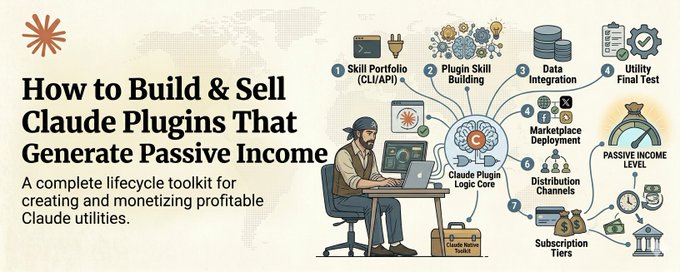
## The Opportunity
There is a marketplace with millions of users and almost no competition.
Save this :)
The Claude plugin ecosystem launched in early 2026. There are already 15+ verified plugins available at claude.com/plugins. Millions of Claude users are looking for ways to get more from the tool they already use daily.
And the number of people actually building plugins? Almost nobody.
That supply-demand imbalance is the definition of an opportunity.
A Claude plugin is a pre-built bundle of capabilities for a specific role or workflow. Product managers, marketers, finance professionals, recruiters, legal teams - each one can have a dedicated plugin that transforms Claude from a general assistant into a specialized tool for their exact job.
You build it once. You sell it to everyone who needs it. That is passive income in the truest sense.
This course shows you how to design, build, test, and sell Claude plugins. From idea to revenue.
## What a Plugin Actually Is
A Claude plugin is a package that combines Claude Skills, slash commands, reference files, and workflow templates into a single installable bundle designed for a specific role.
Think of it like a professional toolkit. A marketing plugin might include:
* A /content-brief command that generates a comprehensive content brief from a topic and audience description.
* A /seo-audit command that analyzes a URL and produces an SEO report.
* A /repurpose command that takes one piece of content and produces five platform-specific versions.
* A /competitor-scan command that researches a competitor's content strategy.
Each command triggers a specific Skill with pre-configured instructions, output formats, and quality standards. The user types the command, provides their input, and gets polished, reliable output every time.
The user does not need to write any prompts. They just use the commands. The prompting expertise is built into the plugin. That is the value proposition - your prompt engineering skill, packaged and sold as a product.
## Step 1: Choose Your Niche (Week 1)
The best plugins solve specific problems for specific roles. Do not build a "general productivity" plugin. Build a plugin for product managers, or recruiters, or real estate agents, or e-commerce sellers.
How to choose:
Pick a role you understand deeply - ideally one you have worked in yourself or closely with. The insider knowledge of what that role actually struggles with daily is your competitive advantage.
Then identify the 5 to 8 tasks that role does repeatedly:
* For product managers: writing PRDs, competitive analysis, feature prioritization, user story creation, launch planning, stakeholder updates, metrics dashboards, roadmap communication.
* For recruiters: writing job descriptions, screening resumes, generating interview questions, drafting candidate outreach, writing rejection emails, creating offer letters, analyzing hiring pipelines.
* For content marketers: research briefs, content calendars, first drafts, SEO optimization, repurposing, performance analysis, competitive content tracking, email campaigns.
Each of these tasks becomes a slash command in your plugin. Five to eight commands is the sweet spot - enough to justify the purchase, not so many that the plugin feels overwhelming.
## Step 2: Design the Commands (Week 1 to 2)
For each command, define:
* **The trigger:** What the user types. /content-brief, /screen-resume, /write-prd. Short, memorable, descriptive.
* **The inputs:** What information the user provides. A topic, a URL, a candidate resume, project requirements. Minimize what you ask for - the less the user has to input, the more they will use the command.
* **The output:** What the command produces. A formatted brief, a scored evaluation, a complete document. Define the exact format, structure, length, and quality standards.
* **The workflow:** The step-by-step process the Skill follows to transform input into output. This is where your expertise lives - the methodology that makes the output genuinely valuable, not just generic AI text.
Design all commands on paper before building any of them. Map out how they connect - does the output of one command feed into another? Can commands be chained together for a complete workflow?
For example, a marketing plugin workflow: /research [topic] → /content-brief (using research output) → /first-draft (using brief) → /seo-check (using draft) → /repurpose (using final article). The user flows through their entire content process using your commands.
## Step 3: Build the Skills (Weeks 2 to 3)
Each command is powered by a Claude Skill - a SKILL.md file with YAML triggers, step-by-step instructions, output format specifications, and examples.
Building each Skill:
* Write the YAML trigger header with a pushy description that lists specific trigger phrases.
* Write the workflow as numbered, imperative steps.
* Define the output format explicitly - structure, length, tone, formatting.
* Include at least two examples - one normal case, one edge case.
* Add negative constraints - what the output should never include.
Test each Skill individually with 10 different inputs. Refine until the output is consistently excellent. Not "good enough." Excellent. Users are paying for this. The quality bar must be higher than anything they could produce by prompting Claude themselves.
The quality standard: If a user could achieve the same result by spending 5 minutes writing their own prompt, your Skill is not valuable enough. Your Skill should produce output that would take them 20 to 30 minutes of careful prompting to achieve on their own.
## Step 4: Package as a Plugin (Week 3)
Organize your Skills into a plugin folder structure:
The README is critical. It must clearly explain what the plugin does, who it is for, what each command does, and how to get started. Most users decide whether a plugin is worth keeping within the first five minutes. A clear README ensures those five minutes are productive.
## Step 5: Test With Real Users (Week 4)
Give your plugin to five to ten people who actually work in your target role. Not friends who will be nice. Real professionals who will judge the output against their actual work standards.
Watch them use it. Note where they get confused. Note which commands they use most. Note which outputs they edit heavily (indicating the Skill needs improvement) and which they use as-is (indicating the Skill nails it).
The feedback from real users will reveal issues you never anticipated. Maybe the resume screener does not handle non-traditional career paths well. Maybe the content brief is too long for their workflow. Maybe they need a command you did not include.
Fix everything. Then test again with five new users. Repeat until the feedback is consistently positive.
## Step 6: Launch and Sell (Week 5 and Beyond)
### Pricing your plugin:
* **One-time purchase:** $49 to $149 for the complete plugin. This is the simplest model. Users pay once and get all commands.
* **Subscription:** $9 to $29 per month for the plugin plus ongoing updates, new commands, and refinement based on user feedback. This generates recurring revenue but requires ongoing work.
* **Freemium:** Two to three commands free, full suite requires payment. This lets users experience the quality before committing. Conversion rates are typically higher because the free commands build trust.
### Where to sell:
* **The Claude plugin marketplace** at claude.com/plugins. This is the primary distribution channel - millions of Claude users browsing for plugins.
* **Your own website.** Build a simple landing page that demonstrates each command with before-and-after examples. Drive traffic through content marketing in your niche.
* **Niche communities.** Post in communities where your target role spends time. Not a sales pitch - a demonstration. Show the plugin in action. Let the quality make the sale.
### Launch content:
* Write a thread or article that demonstrates the plugin solving a real problem for your target role. Show the input, the command, and the output. Make the value instantly visible.
* Record a short video walking through each command. People want to see the plugin in action before buying.
* Create a free sample - let people try two to three commands before purchasing. The quality of the free commands sells the paid ones.
## Scaling: From One Plugin to a Portfolio
Your first plugin establishes the model. Your second and third multiply the revenue.
* **Build plugins for adjacent roles.** If your first plugin is for product managers, your second might be for engineering managers, your third for UX researchers. These roles often work together and will cross-recommend plugins.
* **Build plugins for adjacent workflows.** If your first plugin handles content creation, your second might handle content distribution, and your third might handle content analytics. The same user buys all three.
* **Collect feedback religiously.** Every piece of user feedback is a potential improvement. Update your plugins monthly. Users who see regular improvements become loyal customers and recommenders.
* **Build in public.** Share your plugin development process on X and LinkedIn. Show what you are building, what user feedback you received, and how you are improving. This builds an audience that converts directly into customers.
## The Revenue Math
Let me run realistic numbers.
A plugin priced at $79 one-time purchase. You sell 20 copies in month one through launch marketing. 30 copies in month two through word of mouth and content marketing. 40 copies per month from month three onward as reviews and recommendations compound.
* Month 1: $1,580.
* Month 2: $2,370.
* Month 3 onward: $3,160+ per month.
By month six, one plugin generates $15,000 to $20,000 in cumulative revenue.
Build three plugins over six months. Each one generates $3,000 per month. Total: $9,000 per month in largely passive income from products you built once and update monthly.
These numbers are conservative. Top plugins in established ecosystems (Notion, Obsidian, WordPress) sell thousands of copies. The Claude ecosystem is earlier and growing faster.
The key variable is quality. The plugins that sell are the ones that produce genuinely excellent output. The ones that do not sell are the ones that produce mediocre output users could achieve with their own prompting. Invest heavily in quality.
## The Bottom Line
The Claude plugin marketplace is a new ecosystem with massive user demand and minimal competition.
You design commands for a specific role. You build Skills that produce expert-level output. You package them into a plugin. You sell to the millions of Claude users who want to get more from the tool they already pay for.
Build once. Sell repeatedly. Update monthly. Let revenue compound.
The window for establishing yourself in a new marketplace does not stay open forever. The people who build the best plugins now will have the reviews, the reputation, and the market position that late entrants cannot replicate.
Start with one plugin. One niche. Five commands.
That is all it takes to build a product that earns while you sleep.
Follow me @eng_khairallah1 for more product strategies, plugin building guides, and AI monetization playbooks.
hope this was useful for you, Khairallah ❤️
## 相关链接
- [Khairallah AL-Awady](https://x.com/eng_khairallah1)
- [@eng_khairallah1](https://x.com/eng_khairallah1)
- [308](https://x.com/eng_khairallah1/status/2046157423774400746/analytics)
- [claude.com/plugins](http://claude.com/plugins)
- [SKILL.md](http://skill.md/)
- [claude.com/plugins](http://claude.com/plugins)
- [@eng_khairallah1](https://x.com/@eng_khairallah1)
- [Upgrade to Premium](https://x.com/i/premium_sign_up)
- [5:22 PM · Apr 20, 2026](https://x.com/eng_khairallah1/status/2046157423774400746)
- [308 Views](https://x.com/eng_khairallah1/status/2046157423774400746/analytics)
---
*导出时间: 2026/4/20 17:42:42*
---
## 中文翻译
# 如何构建并销售能产生被动收入的 Claude 插件(完整教程)
**作者**: Khairallah AL-Awady
**日期**: 2026-04-20T09:22:00.000Z
**来源**: [https://x.com/eng_khairallah1/status/2046157423774400746](https://x.com/eng_khairallah1/status/2046157423774400746)
---

## 市场机遇
有一个拥有数百万用户且几乎没有任何竞争的市场。
收藏这篇文章吧 :)
Claude 插件生态系统于 2026 年初推出。目前,claude.com/plugins 上已经有 15 多个经过验证的插件。数百万 Claude 用户正在寻找方法,以从他们日常使用的工具中获得更多价值。
而真正在构建插件的人呢?几乎没有。
这种供需失衡就是机会的代名词。
Claude 插件是一个针对特定角色或工作流程的预构建功能包。产品经理、营销人员、财务专业人士、招聘人员、法律团队——每个人都可以拥有一个专用插件,将 Claude 从通用助手转变为适合其特定工作的专业工具。
你只需构建一次,然后将其卖给每个需要它的人。这就是最纯粹意义上的被动收入。
本课程将向你展示如何设计、构建、测试和销售 Claude 插件。从创意到营收。
## 插件到底是什么
Claude 插件是一个软件包,它将 Claude 技能、斜杠命令、参考文件和工作流模板组合到一个可安装的包中,专门针对特定角色设计。
可以把它想象成一个专业工具箱。一个营销插件可能包括:
* 一个 `/content-brief` 命令,它根据主题和受众描述生成综合的内容简报。
* 一个 `/seo-audit` 命令,它分析 URL 并生成 SEO 报告。
* 一个 `/repurpose` 命令,它获取一段内容并生成五个针对特定平台的版本。
* 一个 `/competitor-scan` 命令,它研究竞争对手的内容策略。
每个命令都会触发一个具有预配置指令、输出格式和质量标准的特定技能。用户输入命令,提供他们的输入,每次都能获得经过润色、可靠的输出。
用户不需要编写任何提示词。他们只需使用命令。提示词专业知识内置在插件中。这就是价值主张——你的提示词工程技能被打包并作为产品出售。
## 第 1 步:选择你的细分领域(第 1 周)
最好的插件为特定角色解决特定问题。不要构建“通用生产力”插件。为产品经理、招聘人员、房地产经纪人或电商卖家构建插件。
如何选择:
选择一个你深刻理解的角色——理想情况下是你自己工作过或密切合作过的角色。对这种角色日常真正困扰之处的内部了解是你的竞争优势。
然后确定该角色重复执行的 5 到 8 项任务:
* 对于产品经理:撰写 PRD、竞品分析、功能优先级排序、用户故事创建、发布规划、利益相关者更新、指标仪表板、路线图沟通。
* 对于招聘人员:撰写职位描述、筛选简历、生成面试问题、起草候选人外联邮件、撰写拒信、创建录用通知书、分析招聘管道。
* 对于内容营销人员:研究简报、内容日历、初稿、SEO 优化、内容再利用、绩效分析、竞品内容跟踪、电子邮件营销活动。
这些任务中的每一项都会成为插件中的一个斜杠命令。5 到 8 个命令是最佳平衡点——足以证明购买物有所值,又不至于多到让插件显得庞杂。
## 第 2 步:设计命令(第 1 至 2 周)
对于每个命令,定义:
* **触发器:** 用户输入的内容。`/content-brief`、`/screen-resume`、`/write-prd`。简短、易记、描述性强。
* **输入:** 用户提供的信息。主题、URL、候选人简历、项目需求。尽量减少你的要求——用户需要输入的内容越少,他们就越会使用该命令。
* **输出:** 命令生成的内容。格式化的简报、评分评估、完整文档。定义确切的格式、结构、长度和质量标准。
* **工作流:** 技能将输入转换为输出所遵循的逐步过程。这是你专业知识所在——使输出真正有价值的方法论,而不仅仅是通用的 AI 文本。
在构建任何命令之前,先在纸上设计所有命令。规划它们的连接方式——一个命令的输出会馈送到另一个命令吗?命令能否链接在一起以形成一个完整的工作流?
例如,营销插件工作流:`/research [topic]` → `/content-brief`(使用研究输出)→ `/first-draft`(使用简报)→ `/seo-check`(使用草稿)→ `/repurpose`(使用最终文章)。用户使用你的命令完成整个内容流程。
## 第 3 步:构建技能(第 2 至 3 周)
每个命令都由一个 Claude 技能驱动——一个包含 YAML 触发器、逐步指令、输出格式规范和示例的 SKILL.md 文件。
构建每个技能:
* 编写带有强制性描述的 YAML 触发器头部,其中列出特定的触发短语。
* 将工作流编写为编号的、祈使句步骤。
* 明确定义输出格式——结构、长度、语气、格式。
* 至少包含两个示例——一个正常情况,一个边缘情况。
* 添加负面约束——输出绝不应包含的内容。
使用 10 个不同的输入单独测试每个技能。进行优化,直到输出始终出色。不是“足够好”,而是“出色”。用户为此付费。质量标准必须高于他们通过自己提示 Claude 所能达到的任何水平。
质量标准:如果用户可以通过花 5 分钟编写自己的提示词来获得相同的结果,那么你的技能就不够有价值。你的技能应该能产生他们自己需要 20 到 30 分钟的仔细提示才能达到的输出。
## 第 4 步:打包为插件(第 3 周)
将你的技能组织到插件文件夹结构中:
README 至关重要。它必须清楚地解释插件的作用、适用对象、每个命令的功能以及如何开始使用。大多数用户会在前五分钟内决定插件是否值得保留。清晰的 README 能确保这五分钟富有成效。
## 第 5 步:与真实用户测试(第 4 周)
将你的插件发给 5 到 10 个真正在你目标角色中工作的人。不是那些会客气的朋友。而是那些会根据实际工作标准来判断输出的真正的专业人士。
观察他们使用插件的过程。注意他们感到困惑的地方。注意他们最常使用哪些命令。注意他们大量编辑哪些输出(表明技能需要改进),以及他们直接使用哪些输出(表明技能很完美)。
来自真实用户的反馈将揭示你从未预料到的问题。也许简历筛选器不能很好地处理非传统的职业道路。也许内容简报对于他们的工作流程来说太长了。也许他们需要一个你没有包含的命令。
修复所有问题。然后与 5 个新用户再次测试。重复此过程,直到反馈始终积极。
## 第 6 步:启动和销售(第 5 周及以后)
### 插件定价
* **一次性购买:** 完整插件价格为 49 到 149 美元。这是最简单的模式。用户支付一次即可获得所有命令。
* **订阅:** 每月 9 到 29 美元,包含插件以及基于用户反馈的持续更新、新命令和改进。这会产生经常性收入,但需要持续的工作。
* **免费增值:** 2 到 3 个命令免费,完整套件需要付费。这让用户在承诺之前体验质量。转化率通常更高,因为免费命令建立了信任。
### 销售渠道
* **Claude 插件市场** claude.com/plugins。这是主要分销渠道——数百万 Claude 用户在那里浏览插件。
* **你自己的网站。** 建立一个简单的落地页,通过前后对比示例展示每个命令。通过你细分领域内的内容营销引流。
* **细分社区。** 在你的目标角色所在的社区发帖。不是推销——而是演示。展示插件的实际运行情况。让质量自己推销产品。
### 发布内容
* 写一个推文或文章,演示插件为你的目标角色解决实际问题。展示输入、命令和输出。让价值立即可见。
* 录制一个简短的视频,演示每个命令。人们想在购买前看到插件的实际运行情况。
* 创建一个免费样品——让人们在购买前尝试 2 到 3 个命令。免费命令的质量会推销付费命令。
## 规模化:从一个插件到产品组合
你的第一个插件确立了模式。你的第二和第三个插件将成倍增加收入。
* **为相邻角色构建插件。** 如果你的第一个插件是针对产品经理的,你的第二个可能是针对工程经理的,第三个是针对 UX 研究人员的。这些角色经常一起工作,并且会交叉推荐插件。
* **为相邻工作流构建插件。** 如果你的第一个插件处理内容创建,你的第二个可能处理内容分发,第三个可能处理内容分析。同一个用户会购买全部三个。
* **虔诚地收集反馈。** 每一条用户反馈都是潜在的改进点。每月更新你的插件。看到定期改进的用户会成为忠诚客户和推荐者。
* **公开构建。** 在 X 和 LinkedIn 上分享你的插件开发过程。展示你正在构建什么、收到了什么用户反馈以及你正在如何改进。这会建立受众,并直接转化为客户。
## 收入数学
让我算一笔现实的账。
一个一次性购买价格为 79 美元的插件。你在第一个月通过发布营销卖出 20 份。第二个月通过口碑和内容营销卖出 30 份。从第三个月开始,随着评价和推荐的复合效应,每月卖出 40 份。
* 第 1 个月:1,580 美元。
* 第 2 个月:2,370 美元。
* 第 3 个月及以后:每月 3,160 美元以上。
到第六个月,一个插件产生的累计收入为 15,000 到 20,000 美元。
在六个月内构建三个插件。每个每月产生 3,000 美元。总计:每月 9,000 美元的绝大部分是被动收入,来自你构建一次并每月更新的产品。
这些数字是保守的。成熟生态系统中的顶级插件(Notion、Obsidian、WordPress)销售数千份。Claude 生态系统处于早期阶段,增长更快。
关键变量是质量。能卖出去的插件是那些能产生真正出色输出的插件。卖不出去的插件是那些产生用户可以通过自己提示达到的平庸输出的插件。在质量上大力投入。
## 结论
Claude 插件市场是一个具有巨大用户需求和最小竞争的新生态系统。
你为特定角色设计命令。你构建能产生专家级输出的技能。你将它们打包成插件。你卖给数百万希望从已经付费的工具中获得更多的 Claude 用户。
构建一次。重复销售。每月更新。让收入复利。
在一个新市场中确立自己的机会窗口不会永远敞开。现在构建最佳插件的人将拥有后来者无法复制的评价、声誉和市场地位。
从一个插件开始。一个细分领域。五个命令。
这就是建立一个在你睡觉时也能赚钱的产品所需的全部。
在 X 上关注我 @eng_khairallah1,以获取更多产品策略、插件构建指南和 AI 变现攻略。
希望这对你有用,Khairallah ❤️
## 相关链接
- [Khairallah AL-Awady](https://x.com/eng_khairallah1)
- [@eng_khairallah1](https://x.com/eng_khairallah1)
- [308](https://x.com/eng_khairallah1/status/2046157423774400746/analytics)
- [claude.com/plugins](http://claude.com/plugins)
- [SKILL.md](http://skill.md/)
- [claude.com/plugins](http://claude.com/plugins)
- [@eng_khairallah1](https://x.com/@eng_khairallah1)
- [Upgrade to Premium](https://x.com/i/premium_sign_up)
- [5:22 PM · Apr 20, 2026](https://x.com/eng_khairallah1/status/2046157423774400746)
- [308 Views](https://x.com/eng_khairallah1/status/2046157423774400746/analytics)
---
*导出时间: 2026/4/20 17:42:42*