# How to Become a Claude Code Power User (Full Course)
**作者**: Khairallah AL-Awady
**日期**: 2026-04-23T09:24:36.000Z
**来源**: [https://x.com/eng_khairallah1/status/2047245243503050997](https://x.com/eng_khairallah1/status/2047245243503050997)
---
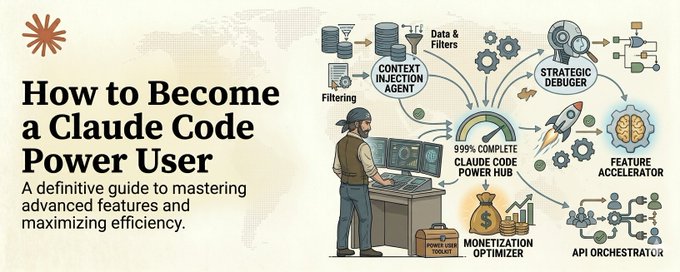
Most users are using Claude Code like a fancy autocomplete.
Save this :)
They paste in a bug. They get a fix. They paste in a feature request. They get some code. One question, one answer, over and over, never building on anything.
That is like buying a Ferrari and only driving it in first gear.
Claude Code is not a code suggestion tool. It is an autonomous engineering partner that can read your entire codebase, understand your architecture, execute multi-step plans, run tests, debug failures, and ship features end to end.
But only if you know how to use it properly.
The gap between a casual Claude Code user and a power user is not talent. It is configuration. It is workflow. It is knowing the 20% of features that deliver 80% of the results.
This is the full course. Everything I have learned from using Claude Code every single day for months. No filler. Just what works.
## Level 1: The Foundation Most People Skip
CLAUDE.md Is Your Secret Weapon
The single most important file in your entire project is one that most people have never created.
CLAUDE.md sits in the root of your project and tells Claude Code exactly how your codebase works. Your conventions. Your patterns. Your rules. Your preferences.
Without it, Claude Code is guessing. It does not know that your team uses camelCase. It does not know that you prefer functional components over class components. It does not know that your API naming convention is verb-first. It does not know that you never use any-typed variables.
With a good CLAUDE.md, Claude Code follows your team's standards automatically. Every file it touches. Every function it writes. Every test it generates.
Here is what belongs in your CLAUDE.md:
- Your tech stack and versions
- Coding conventions and naming patterns
- File structure and where things go
- Testing requirements and what constitutes a good test
- Error handling patterns you prefer
- Common pitfalls specific to your codebase
- Things Claude should never do in this project
Spend 30 minutes writing this file. That investment will save you thousands of corrections over the next year.
The CLAUDE.md Hierarchy
There are three levels and knowing the difference matters.
User-level lives at ~/.claude/CLAUDE.md. This is personal to you. Your preferences, your shortcuts, your style. It is not version controlled and your teammates will never see it.
Project-level lives at .claude/CLAUDE.md in your repo root. This is shared with your entire team through git. Team standards, architectural decisions, and universal rules live here.
Directory-level lives inside specific directories. These apply only when Claude Code is working on files in that directory. Perfect for sub-projects or modules with different conventions.
The most common mistake: Putting team-wide rules in your user-level config. Then wondering why the new developer's Claude Code is not following the same standards. The fix is always the same. Move shared rules to project-level.
## Level 2: Think in Modes, Not Messages
Plan Mode vs Direct Execution
This distinction will change how you use Claude Code overnight.
Direct execution is for tasks with clear, limited scope. Fix this bug. Add this validation. Rename this variable across the codebase. Claude Code can handle these immediately without needing to plan.
Plan mode is for everything bigger. Refactoring a module. Adding a new feature that touches multiple files. Migrating from one pattern to another. Restructuring your test suite.
In plan mode, Claude Code first creates a plan. It outlines what files it will touch, what changes it will make, and in what order. You review the plan before any code is written.
The rule is simple: if the task touches more than 2 files or requires architectural decisions, use plan mode. If you let Claude Code execute complex tasks without planning first, you will spend more time undoing damage than you saved.
## Level 3: Tools That Make Claude Code Dangerous
Built-in Tools You Are Not Using
Claude Code comes with tools that most people never discover.
Grep vs Glob: Grep searches file contents. Glob matches file paths. Most people use the wrong one and waste time. If you are looking for where a function is called, use Grep. If you are looking for all test files, use Glob. The exam for Claude Certified Architect literally tests this distinction. That is how important it is.
Read, Write, Edit: Edit is for targeted modifications using unique text matching. It is fast and precise. When Edit fails because the text match is not unique, fall back to Read plus Write. Read the full file, then write the complete modified version. Know when to use which.
The /memory command: This shows you which memory files Claude Code has loaded. If Claude Code is behaving inconsistently, this is your debugging tool. Run it and check whether the right context is actually loaded.
Custom Slash Commands
Build commands for tasks you run repeatedly.
Create them in .claude/commands/ for shared team commands or ~/.claude/commands/ for personal ones.
A /review command that runs your team's code review checklist. A /test command that generates tests following your specific patterns. A /deploy-check command that verifies everything is ready for deployment.
These take 10 minutes to create and save hours of repetitive prompting.
## Level 4: Skills and Context Engineering
Skills vs CLAUDE.md — Know the Difference
CLAUDE.md is always loaded. Every session. Every task. Universal standards live here.
Skills are on-demand. They activate when you invoke them. Task-specific workflows live here.
The mistake most people make is putting task-specific procedures in CLAUDE.md. Your CLAUDE.md gets bloated, Claude Code gets confused by irrelevant context, and you burn tokens on instructions that do not apply to the current task.
The rule: If it applies to every task, put it in CLAUDE.md. If it applies to a specific type of work, make it a skill.
Path-Specific Rules
This is the feature that teams discover and immediately wonder how they lived without.
Create rule files in .claude/rules/ with YAML frontmatter that specifies glob patterns. For example:
These rules only load when Claude Code is editing files that match the pattern. Every test file in your entire codebase, regardless of directory, gets the same testing conventions applied automatically.
This is dramatically more powerful than directory-level CLAUDE.md because it works across your entire project structure.
## Level 5: CI/CD Integration
Claude Code in Your Pipeline
The -p flag runs Claude Code in non-interactive mode. Without it, your CI job hangs forever waiting for input. This is the single most tested concept in the Claude Certified Architect exam.
Use --output-format json with --json-schema to get machine-parseable structured output. Your CI system can then post findings as inline PR comments automatically.
Critical insight: The same Claude Code session that generated code is less effective at reviewing its own changes. It retains reasoning context that makes it biased toward its own decisions. Always use an independent review instance for code review in CI.
## Level 6: The Power User Workflow
Here is what a typical day looks like for a Claude Code power user:
Morning: Open terminal. Claude Code loads your CLAUDE.md and relevant path-specific rules automatically. You describe the first feature in plain language. Claude Code creates a plan. You review it, adjust one step, approve. Claude Code executes across 8 files, writes tests, runs them, fixes two failures, and commits.
Afternoon: You review a PR. Instead of reading every line yourself, you run your custom /review command. Claude Code checks against your team's standards, flags 3 issues, and explains why each matters. You address the one real issue and approve the rest.
End of day: Your CI pipeline runs Claude Code with -p flag on every new PR. Automated security review. Automated test generation for uncovered paths. Automated documentation updates. All posted as PR comments.
That is not the future. That is what Claude Code power users are doing right now.
## The Certification Path
If you want to formalize this knowledge, Anthropic offers the Claude Certified Architect Foundations exam. It tests everything covered in this article: CLAUDE.md hierarchy, tool usage, plan mode, path-specific rules, CI/CD integration, prompt engineering, and MCP configuration.
It is scenario-based multiple choice. The wrong answers are designed to sound like good engineering. The right answers require knowing specifically which technique applies to which problem.
If you have built real projects with Claude Code and understand the concepts in this article, you are ready to sit the exam.
## The Bottom Line
Claude Code is the most powerful developer tool most developers are barely using.
The gap between using it casually and using it like a power user is not months of learning. It is a few days of intentional setup and practice.
Configure your CLAUDE.md. Learn plan mode. Build custom commands. Use path-specific rules. Integrate it into CI.
Do those five things and you will ship more code in a week than most developers ship in a month.
Most people will keep pasting one-off questions into Claude Code and getting one-off answers.
The ones who build a real system around it will be operating at a completely different level within 30 days.
Follow me @eng_khairallah1 for more agent architecture guides, orchestration patterns, and building systems.
hope this was useful for you, Khairallah ❤️
## 相关链接
- [Khairallah AL-Awady](https://x.com/eng_khairallah1)
- [@eng_khairallah1](https://x.com/eng_khairallah1)
- [228K](https://x.com/eng_khairallah1/status/2047245243503050997/analytics)
- [CLAUDE.md](http://claude.md/)
- [CLAUDE.md](http://claude.md/)
- [CLAUDE.md](http://claude.md/)
- [CLAUDE.md](http://claude.md/)
- [CLAUDE.md](http://claude.md/)
- [CLAUDE.md](http://claude.md/)
- [CLAUDE.md](http://claude.md/)
- [CLAUDE.md](http://claude.md/)
- [CLAUDE.md](http://claude.md/)
- [CLAUDE.md](http://claude.md/)
- [CLAUDE.md](http://claude.md/)
- [CLAUDE.md](http://claude.md/)
- [CLAUDE.md](http://claude.md/)
- [CLAUDE.md](http://claude.md/)
- [@eng_khairallah1](https://x.com/@eng_khairallah1)
- [Upgrade to Premium](https://x.com/i/premium_sign_up)
- [5:24 PM · Apr 23, 2026](https://x.com/eng_khairallah1/status/2047245243503050997)
- [228.2K Views](https://x.com/eng_khairallah1/status/2047245243503050997/analytics)
- [View quotes](https://x.com/eng_khairallah1/status/2047245243503050997/quotes)
---
*导出时间: 2026/4/24 11:13:38*