# 25 Powerful AI Skills, Agents & Automations You Can Build Today — The Complete List.
**作者**: Khairallah AL-Awady
**日期**: 2026-04-04T08:59:15.000Z
**来源**: [https://x.com/eng_khairallah1/status/2040353492846755982](https://x.com/eng_khairallah1/status/2040353492846755982)
---
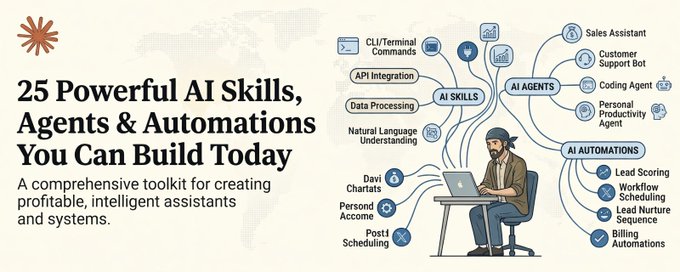
I tested 300+ AI project ideas and filtered them down to the 25 that actually deliver real value.
Save this :)
Most people learn about AI and then have no idea what to build. They understand the theory. They know the tools. But when they sit down to create something, they stare at a blank screen.
This is the list that fixes that problem.
25 projects organized by difficulty. Each one can be built in a weekend. Each one solves a real problem. Each one teaches you a skill that compounds into the next project.
Bookmark this. Come back to it every weekend. Build one thing at a time.
Beginner Tier: Build These First
If you have never built anything with AI, start here. These projects use Claude's chat interface or basic API calls. No advanced skills needed.
01. Personal Writing Editor: Build a system prompt that knows your writing style, your audience, and your quality standards. Feed it any draft and it returns a polished version in your voice. Include examples of your best writing so Claude can pattern match. Test with five real drafts. Refine until the output sounds like you wrote it yourself. Skill learned: System prompt engineering, few-shot examples
02. Meeting Notes Processor: Build a tool that takes raw meeting notes or transcripts and outputs structured summaries with action items, decisions made, open questions, and owner assignments. Configure it for your team's format. Skill learned: Output formatting, structured extraction
03. Email Drafter by Situation: Build a prompt system with multiple modes: cold outreach, follow-up, bad news delivery, negotiation, and appreciation. Each mode has its own tone, structure, and rules. You input the situation and recipient, it outputs a ready-to-send email. Skill learned: Multi-mode prompting, context-dependent behavior
04. Weekly Content Idea Generator: Build a system that takes your niche, recent trends, and past content as input, then generates 15 content ideas ranked by predicted engagement. Each idea includes a working title, core argument, and hook. Skill learned: Context engineering, ranking and evaluation prompts
05. Customer FAQ Auto-Responder: Feed Claude your product documentation and FAQ database. Build a system prompt that answers customer questions accurately based only on your documentation. If the answer is not in the docs, it says so instead of guessing. Skill learned: Grounded generation, hallucination prevention
06. Study Guide Creator: Input a topic and difficulty level. The system generates a structured study guide with key concepts, practice questions, common misconceptions, and a recommended learning sequence. Built for students or self-learners in any field. Skill learned: Educational content generation, structured output
07. Resume Tailor: Input a job description and your master resume. The system rewrites your resume experience section to match the job requirements, emphasizing relevant skills and using the job posting's language. Different output for each application. Skill learned: Comparative analysis, audience-specific rewriting
Intermediate Tier: Requires Basic Python
These projects use the Claude API and basic Python scripting. You need to be comfortable running scripts in a terminal.
08. Document Analyzer CLI: A command line tool that reads any PDF or text file and answers questions about its contents. Upload a contract and ask "what are the termination clauses?" Upload a research paper and ask "what methodology did they use?" Uses the Claude API with file processing. Skill learned: API integration, file I/O, large context handling
09. Competitive Intelligence Tracker: A script that takes a list of competitor URLs, fetches their latest content or updates, and generates a weekly competitive intelligence briefing. Tracks what competitors are talking about, what products they launched, and what positioning they use. Skill learned: Web scraping, automated analysis, recurring workflows
10. Code Review Bot: A tool that reviews pull requests or code files and provides structured feedback: security vulnerabilities, logic errors, performance issues, and readability suggestions. Each issue gets a severity rating and a suggested fix. Skill learned: Structured evaluation, technical analysis, prompting
11. Multi-Format Content Repurposer: Input one long-form piece of content. The tool outputs: a Twitter thread, a LinkedIn post, three standalone tweets, a newsletter intro, and a short-form video script. All in your voice. All platform-optimized. Skill learned: Prompt chaining, multi-format output, voice consistency
12. Invoice and Receipt Processor: A tool that reads photos or PDFs of invoices and receipts, extracts key data (vendor, amount, date, category), and outputs structured JSON or adds rows to a spreadsheet. Saves hours of manual data entry. Skill learned: Document extraction, structured outputs, data pipeline basics
13. Personal Finance Analyzer: Import your bank statement CSV. The tool categorizes every transaction, calculates spending by category, identifies unusual charges, and generates a monthly financial summary with trends. Skill learned: Data processing, pattern recognition, CSV handling
14. Technical Documentation Generator: Point it at a codebase or a project folder. The tool reads the code and generates comprehensive documentation: architecture overview, function descriptions, setup instructions, and API reference. Keeps documentation in sync with code. Skill learned: Code analysis, documentation standards, and large context management
Advanced Tier: Agents and Automations
These projects use the agentic loop, tool calling, and multi-step workflows. This is where you build real systems.
15. Research Agent: An agent with web search and note-saving tools. Give it a research question. It searches multiple sources, cross-references findings, identifies contradictions, saves key facts, and delivers a structured research report with citations. Skill learned: Agentic loop, tool use, multi-step reasoning
16. Lead Qualification Agent: An agent that reads new leads from a spreadsheet or form submission, researches each company online, scores them against your Ideal Customer Profile criteria, and outputs a ranked list with reasoning. Saves sales teams hours of manual research. Skill learned: Business workflow automation, scoring systems, batch processing
17. Daily Briefing Automation: A scheduled agent that runs every morning. It checks your email for urgent items, summarizes overnight Slack messages, pulls your calendar for the day, reviews your task list, and generates a one-page morning briefing saved to your desktop. Skill learned: Multi-source data integration, scheduling, and file system interaction
18. Smart Expense Report Builder: An agent that processes a folder of receipt images, extracts the data from each one, categorizes expenses, checks for policy violations, calculates totals by category, and generates a formatted expense report ready for submission. Skill learned: Image processing, batch operations, report generation
19. Content Calendar Planner: An agent that analyzes your past content performance, researches trending topics in your niche, identifies content gaps, and generates a complete 30-day content calendar with topics, formats, hooks, and target platforms for each piece. Skill learned: Data-driven planning, trend analysis, strategic reasoning
20. Multi-Agent Debate System: A system with three specialized agents: a researcher, a critic, and a synthesizer. The researcher gathers evidence. The critic challenges every finding. The synthesizer produces a balanced conclusion. Produces better analysis than a single agent dramatically. Skill learned: Multi-agent orchestration, role specialization, quality through adversarial processes
Production Tier: Ship These for Money 💰
These are the projects that become products or services.
21. Client Proposal Generator: A production system that takes basic project details and generates complete, branded business proposals in a client's voice. Includes scope, timeline, pricing, terms, and case studies. Saves service businesses hours per proposal. Skill learned: Template systems, brand voice encoding, document generation
22. Customer Support Agent: A full support agent that reads your product documentation, handles common questions, escalates complex issues to humans, and maintains conversation context across multiple messages. Deploy it as a widget on your website. Skill learned: Production agent deployment, escalation logic, conversation management
23. Automated Report Pipeline: A scheduled system that pulls data from multiple sources weekly, processes it through Claude for analysis, generates formatted reports, and distributes them to stakeholders via email. Runs completely unattended. Skill learned: End-to-end automation, data pipeline design, production reliability
24. SEO Content Engine: A system that takes a target keyword, researches the top-ranking content, identifies gaps in existing coverage, generates a comprehensive article optimized for search, and formats it for your CMS. Includes meta descriptions, headers, and internal linking suggestions. Skill learned: SEO-aware content generation, competitive analysis, CMS integration
25. AI Workflow Builder for Non-Technical Users: The meta-project. Build a tool that lets non-technical users create their own AI workflows through a simple interface. They describe what they want in plain English, and your system translates it into a working automation. This is a product people will pay for. Skill learned: Abstraction design, user experience for AI systems, meta-level architecture
How to Use This List
Do not try to build all 25 at once. That is a recipe for burnout and nothing shipped.
If you are just starting: Build projects 01 through 04 this weekend. Each takes two to four hours. By Sunday night, you have four working AI tools and real prompt engineering experience.
If you can already prompt well: Skip to projects 08 through 12. These teach you API integration and scripting. Build two this weekend.
If you already use the API: Jump to projects 15 through 18. These teach you agent architecture. Build one this weekend and polish it next weekend.
If you want to make money: Study projects 21 through 25 and pick the one that fits your niche. Build it over two weekends. Then start selling it.
The progression matters. Each tier builds skills that the next tier requires. Rushing to production-tier projects without the fundamentals leads to fragile systems that break under real usage.
TL;DR
25 projects. Four difficulty tiers. Each one solves a real problem and teaches a real skill.
Stop watching tutorials. Pick a number. Build it this weekend.
The fastest way to learn AI is to build with AI. The second fastest way does not exist.
This list took a long time to compile and test. If it saved you the trouble of figuring out what to build, you know what to do.
Follow @eng_khairallah1 for more lists, guides, and building resources. No fluff. Just what works.
hope this was useful for you, Khairallah ❤️
## 相关链接
- [Khairallah AL-Awady](https://x.com/eng_khairallah1)
- [@eng_khairallah1](https://x.com/eng_khairallah1)
- [30K](https://x.com/eng_khairallah1/status/2040353492846755982/analytics)
- [@eng_khairallah1](https://x.com/@eng_khairallah1)
- [Upgrade to Premium](https://x.com/i/premium_sign_up)
- [4:59 PM · Apr 4, 2026](https://x.com/eng_khairallah1/status/2040353492846755982)
- [30.8K Views](https://x.com/eng_khairallah1/status/2040353492846755982/analytics)
- [View quotes](https://x.com/eng_khairallah1/status/2040353492846755982/quotes)
---
*导出时间: 2026/4/5 03:22:29*