# How to Build & Sell Your First Claude Skill This Month (Full Course)
**作者**: Khairallah AL-Awady
**日期**: 2026-04-17T09:33:25.000Z
**来源**: [https://x.com/eng_khairallah1/status/2045073135381438929](https://x.com/eng_khairallah1/status/2045073135381438929)
---
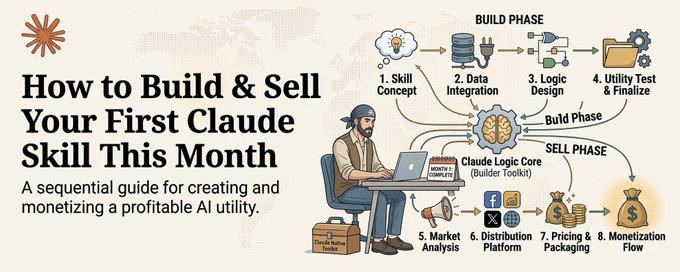
There is a brand new market emerging right now that almost nobody is talking about.
Save this :)
It is not apps. It is not courses. It is not content.
It is Claude Skills.
A Claude Skill is a plug-and-play workflow that teaches Claude how to perform a specific task at an expert level. Once installed, Claude automatically activates the Skill whenever someone asks for that type of work.
Think of it like building an app for the App Store. Except you do not need to code. You do not need a developer account. You do not need to wait for approval. You write a markdown file, you upload it, and people can install it instantly.
There are already over 80,000 Skills in the ecosystem. The marketplace is real. And it is growing faster than anyone expected.
The people who build Skills now are establishing themselves in a market that is going to be massive. Because every person and every business that uses Claude will eventually need Skills tailored to their specific workflow.
That is the opportunity. And this is exactly how to take it.
What a Claude Skill Actually Is (The 60-Second Version)
A Skill is a SKILL.md file. That is it. A single markdown file that contains:
YAML frontmatter: tells Claude when to activate (the trigger)
Instructions: tells Claude exactly what to do and how to do it (the workflow)
Optional references: supporting files like templates or brand guides
Optional scripts: Python scripts for tasks that need computation
When someone installs your Skill and then types a request that matches your trigger description, Claude reads your SKILL.md file, follows the instructions, and produces the output exactly as you defined it.
You are not building software. You are packaging expertise into a format that AI can execute.
That distinction is important. Because it means the most valuable Skills are not built by the best coders. They are built by the people with the deepest domain knowledge.
The real estate agent who builds a property analysis Skill knows more about what matters in a comp report than any developer. The content marketer who builds a content repurposing Skill knows more about platform-specific formatting than any engineer.
Your expertise is the product. The SKILL.md file is just the packaging.
Step 1: Find a Skill That People Actually Need
The Skills that sell are not the clever ones. They are the ones that solve painful, repetitive problems for a specific group of people.
Here is how to find yours:
Method 1: Audit your own workflow. What tasks do you do every week that are time-consuming, process-driven, and boring? If you have already built a process for it, you are 80% of the way to a sellable Skill.
Method 2: Listen to complaints. Join communities where your target audience hangs out. What do they complain about doing manually? What takes them too long? What are they getting wrong?
Method 3: Browse existing Skills and find gaps. Go to skillsmp.com and browse the 80,000+ existing Skills. Look for categories that are underserved. Look for Skills that have high install counts but bad reviews. Look for niches that do not have any Skills at all.
The sweet spot: A Skill that saves a specific person at least 2 hours per week on a task they do every single week. That is a no-brainer purchase.
Good Skill ideas:
- Weekly client report generator for marketing agencies
- Property listing description writer for real estate agents
- Invoice processor and categorizer for freelancers
- Content performance analyzer for creators
- Sales call prep researcher for account executives
- Contract clause checker for small business owners
- Meal plan generator for nutrition coaches
- Patient intake summarizer for healthcare providers
Notice the pattern. Every single one is specific to a niche, solves a recurring problem, and saves real time.
Step 2: Define the Skill Precisely
Before you write a single line of your SKILL.md file, you need to define exactly what the Skill does, when it activates, what input it takes, and what output it produces.
Use this framework:
The Task: "This Skill [does what] for [whom] by [process]."
Example: "This Skill generates weekly client performance reports for marketing agencies by pulling key metrics, comparing them to the previous week, and formatting the results in a client-ready document."
The Trigger: When should Claude activate this Skill? List 5 to 7 phrases someone might type that should fire it.
The Anti-Trigger: When should Claude NOT activate this Skill? List the requests that sound similar but are actually different tasks.
The Input: What does the user need to provide? Raw data? A URL? A topic? A file?
The Output: What does the finished result look like? How long is it? What format? What sections does it include?
The Quality Standard: What makes a good output versus a bad one? If you can describe what failure looks like, you can prevent it.
Spend real time on this step. A poorly defined Skill produces inconsistent results. A precisely defined Skill works reliably every single time. The entire value proposition of your Skill depends on reliability.
Step 3: Write the SKILL.md File
Here is the complete structure:
The YAML description is the most critical part. If it is too weak, the Skill never activates. If it is too broad, it activates at wrong times. Be pushy with your trigger phrases and explicit with your negative boundaries.
Step 4: Test Until It Is Bulletproof
Install your Skill locally at ~/.claude/skills/your-skill-name/ and run it on real data.
Test it 10 times with different inputs. Look for these failure modes:
The Silent Skill: You type a trigger phrase and the Skill does not activate. Fix: make your YAML description more aggressive with trigger phrases.
The Hijacker: The Skill activates when you did not want it to. Fix: add negative boundaries to your YAML description.
The Drifter: The Skill activates but produces the wrong output. Fix: make your instructions more specific. Add examples showing exactly what good output looks like.
The Hallucinator: The Skill invents data or makes claims not supported by the input. Fix: add explicit rules about handling missing data. "If the information is not in the provided data, say 'not available' rather than generating an estimate."
The Format Breaker: The output is correct but formatted inconsistently. Fix: add a more detailed output format specification with exact section headers and length constraints.
Every time you find a failure, update the SKILL.md file. This iterative refinement is what turns an amateur Skill into a professional one.
Step 5: Package and Publish
Your Skill folder structure should look like this:
Where to publish:
- skillsmp(.)com: The largest marketplace with 80,000+ Skills. Highest visibility.
- GitHub: Open source your Skill for maximum distribution and credibility.
- Your own audience: If you have followers, sell directly. No marketplace fees.
Pricing strategies:
- Free: Best for building reputation and getting installs. Open source on GitHub.
- $10 to $50: Simple Skills that save 1 to 2 hours per week. Low barrier.
- $50 to $200: Complex Skills with multiple workflows and reference files. Professional use cases.
- $200 to $500: Industry-specific Skills with deep domain expertise baked in.
Start with one free Skill to build credibility and installs. Then release paid Skills once you have social proof.
Step 6: Market Your Skill
Building a great Skill is half the battle. The other half is making sure people know it exists.
Write a breakdown article. Show exactly what your Skill does, the problem it solves, and a before/after comparison. Post it on X and LinkedIn.
Create a demo video. Screen record yourself using the Skill. Show the input. Show the output. Show the time saved. 60 seconds is enough.
Target niche communities. Find the exact communities where your target users hang out. Share the Skill as a free resource. Let the results speak for themselves.
Build in public. Document your process of creating the Skill. Share what worked and what failed. People love watching the build and they remember who built it.
The Skills with the most installs are not always the best ones. They are the ones that were marketed most effectively. Do not skip this step.
The Bigger Picture
What you are really learning here is not how to write a markdown file.
You are learning how to package expertise into scalable products. How to identify problems worth solving. How to build something once and sell it repeatedly.
Those are entrepreneurial skills that apply far beyond Claude Skills. They apply to courses, SaaS products, consulting packages, and every other form of digital product.
The Skill is the product. But the real skill is learning how to build products.
Your 30-Day Launch Plan
Week 1: Identify your niche and your Skill idea. Define it precisely using the framework in Step 2. Write version 1 of your SKILL.md.
Week 2: Test extensively. Refine based on failures. Get 3 real people to try it and give feedback. Update the SKILL.md based on what they tell you.
Week 3: Publish on skillsmp.com and GitHub. Write a breakdown article. Record a demo video. Share it everywhere.
Week 4: Analyze installs and feedback. Start building Skill number 2 based on what you learned. Engage with the community. Build your reputation as a Skill builder.
By the end of 30 days you will have a published, installed, working Claude Skill and the knowledge to build more whenever you want.
The Skills marketplace is in its App Store 2009 moment. The early builders who establish themselves now will own their categories later.
Most people will think about building a Skill someday.
The ones who ship their first one this month will have a library of products earning while they sleep.
Follow me @eng_khairallah1 for more vibe coding guides, project ideas, and building tutorials.
hope this was useful for you, Khairallah ❤️
## 相关链接
- [Khairallah AL-Awady reposted](https://x.com/eng_khairallah1)
- [Khairallah AL-Awady](https://x.com/eng_khairallah1)
- [@eng_khairallah1](https://x.com/eng_khairallah1)
- [11K](https://x.com/eng_khairallah1/status/2045073135381438929/analytics)
- [SKILL.md](http://skill.md/)
- [SKILL.md](http://skill.md/)
- [SKILL.md](http://skill.md/)
- [skillsmp.com](http://skillsmp.com/)
- [SKILL.md](http://skill.md/)
- [SKILL.md](http://skill.md/)
- [SKILL.md](http://skill.md/)
- [SKILL.md](http://skill.md/)
- [SKILL.md](http://skill.md/)
- [skillsmp.com](http://skillsmp.com/)
- [@eng_khairallah1](https://x.com/@eng_khairallah1)
- [Upgrade to Premium](https://x.com/i/premium_sign_up)
- [5:33 PM · Apr 17, 2026](https://x.com/eng_khairallah1/status/2045073135381438929)
- [11.9K Views](https://x.com/eng_khairallah1/status/2045073135381438929/analytics)
- [View quotes](https://x.com/eng_khairallah1/status/2045073135381438929/quotes)
---
*导出时间: 2026/4/17 21:12:51*