构建协同工作的 AI Agent 团队指南 ✍ Khairallah AL-Awady🕐 2026-04-18📦 8.7 KB 🟢 已读 𝕏 文章列表 本文深入探讨了如何构建高效的多 Agent 协作系统。文章指出,单个 Agent 难以同时胜任多种复杂任务,而通过“中心辐射”架构,利用协调者管理多个专业化 Agent,可显著提升输出质量。文章详细解析了上下文传递的关键原则、常见的失败模式及预防措施,并提供了构建研究与报告团队的实战指南。 多Agent系统系统架构团队协作LLM提示词工程AI应用技术教程Hub-and-Spoke工作流设计 # How to Build a Team of AI Agents That Work Together (Full Course) **作者**: Khairallah AL-Awady **日期**: 2026-04-18T09:15:06.000Z **来源**: [https://x.com/eng_khairallah1/status/2045430911257432225](https://x.com/eng_khairallah1/status/2045430911257432225) --- 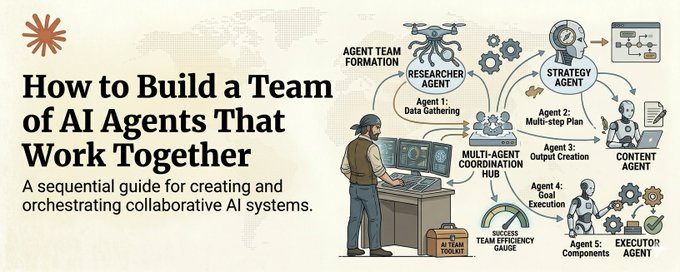 One agent is useful. A team of agents is a competitive advantage. Save this :) A single AI agent can research, or write, or analyze, or code. But it cannot do all of these things well simultaneously. Just like a single employee who tries to handle research, writing, sales, and customer support will do all of them poorly. The solution is the same solution humans figured out centuries ago: specialization. Instead of one overloaded agent, you build a team. A research agent that only researches. A writing agent that only writes. An analysis agent that only analyzes. A coordinator agent that manages the team, assigns tasks, and assembles the final output. Each agent is focused. Each agent is excellent at its specific job. Together they produce work that no single agent could match. This is called multi-agent orchestration and it is the architecture behind the most powerful AI systems being built right now. Customer support platforms, research systems, content engines, and business automation pipelines all use multi-agent teams at their core. This course teaches you how to design, build, and deploy your own. The Architecture: Hub and Spoke Every effective multi-agent system follows the same fundamental pattern: hub and spoke. The hub (coordinator agent) sits at the center. It receives the overall goal from the user. It decomposes the goal into subtasks. It decides which specialist agent handles each subtask. It passes context between specialists. It assembles the final output from all the pieces. The spokes (specialist agents) are focused experts. Each one has a defined role, a small set of tools optimized for that role, and a system prompt that constrains it to its specialty. All communication flows through the coordinator. Specialists never talk to each other directly. The coordinator is the single point of routing, quality control, and assembly. This architecture has massive advantages. Each specialist stays focused - reducing errors from context overload. Specialists can be developed and tested independently. You can swap out or upgrade individual specialists without rebuilding the system. The coordinator provides a single point of observability for debugging and monitoring. The Critical Rule Everyone Violates I cannot emphasize this enough because it is the single most common bug in multi-agent systems. Specialist agents do NOT automatically inherit the coordinator's conversation history. Let me say that more directly. When the coordinator spawns a specialist, the specialist starts with a blank context. It knows nothing. It has not read the conversation history. It has not seen what other specialists produced. It has zero awareness of anything except what you explicitly include in its prompt. Most people assume that because the coordinator knows everything, the specialist must also know everything. It does not. If the coordinator gathered research data and wants the writing specialist to turn it into a report, the coordinator must include all the research data in the writing specialist's prompt. If it just says "write the report based on our research," the writing specialist has no idea what research was done. The second version is longer. It is also the only version that works. Every piece of context the specialist needs must be explicitly included. No exceptions. Building Your First Multi-Agent Team: The Research and Report System Let me walk you through building a complete multi-agent team. This system takes a research question and produces a comprehensive, well-written, fact-checked report. The team: Agent 1: Research Specialist - searches for information, extracts key facts, and compiles raw research data. Agent 2: Analyst Specialist - takes raw research data, identifies patterns, draws conclusions, and spots contradictions between sources. Agent 3: Writer Specialist - takes analyzed data and produces a polished, structured report in a defined format and voice. Agent 4: Reviewer Specialist - reads the finished report, checks for accuracy against the raw research, identifies weak claims, and suggests improvements. Agent 0: Coordinator - manages the entire workflow. The coordinator's workflow: Each specialist has a focused system prompt: Research Specialist: Analyst Specialist: Writer Specialist: Reviewer Specialist: Why this team produces better output than a single agent: The research agent goes deep on finding information - it is not distracted by having to write a report at the same time. The analyst focuses purely on patterns - not on finding information or writing prose. The writer focuses purely on quality prose - not on doing research or analysis. The reviewer catches mistakes that the writer missed because reviewing is its entire job. Each agent does one thing well. The coordinator ensures the pieces fit together. The result is consistently higher quality than asking one agent to do everything. Designing Your Own Multi-Agent Teams The research and report team is just one configuration. You can build multi-agent teams for any complex workflow. The Content Team: Researcher → Outline Architect → Draft Writer → Editor → Formatter Takes a topic and produces polished, multi-format content. The Customer Support Team: Classifier → Knowledge Base Searcher → Response Drafter → Quality Checker Handles support tickets with multiple verification layers. The Business Analysis Team: Data Collector → Trend Analyzer → Risk Assessor → Recommendation Writer Takes raw business data and produces actionable strategic recommendations. The design principles are always the same: Each agent has ONE clear responsibility. Each agent has a focused set of tools (3 to 5 maximum). All communication flows through the coordinator. Context is passed explicitly between agents - never assumed. The coordinator validates output at each stage before passing to the next agent. The Three Failure Modes (And How to Prevent Them) Failure 1: Narrow decomposition. The coordinator decomposes "impact of AI on industries" into only software and healthcare subtopics, missing finance, education, manufacturing, media, and legal entirely. Prevention: Instruct the coordinator to enumerate the full scope before decomposing. Add a self-check step: "Review your decomposition. Have you covered all major aspects of this topic? If any significant area is missing, add it." Failure 2: Lost context. Information discovered by the research agent never reaches the writing agent because the coordinator did not pass it along. Prevention: The coordinator must include all prior agent outputs in each subsequent agent's prompt. Build explicit context-passing into the coordinator's workflow. Failure 3: Quality degradation through telephone effect. Each agent subtly changes or loses nuance from the previous agent's output. By the time information passes through four agents, important details have been diluted. Prevention: Include the original source data at every stage - not just the previous agent's output. The writer should receive the raw research AND the analysis, not just the analysis alone. The Bottom Line Single agents are useful. Multi-agent teams are powerful. The architecture is straightforward: a coordinator manages specialists, each specialist does one thing well, all context is passed explicitly, and the coordinator assembles the final output. Build your first team this week. Start with the research and report configuration. Test it with a real research question. Observe how the quality compares to asking a single agent to do everything. Once you experience the quality difference, you will never go back to single-agent workflows for complex tasks. The future of AI is not one agent doing everything. It is teams of agents doing everything well. Follow me @eng_khairallah1 for more agent architecture guides, orchestration patterns, and building systems. hope this was useful for you, Khairallah ❤️ ## 相关链接 - [Khairallah AL-Awady](https://x.com/eng_khairallah1) - [@eng_khairallah1](https://x.com/eng_khairallah1) - [18K](https://x.com/eng_khairallah1/status/2045430911257432225/analytics) - [@eng_khairallah1](https://x.com/@eng_khairallah1) - [Upgrade to Premium](https://x.com/i/premium_sign_up) - [5:15 PM · Apr 18, 2026](https://x.com/eng_khairallah1/status/2045430911257432225) - [18.2K Views](https://x.com/eng_khairallah1/status/2045430911257432225/analytics) - [View quotes](https://x.com/eng_khairallah1/status/2045430911257432225/quotes) --- *导出时间: 2026/4/18 23:16:23*
终 终极 Hermes 指南:构建 30 天后仍保持高内聚的多代理团队 本文是一篇关于 Hermes 多代理系统的深度操作指南。作者指出,单个代理承担多种角色会导致声音模糊和上下文污染,而简单的角色划分也难以维持长期的一致性。文章提出了基于“隔离配置文件”的解决方案,详细介绍了构建包含编排者、研究员、作家和工程师的四人团队步骤。重点阐述了通过“交接契约”、内存 KPI 审计和策略门禁来建立“操作员层”,确保团队在运行 30 天后依然保持专业分工和清晰边界,避免多代理系统退化为单一混乱体。 技术 › Hermes ✍ Nyk🕐 2026-04-16 多智能体HermesAgent系统架构LLM提示词工程工作流自动化团队协作AI运营
万 万字长文:做了些爆款 Skills 以后,我对 Skills 的看法 本文通过作者制作多个爆款 Skill(如 PPT、社交媒体卡片、Logo 生成等)的实战经验,深入探讨了 Skill 在 AI 时代的本质与价值。作者指出,Skill 不仅是提示词,更是封装专家经验、工作流和审美判断的“能力商品”,能有效弥合 Agent 使用中的认知差距。文章详细阐述了 Skill 的设计哲学(中心短、辐射厚)、像代码一样的维护流程,以及如何通过“把品味变成约束”来保证高质量输出。 技术 › Skill ✍ 歸藏(guizang.ai)🕐 2026-06-12 AgentSkillLLM上下文工程提示词工程产品设计经验封装DevOps交互设计AI应用
用 用多Agent Claude系统替代4人团队的架构解析 作者分享了如何利用周末时间构建一个多Agent Claude系统,成功替代了由4人(研究助理、写手、分发经理、数据分析师)组成的内容运营团队。该系统将月成本从11,400美元降至340美元,并显著提升了产出速度与质量。文章详细阐述了系统的架构设计,包括负责任务分配的编排器以及分别负责研究、内容创作、分发、分析和质量控制的5个专业Agent,并提供了针对编排器和研究Agent的详细提示词模板。 技术 › Agent ✍ CyrilXBT🕐 2026-05-01 多Agent系统ClaudeAI架构自动化内容运营提示词工程降本增效OrchestratorAI应用
提 提示词工程实战:从“AI写的很烂”到“AI写得真好”的完整方法 文章旨在解决用户使用AI输出质量差的问题,提出了一套系统的提示词工程方法论。核心内容包括“六要素检查法”(角色、背景、任务、格式、约束、质量标准),使用XML标签进行结构化提示,以及链式提问、自我修正等进阶技巧。文章还强调了建立上下文文件和模板库以实现长期复利,帮助读者从新手进阶为提示词工程大师。 技术 › LLM ✍ 唐清乐🕐 2026-05-01 提示词工程AI技巧LLM结构化提示ChatGPT效率工具自动化AI应用方法论
H Hermes 高级用法:用多 Profile 协作搭建 OPC Agent 团队 本文探讨了如何利用 Hermes 的多 Profile 协作功能,将多个 Agent 组织成一支 OPC(一人公司)团队。文章指出,单一 Agent 存在幻觉、记忆污染和角色混乱等问题,因此建议引入类似公司架构的四角色模型:Coordinator(协调员)、Researcher(研究员)、Writer(作家)和 Builder(构建者)。文章详细阐述了 Profile、Subagent、Project 和 Wiki 四个核心概念的区别,并提供了构建稳定 Agent 工作系统的具体配置方法,旨在建立清晰的角色边界和可长期运行的协作体系。 技术 › Hermes ✍ 知野🕐 2026-04-30 HermesAgent多Profile协作OPCWiki知野LLM系统架构团队协作Skill
C CIA 红队方法:用 4 个 Prompt 在执行前摧毁你的坏点子 文章介绍了如何利用 CIA 的红队策略,通过 4 个特定的 Prompt 让 Claude 对你的点子进行残酷的压力测试。这种方法旨在通过识别关键假设、扮演魔鬼代言人等手段,克服认知偏见和 AI 的阿谀奉承,帮助你在浪费数月时间之前验证或否定想法,让点子变得无懈可击。 技术 › 工具与效率 ✍ Nav Toor🕐 2026-07-24 LLMClaude方法论思维模型提示词工程批判性思维产品策略
H Hermes Agent 大师课程:完整指南 本文是一份关于 Hermes Agent 的 12 部分系列课程汇总,涵盖了从工作流程、学习系统、技能管理到多平台集成、浏览器控制等核心功能,详细介绍了该系统的架构设计与最佳实践。 技术 › Hermes ✍ Tony Simons🕐 2026-07-20 AgentHermesLLM教程系统架构工具集成多代理自动化
如 如何构建自动纠错 AI 循环 文章介绍如何构建一个 AI 自我纠错系统,通过分离生成、判断和管理三个角色,避免人工介入验证。关键在于利用独立的标准(如测试套件)进行结构化验证,而非简单的重复提问,从而实现自动化错误捕捉与修复。 技术 › Agent ✍ CyrilXBT🕐 2026-07-17 AI架构自我纠错Agent提示词工程自动化系统设计LLM流程优化
使 使用 Fable 5 构建自我改进 Agent 系统的 14 步指南 本文介绍如何利用 Claude Fable 5 模型构建具有复合能力的自我改进 Agent 系统。文章首先澄清了 Fable 5 作为 Mythos 级模型的定位,强调了其支持“长周期自主会话”和“自验证”的核心能力。作者指出,真正的自我改进并非模型权重的更新,而是通过 loops、dynamic workflows 和 routines 这三种原语,构建起包含记忆层和评估反馈层的环境架构。文章还详细阐述了如何根据任务复杂度在 Fable 5、Opus 和 Sonnet 之间进行成本最优的路由配置。 技术 › LLM ✍ Codez🕐 2026-06-12 LLMAgentClaudeFable 5自我改进系统架构工作流Claude Code工程化
3 32个Claude Code技巧:从入门到精通 文章介绍了Claude Code的32个高效使用技巧,分为基础、控制和精通三个层级。内容涵盖项目初始化、上下文管理、语音模式、子代理并行工作、自定义Skills编写、Hooks钩子配置及多模型切换等实战方法,旨在帮助用户在16分钟内掌握从新手到专业开发者的进阶路径。 技术 › Claude Code ✍ Codez🕐 2026-05-31 Claude CodeLLM编程技巧提示词工程开发效率教程AnthropicAI编程技巧分享技术指南
H Hermes Agent 进阶指南:从架构原理到构建自进化的多智能体系统 本文深入介绍了 Nous Research 开源项目 Hermes Agent。文章详细解析了其独特的“学习闭环”架构,该架构结合了三层持久化内存、自进化技能系统以及 GEPA 优化引擎,解决了传统 Agent 随会话结束而遗忘的问题。文中还将 Hermes 与 OpenClaw 进行了对比,并提供了从零开始配置多个个性化 Agent(程序员、研究员、设计师)的实战教程,旨在帮助开发者打造能够 24/7 运行且持续学习的个人 AI 队伍。 技术 › Hermes ✍ Akshay🕐 2026-05-28 AgentHermes自进化LLM开发者工具系统架构教程Nous ResearchGEPA多智能体
把 把自己“重做”一遍:一队 AI 同事帮我重塑个人 IP 本文作者分享了利用 AI 团队协作工具 Helio,仅用 2 小时便完成了原本需耗时 3 天的个人 IP 重塑(含 Banner、Bio 及视觉体系)。通过配置品牌策略师、设计师和文案 AI 角色,作者仅需提供素材并在关键节点审核,Agent 团队便自动完成了分工协作与交付,展示了多 Agent 协作在提升个人生产力方面的巨大潜力。 技术 › Agent ✍ 劳伦斯🕐 2026-05-27 AI AgentHelio个人IP工作流效率团队协作提示词工程AIGC个人生产力复盘自动化