# How to Build AI Workflows That Run Your Entire Business on Autopilot (Full Course)
**作者**: Khairallah AL-Awady
**日期**: 2026-04-25T09:25:51.000Z
**来源**: [https://x.com/eng_khairallah1/status/2047970333865746734](https://x.com/eng_khairallah1/status/2047970333865746734)
---
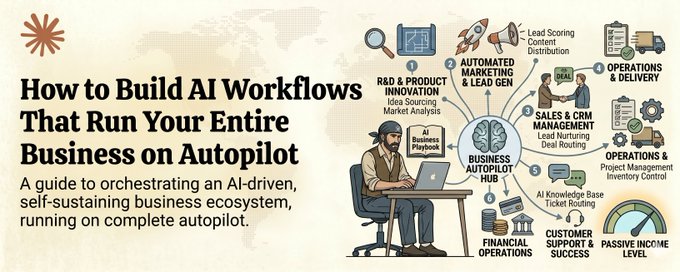
Every business owner hits the same wall.
Save this :)
You are doing everything. Sales. Support. Marketing. Operations. Admin. You know you should be focusing on strategy and growth but you are stuck in execution mode because there is nobody else to do the work.
Hiring is expensive. Training takes months. Managing people adds complexity.
But what if the work just happened?
What if your leads were qualified before you saw them. Your support tickets were answered before you woke up. Your weekly reports compiled themselves. Your invoices processed automatically. Your content calendar populated itself from your ideas. Your meeting notes organized into action items without you touching them.
This is not a hypothetical. This is what AI workflows do when they are built correctly.
Not one automation. Not a single chatbot. A system of interconnected workflows that handle the operational layer of your business while you focus on the decisions that actually move the needle.
This course teaches you how to build that system. Step by step, from identifying what to automate to deploying workflows that run without you.
Why Workflows, Not Tools
Most people approach AI automation backwards. They start with a tool. "I should use Claude for something." Then they wander around looking for a use case that fits the tool.
This is like buying a drill and then walking around your house looking for things to drill. Backwards.
Start with the workflow. A workflow is a sequence of steps that transforms an input into an output. Every business runs on workflows, even if nobody has written them down.
A sales workflow: Lead comes in → research the company → score against criteria → draft outreach → send email → track response → follow up.
A support workflow: Ticket arrives → classify the issue → find the solution → draft response → send to customer → update knowledge base if new issue.
A content workflow: Idea captured → research the topic → write first draft → edit → format for each platform → schedule posts.
Each of these workflows has steps that require human judgment and steps that do not. Your job is to identify which steps can be automated and connect them into a system that runs autonomously.
A tool does one thing. A workflow does everything between input and output. The value is in the workflow, not the individual tool.
Phase 1: Map Your Workflows (Week 1)
You cannot automate what you do not understand. The first step is making every workflow in your business explicit.
The process:
For each area of your business - sales, marketing, support, operations, finance - write down every recurring workflow.
For each workflow, document every step in order. Include: what triggers the workflow, what happens at each step, what tools or data each step requires, what the output looks like, and how long each step takes.
Mark each step with one of three labels:
🟢 Automate: This step follows a predictable pattern and does not require human judgment. AI can handle it.
🟡 Assist: This step benefits from AI doing the heavy lifting but needs human review before proceeding. AI drafts, human approves.
🔴 Human: This step requires genuine creativity, relationship awareness, ethical judgment, or emotional intelligence that AI cannot replicate. Keep it human.
Most people discover that 60 to 70 percent of their workflow steps are green (fully automatable) or yellow (AI-assisted). The remaining 30 to 40 percent genuinely require human involvement.
The goal is not to automate everything. The goal is to automate everything that does not need you.
Phase 2: Design the Automation Architecture (Week 2)
Now design how each workflow will work as an automated system.
Every automated workflow has five components:
Trigger: What starts the workflow? A new email arriving, a form submission, a scheduled time, a file appearing in a folder, a webhook from another system.
Input Processing: How does the raw input get prepared for AI processing? Extracting text from PDFs, parsing email contents, structuring form data, fetching additional context from your CRM or database.
AI Processing: What does Claude do with the processed input? Classify it, analyze it, generate a response, extract data, make a decision, produce a document. This is where your system prompt and tool definitions live.
Output Routing: Where does the AI output go? Into your CRM, into an email, into a folder, into a spreadsheet, into a Slack channel. The output needs to arrive at the right destination in the right format.
Quality Check: How do you verify the output is correct? Automated validation rules for structured data. Human review queues for customer-facing content. Confidence thresholds below which the workflow escalates to a human.
Design each workflow on paper before building it. Draw boxes for each component. Draw arrows for data flow. Identify where errors could occur and what happens when they do.
Phase 3: Build the Core Workflows (Weeks 3 to 6)
Build your first three workflows. Start with the ones that save the most time and have the clearest input-output patterns.
I recommend this order for most businesses:
Workflow 1: The Email Operations Center
This is usually the highest-impact first workflow because email touches every part of the business.
Trigger: New email arrives.
Processing: Claude reads the email and classifies it:
- Sales inquiry → extract company name, stated need, and urgency. Score against ICP. Draft holding response. Add to CRM with enrichment data.
- Support request → classify by category and severity. Search knowledge base for solution. Draft response. If no solution found, escalate to human with full context.
- Invoice or billing → extract vendor, amount, date, payment terms. Add to accounts payable tracker. Flag if amount exceeds approval threshold.
- Internal communication → summarize key points. Extract action items. Route to relevant team member.
- Newsletter or promotional → archive. No action needed.
Output: Each email type routes to its specific destination. Draft responses queue for human review. Financial data enters the accounting system. The daily email summary saves to a briefing document.
Quality check: All customer-facing responses queue for human approval before sending. Financial extractions are flagged for manual verification above a dollar threshold.
Workflow 2: The Report Factory
Every report your business produces regularly - weekly status updates, monthly analytics, quarterly reviews - can be automated.
Trigger: Scheduled. Weekly on Fridays at 3 PM, monthly on the 1st, quarterly at end of quarter.
Processing: The workflow connects to your data sources - CRM, analytics platform, financial system, project management tool - pulls the relevant data, and passes it to Claude with your report template.
Claude processes the data: calculates key metrics, compares against targets and previous periods, identifies trends, flags anomalies, and writes the narrative sections.
Output: A formatted report saved to the shared drive and distributed to the stakeholder list via email.
Quality check: Automated validation checks that all numbers are internally consistent (do percentages add up? are totals correct?). Anomaly flags for any metric that deviates more than 20 percent from the previous period. Human review for the executive summary before distribution.
Workflow 3: The Content Engine
For businesses that produce regular content - blog posts, social media, newsletters - the content pipeline can be largely automated while preserving your unique voice and perspective.
Trigger: Weekly on Monday morning.
Processing:
- Step 1: Claude scans trending topics in your industry, reviews your content calendar, and generates 10 content ideas with hooks and angles.
- Step 2: You pick 3 ideas (2 minutes of your time).
- Step 3: Claude researches each topic, generates a detailed outline, writes the first draft using your voice guide, and runs a self-correction pass.
- Step 4: Claude repurposes each article into social posts, thread, newsletter section, and short-form video script.
Output: Three drafted articles, each with multi-platform repurposed versions, saved to your content folder ready for human review and scheduling.
Quality check: You review each piece for voice accuracy, factual correctness, and strategic alignment. This review takes 15 to 20 minutes for three articles - compared to 4 to 6 hours to create the same content from scratch.
Phase 4: Connect the Workflows (Weeks 7 to 8)
Individual workflows are powerful. Connected workflows are transformational.
In this phase, you wire your workflows together so the output of one becomes the input of another:
The email center classifies a sales inquiry → the lead data feeds into the CRM → the CRM triggers the lead qualification workflow → the qualified lead generates a meeting prep brief → the meeting generates action items → the action items feed into the weekly report.
Each workflow handles its piece. The connections between them create a system that runs the operational layer of your business end-to-end.
The connection architecture:
Use a central event system. When one workflow produces an output, it emits an event. Other workflows listen for relevant events and trigger when they detect one.
Tools like n8n, Zapier, or Make handle this orchestration visually. For more control, you can build event routing in code using webhooks and message queues.
The key design principle: workflows should be loosely coupled. Each workflow should function independently even if another workflow is down. If the email center fails, the report factory should still run on its data sources. Loose coupling prevents cascading failures.
Phase 5: Monitor, Measure, and Improve (Ongoing)
Your workflow system is running. Now keep it running well.
Monitor three things per workflow:
Success rate: what percentage of inputs are processed without errors?
Target: 95 percent or higher.
Processing time: how long does each workflow take from trigger to completion?
Track trends. Increasing times suggest a problem.
Quality score: sample 10 percent of outputs weekly and rate their quality. Are the email responses accurate? Are the reports correct? Is the content good enough to publish with minimal editing?
Monthly improvement cycle:
Review quality scores. Identify the workflow with the lowest score. Diagnose why - is it a prompt issue, a tool connection issue, or an edge case issue? Fix it. Re-score the following month.
Review the workflow map from Phase 1. Have any new workflows emerged that should be automated? Have any automated workflows become obsolete? Keep the system aligned with how the business actually operates.
Quarterly capability assessment:
What new AI capabilities have become available since you built the system? New MCP servers, new model capabilities, new tools? Evaluate whether any would improve your existing workflows or enable new ones.
The Bottom Line
An AI autopilot for your business is not one magic tool. It is a system of interconnected workflows that handle the operational layer while you focus on strategy, relationships, and growth.
Map your workflows. Design the automation architecture. Build the core three. Connect them into a system. Monitor and improve continuously.
The businesses that build this system now will operate at a fundamentally different level than businesses that continue doing everything manually.
Not because AI is smarter. Because AI does not sleep, does not forget, does not get sick, and does not need to be asked twice.
The operational overhead that consumes 60 to 70 percent of your time is solvable.
The solution is not hiring more people. It is building better systems.
Follow me @eng_khairallah1 for more automation architectures, workflow designs, and business AI playbooks.
hope this was useful for you, Khairallah ❤️
## 相关链接
- [Khairallah AL-Awady](https://x.com/eng_khairallah1)
- [@eng_khairallah1](https://x.com/eng_khairallah1)
- [307K](https://x.com/eng_khairallah1/status/2047970333865746734/analytics)
- [@eng_khairallah1](https://x.com/@eng_khairallah1)
- [Upgrade to Premium](https://x.com/i/premium_sign_up)
- [5:25 PM · Apr 25, 2026](https://x.com/eng_khairallah1/status/2047970333865746734)
- [307.1K Views](https://x.com/eng_khairallah1/status/2047970333865746734/analytics)
- [View quotes](https://x.com/eng_khairallah1/status/2047970333865746734/quotes)
---
*导出时间: 2026/4/26 11:52:03*