# 40 Hidden Claude Features, Settings & Shortcuts That Most Users Don't Know
**作者**: Khairallah AL-Awady
**日期**: 2026-05-03T09:25:58.000Z
**来源**: [https://x.com/eng_khairallah1/status/2050869463252455584](https://x.com/eng_khairallah1/status/2050869463252455584)
---
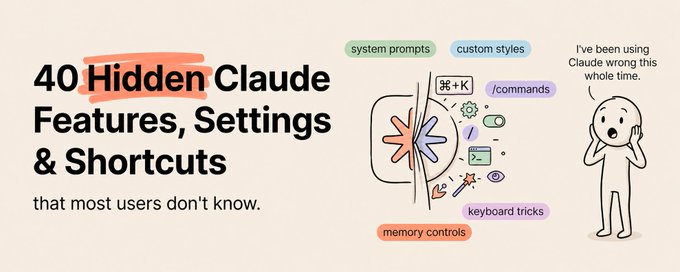
I've spent hundreds of hours inside every Claude interface.
Save this :)
These are the features that nobody talks about but everyone should be using.
Claude has three interfaces - Chat, Cowork, and Code. Most people use one. Almost nobody has explored all three. And even within the one they use, most people have touched maybe 20% of the available functionality.
The result is millions of people paying for a tool and using a fraction of what it can do.
Here are 40 features, settings, and shortcuts buried across the Claude ecosystem that change how you work the moment you discover them.
## Claude Chat - Hidden Power
01. Styles: Go to Settings → Styles. Claude has preset communication styles you can switch between: Concise, Explanatory, Formal, and more. You can also create custom styles. Build one that matches your voice and every conversation starts with the right tone automatically.
02. Projects: Most people miss this entirely. Projects let you create persistent workspaces with their own instructions and files. Every conversation inside a project automatically inherits the context. Instead of pasting your context file every time, create a project and set the context once.
03. Project Knowledge: Inside any project, upload reference documents. Claude reads them at the start of every conversation. Your brand guidelines. Your product docs. Your writing samples. Always loaded. Never forgotten.
04. Custom Instructions (System Prompt): In Project settings, you can write custom instructions that act as a system prompt for every conversation. "You are my content strategist. Always respond in my brand voice. Never use these words: [list]. Always format outputs as: [format]." This runs silently behind every message.
05. Artifacts: When Claude produces code, documents, or visual outputs, they render in a separate panel. You can iterate on artifacts independently of the conversation. Edit, refine, and download without losing your chat context.
06. Memory: Claude now remembers things across conversations. It learns your preferences, your projects, and your communication style over time. You can view and edit what Claude remembers in Settings → Memory. Curate it like you would curate an employee's onboarding notes.
07. Deep Research: Toggle on Deep Research for any query and Claude runs extended searches, reading dozens of sources before producing a comprehensive research report. Think of it as a junior analyst spending 2 hours on research, delivered in 2 minutes.
08. File Upload Intelligence: You can upload PDFs, images, spreadsheets, CSVs, code files, and documents directly into chat. Claude does not just store them - it reads and understands them. Upload a 50-page report and ask specific questions about page 37. Upload a spreadsheet and ask for trend analysis.
09. Image Analysis: Upload any image and Claude sees it with remarkable detail. Screenshots of errors, photos of whiteboards, charts, diagrams, handwritten notes, receipts, business cards. If it has visual information, Claude can extract and interpret it.
10. Canvas: Claude can generate visuals, diagrams, and interactive components directly in chat. Ask for a flowchart of your process. A comparison table. An organizational chart. A simple calculator. They render inline and are interactive.
11. LaTeX Rendering: For anyone working with math, statistics, or technical content, Claude renders LaTeX equations beautifully. Ask for formulas, derivations, or statistical outputs and they display properly formatted.
12. Conversation Branching: Edit any previous message and Claude regenerates the response from that point, creating a new branch. This lets you explore alternative approaches without losing your original conversation thread.
## Claude Code - Power Features
13. The CLAUDE.md Hierarchy: Most users have one CLAUDE.md. Power users have three levels. User-level (~/.claude/CLAUDE.md) for personal preferences. Project-level (.claude/CLAUDE.md) for team standards. Directory-level for module-specific rules. They cascade and the most specific level wins.
14. Path-Specific Rules: Create files in .claude/rules/ with YAML frontmatter specifying glob patterns. A rule with paths: ["**/*.test.*"] applies to every test file in your codebase automatically. Different standards for different file types without cluttering your main CLAUDE.md.
15. Plan Mode (Shift+Tab): Switch to plan mode before complex tasks. Claude creates a step-by-step plan, shows it for approval, and only executes after you agree. Essential for any task touching multiple files. The difference between clean execution and debugging chaos.
16. /compact: Compresses your conversation when context gets long. Claude keeps the important details but frees up context window space. Use this when Claude starts repeating mistakes or losing track of earlier decisions.
17. /memory: Shows exactly which memory files Claude Code has loaded for this session. If Claude is behaving inconsistently, run this to check whether the right context is actually active.
18. Custom Slash Commands: Build reusable commands in .claude/commands/ (personal) or ~/.claude/commands/ (global). A /review command that runs your code review checklist. A /test command that generates tests following your patterns. Ten minutes to create, hours saved over time.
19. Git Integration: Claude Code has native git awareness. It can commit, push, create branches, and even write commit messages based on the changes it made. "Commit everything with a descriptive message" actually works.
20. Multi-File Editing: Claude Code can read and edit multiple files in a single operation. Rename a function across your entire codebase. Update an import path in every file that references it. Refactor a component and update every file that uses it.
21. Test Generation: Point Claude Code at any function or module. "Write comprehensive tests for this." It generates test files that follow your project's testing conventions (if you set them in CLAUDE.md or path rules) including edge cases and error scenarios.
22. The -p Flag: Runs Claude Code in non-interactive, headless mode. Essential for CI/CD pipelines. Without it, your CI job hangs waiting for user input forever. With it, Claude runs autonomously and returns structured output.
23. --output-format json: Combined with --json-schema, Claude Code returns machine-parseable structured output. Your CI pipeline can automatically parse findings and post them as inline PR comments.
24. Independent Review Instances: The same Claude Code session that wrote code is biased toward its own decisions when reviewing. Always use a separate, fresh session for code review. The exam for Claude Certified Architect explicitly tests this concept.
## Claude Cowork - Hidden Functionality
25. Sub-Agent Parallel Processing: When Cowork gets a large task, it can spin up multiple sub-agents that work simultaneously. Tell it to process 20 files and it divides them across 4-5 sub-agents running in parallel. What takes 30 minutes sequentially finishes in 6.
26. /schedule: Set recurring tasks. Daily briefings. Weekly cleanups. Monthly financial processing. Your computer needs to be on and Claude Desktop open, but the tasks run unattended. If your laptop sleeps during a run, it auto-runs when you reopen.
27. Connector Chaining: Combine multiple connectors in a single workflow. "Read my Gmail, check my calendar, pull relevant files from Drive, and create a meeting prep document." Four connectors, one instruction, zero tab switching.
28. Plugin Marketplace: Verified plugins at claude.com/plugins give you pre-built capabilities for specific roles. Product management. Marketing. Finance. Legal. Each plugin adds slash commands and skills tailored to that function.
29. Folder Instructions: Place a markdown file with instructions inside any folder. When Cowork works on files in that folder, it reads those instructions first. Different rules for different projects. Different formatting for different clients. Automatic context switching.
30. Sandbox Security: Everything Cowork does runs inside a sandboxed Linux VM. It cannot access files outside the folders you explicitly grant permission for. You control the blast radius. This is why Cowork is safe for production work.
31. Browser Bridge: When Claude in Chrome is installed alongside Cowork, the two work together. Cowork can delegate web research to Chrome, process the results locally, and continue the workflow. The best of both worlds.
32. Session History: Every Cowork session is logged with full details of what actions were taken, what files were modified, and what the output was. Review any past session to understand exactly what happened. Essential for debugging failed automations.
33. Token Usage Awareness: Cowork tasks consume 3-5x more tokens than regular chat. Batch related tasks into single sessions. Be specific to avoid back-and-forth clarification. Schedule heavy tasks for off-peak hours where throughput is reportedly higher.
34. Plugin Chaining: Combine multiple plugins in a single workflow. Your research plugin feeds into your analysis plugin feeds into your report plugin. Multi-step, multi-capability workflows triggered by one command.
## Platform-Wide Settings
35. Usage Dashboard: Check your token consumption and usage patterns. If you are hitting limits, this shows you where your tokens are going so you can optimize.
36. Model Selection: Different tasks benefit from different models. Haiku is faster and cheaper for simple tasks. Sonnet balances speed and quality. Opus is the most capable for complex reasoning. Match the model to the task.
37. API Access: Your Claude subscription includes API credits. Build custom integrations, connect Claude to your own tools, or automate workflows that the standard interfaces do not support.
38. Team Sharing (Team/Enterprise plans): Share projects, skills, and configurations with your team. Everyone gets the same context, the same standards, and the same capabilities. Consistency across the entire organization.
39. Data Privacy Controls: You can opt out of your conversations being used for training. Check Settings → Privacy. For sensitive business work, verify your data handling preferences are set correctly.
40. Keyboard Shortcuts: Ctrl+/ shows all available shortcuts. Ctrl+Shift+O opens a new conversation. Ctrl+Shift+C copies the last response. These small efficiencies compound across hundreds of daily interactions.
## TL;DR
40 features. All hidden in plain sight. 99% of users know maybe 10.
Claude is not one tool. It is three interfaces (Chat, Code, Cowork), each with layers of functionality most users never explore. The people who discover these features do not just save time - they operate on a completely different level.
Pick the 5 features most relevant to your work. Try them today. Each one unlocks a workflow you did not know was possible.
This list took hundreds of hours of exploration to compile. If it saved you time, you know what to do.
I post stuff like this regularly - AI tools, features, workflows, and things I actually use. No fluff.
Follow me @eng_khairallah1 for more automation architectures, workflow designs, and business AI playbooks.
hope this was useful for you, Khairallah ❤️
## 相关链接
- [Khairallah AL-Awady reposted](https://x.com/eng_khairallah1)
- [Khairallah AL-Awady](https://x.com/eng_khairallah1)
- [@eng_khairallah1](https://x.com/eng_khairallah1)
- [5.1K](https://x.com/eng_khairallah1/status/2050869463252455584/analytics)
- [CLAUDE.md](http://claude.md/)
- [CLAUDE.md](http://claude.md/)
- [CLAUDE.md](http://claude.md/)
- [CLAUDE.md](http://claude.md/)
- [claude.com/plugins](http://claude.com/plugins)
- [@eng_khairallah1](https://x.com/@eng_khairallah1)
- [Upgrade to Premium](https://x.com/i/premium_sign_up)
- [5:25 PM · May 3, 2026](https://x.com/eng_khairallah1/status/2050869463252455584)
- [5,171 Views](https://x.com/eng_khairallah1/status/2050869463252455584/analytics)
- [View quotes](https://x.com/eng_khairallah1/status/2050869463252455584/quotes)
---
*导出时间: 2026/5/3 19:52:15*
---
## 中文翻译
# 40 个大多数用户不知道的 Claude 隐藏功能、设置和快捷键
**作者**: Khairallah AL-Awady
**日期**: 2026-05-03T09:25:58.000Z
**来源**: [https://x.com/eng_khairallah1/status/2050869463252455584](https://x.com/eng_khairallah1/status/2050869463252455584)
---

我在 Claude 的每一个界面里都花费了数百个小时。
收藏这个 :)
这些功能鲜有人提及,但每个人都应该使用。
Claude 拥有三个界面——Chat(聊天)、Cowork(协作)和 Code(代码)。大多数人只用其中一个。几乎没有人探索过全部三个。即便是在他们常用的那个界面里,大多数人也就接触了大概 20% 的功能。
结果是,数百万人为这个工具付费,却只使用了它能力的一小部分。
以下是隐藏在 Claude 生态系统各处的 40 个功能、设置和快捷键,一旦发现它们,就会立刻改变你的工作方式。
## Claude Chat - 隐藏的威力
01. 风格:进入设置 → 风格。Claude 拥有预设的沟通风格,你可以在“简洁”、“解释性”、“正式”等风格之间切换。你也可以创建自定义风格。建立一个匹配你语气的风格,这样每次对话都会自动以正确的基调开始。
02. 项目:大多数人完全错过了这个功能。项目允许你创建具有独立指令和文件的持久化工作区。项目内的每一次对话都会自动继承上下文。与其每次都粘贴你的上下文文件,不如创建一个项目并一次性设置好上下文。
03. 项目知识库:在任何项目内部,上传参考文档。Claude 会在每次对话开始时阅读它们。你的品牌指南。你的产品文档。你的写作样本。始终加载。永不遗忘。
04. 自定义指令(系统提示词):在项目设置中,你可以编写自定义指令,作为每次对话的系统提示词。“你是我的内容策划。始终以我的品牌口吻回应。永远不要使用这些词:[列表]。始终将输出格式化为:[格式]。”这会在每条消息背后静默运行。
05. 成品:当 Claude 生成代码、文档或视觉输出时,它们会渲染在独立的侧边栏中。你可以独立于对话对成品进行迭代。编辑、优化和下载,而无需丢失聊天上下文。
06. 记忆:Claude 现在可以跨对话记住信息。它会随着时间的推移了解你的偏好、项目和沟通风格。你可以在 设置 → 记忆 中查看和编辑 Claude 记住的内容。像管理员工入职笔记一样精心管理它。
07. 深度研究:为任何查询开启深度研究,Claude 会进行扩展搜索,在阅读数十个来源后生成一份综合研究报告。把它想象成一名初级分析师花费 2 小时进行研究,在 2 分钟内交付成果。
08. 文件上传智能:你可以直接在聊天中上传 PDF、图片、电子表格、CSV、代码文件和文档。Claude 不仅仅是存储它们——它会阅读并理解它们。上传一份 50 页的报告,并询问关于第 37 页的具体问题。上传一个电子表格并要求进行趋势分析。
09. 图像分析:上传任何图片,Claude 都能以惊人的细节看到它。错误截图、白板照片、图表、图解、手写笔记、收据、名片。只要有视觉信息,Claude 就能提取并解读它。
10. 画布:Claude 可以直接在聊天中生成视觉图、图表和交互组件。索要流程图。对比表。组织结构图。一个简单的计算器。它们会内联渲染并支持交互。
11. LaTeX 渲染:对于任何使用数学、统计或技术内容的人,Claude 都能漂亮地渲染 LaTeX 方程。索要公式、推导或统计输出,它们会以正确的格式显示。
12. 对话分支:编辑任何之前的消息,Claude 会从该点重新生成回复,从而创建一个新的分支。这让你可以在不丢失原始对话线索的情况下探索不同的方法。
## Claude Code - 强力功能
13. CLAUDE.md 层级结构:大多数用户只有一个 CLAUDE.md。高级用户拥有三个层级。用户级用于个人偏好。项目级用于团队标准。目录级用于特定模块的规则。它们是级联的,最具体的层级优先。
14. 路径特定规则:在 .claude/rules/ 中创建文件,并在 YAML 前置元数据中指定 glob 模式。一个带有 paths: ["**/*.test.*"] 的规则会自动应用于代码库中的每个测试文件。针对不同文件类型采用不同标准,而不会让你的主 CLAUDE.md 变得杂乱。
15. 计划模式 (Shift+Tab):在复杂任务之前切换到计划模式。Claude 会创建一个分步计划,展示给你以供批准,并且只有在你同意后才会执行。对于涉及多个文件的任何任务,这都至关重要。这是干净执行与调试混乱的区别。
16. /compact:当上下文变长时压缩你的对话。Claude 会保留重要细节,但会释放上下文窗口空间。当 Claude 开始重复错误或忘记之前的决定时,请使用此命令。
17. /memory:显示 Claude Code 为本次会话加载的确切记忆文件。如果 Claude 的行为不一致,请运行此命令以检查正确的上下文是否处于激活状态。
18. 自定义斜杠命令:在 .claude/commands/(个人)或 ~/.claude/commands/(全局)中构建可重用命令。一个运行你的代码审查清单的 /review 命令。一个根据你的模式生成测试的 /test 命令。十分钟创建,长期节省时间。
19. Git 集成:Claude Code 原生支持 git 感知。它可以提交、推送、创建分支,甚至根据它所做的更改编写提交消息。“提交所有内容并附带描述性消息”确实有效。
20. 多文件编辑:Claude Code 可以在单个操作中读取和编辑多个文件。在整个代码库中重命名一个函数。更新每个引用它的文件中的导入路径。重构一个组件并更新使用它的每个文件。
21. 测试生成:将 Claude Code 指向任何函数或模块。“为此编写全面的测试。”它会生成遵循你项目测试约定(如果你在 CLAUDE.md 或路径规则中设置了它们)的测试文件,包括边缘情况和错误场景。
22. -p 标志:以非交互式、无头模式运行 Claude Code。对于 CI/CD 管道至关重要。没有它,你的 CI 作业将永远挂起等待用户输入。有了它,Claude 会自主运行并返回结构化输出。
23. --output-format json:与 --json-schema 结合使用,Claude Code 会返回机器可解析的结构化输出。你的 CI 管道可以自动解析发现结果,并将其作为内联 PR 评论发布。
24. 独立审查实例:编写代码的同一个 Claude Code 会话在审查时往往会倾向于自己的决策。始终使用一个单独的、全新的会话进行代码审查。Claude 认证架构师的考试明确考察了这一概念。
## Claude Cowork - 隐藏功能
25. 子代理并行处理:当 Cowork 收到一项大任务时,它可以启动多个同时工作的子代理。告诉它处理 20 个文件,它会将其分配给 4-5 个并行运行的子代理。顺序处理需要 30 分钟的工作,6 分钟即可完成。
26. /schedule:设置重复性任务。每日简报。每周清理。每月财务处理。你的电脑需要保持开机并且 Claude Desktop 处于打开状态,但任务会在无人看管的情况下运行。如果你的笔记本电脑在运行期间休眠,它会在你重新打开时自动运行。
27. 连接器链式组合:在单个工作流中结合多个连接器。“阅读我的 Gmail,检查我的日历,从 Drive 中提取相关文件,并创建一份会议准备文档。”四个连接器,一条指令,零标签切换。
28. 插件市场:claude.com/plugins 上的经过验证的插件为你提供针对特定角色的预构建能力。产品管理。市场营销。财务。法律。每个插件都增加了针对该功能定制的斜杠命令和技能。
29. 文件夹指令:在任何文件夹中放置包含指令的 markdown 文件。当 Cowork 处理该文件夹中的文件时,它会首先阅读这些指令。针对不同项目采用不同规则。针对不同客户采用不同格式。自动上下文切换。
30. 沙盒安全性:Cowork 做的所有事情都在一个沙盒化的 Linux 虚拟机中运行。它无法访问你明确授权权限之外的文件夹。你控制着爆炸半径。这就是为什么 Cowork 对生产工作是安全的。
31. 浏览器桥接:当 Chrome 中的 Claude 与 Cowork 一起安装时,两者可以协同工作。Cowork 可以将网络研究委托给 Chrome,在本地处理结果,然后继续工作流。两全其美。
32. 会话历史:每个 Cowork 会话都会记录详细信息,包括采取了哪些操作、修改了哪些文件以及输出了什么。查看任何过去的会话,以准确了解发生了什么。对于调试失败的自动化操作至关重要。
33. Token 使用感知:Cowork 任务消耗的 token 比普通聊天多 3-5 倍。将相关任务批量处理到单个会话中。要具体,以避免来回澄清。将繁重的任务安排在据报告吞吐量较高的非高峰时段。
34. 插件链式组合:在单个工作流中结合多个插件。你的研究插件输入到你的分析插件,再输入到你的报告插件。由一个命令触发的多步骤、多能力工作流。
## 平台级设置
35. 使用情况仪表板:检查你的 token 消耗和使用模式。如果你达到了限制,这里会显示你的 token 去向了哪里,以便你进行优化。
36. 模型选择:不同的任务受益于不同的模型。Haiku 对于简单任务来说更快、更便宜。Sonnet 平衡了速度和质量。Opus 对于复杂推理来说能力最强。将模型与任务相匹配。
37. API 访问:你的 Claude 订阅包含 API 积分。构建自定义集成,将 Claude 连接到你自己的工具,或者自动化标准界面不支持的工作流。
38. 团队共享(团队/企业计划):与你的团队共享项目、技能和配置。每个人都获得相同的上下文、相同的标准和相同的能力。整个组织的一致性。
39. 数据隐私控制:你可以选择退出使用你的对话进行训练。检查 设置 → 隐私。对于敏感业务工作,请验证你的数据处理偏好是否设置正确。
40. 键盘快捷键:Ctrl+/ 显示所有可用的快捷键。Ctrl+Shift+O 开始一个新对话。Ctrl+Shift+C 复制最后的回复。这些微小的效率在数百次日常互动中会不断积累。
## TL;DR(总结)
40 个功能。全部隐藏在显而易见的地方。99% 的用户可能只知道 10 个。
Claude 不是一个工具。它是三个界面,每个界面都有大多数用户从未探索过的多层功能。发现这些功能的人不仅节省了时间——他们在完全不同的层面上运作。
挑选 5 个与你的工作最相关的功能。今天就来试试。每一个都会解锁一个你意想不到的工作流。
这份列表花费了数百小时的探索才汇编而成。如果它为你节省了时间,你知道该怎么做。
我定期发布类似的内容——AI 工具、功能、工作流以及我实际使用的东西。没有废话。
关注我 @eng_khairallah1 以获取更多自动化架构、工作流设计和商业 AI 实战指南。
希望这对你有用,Khairallah ❤️