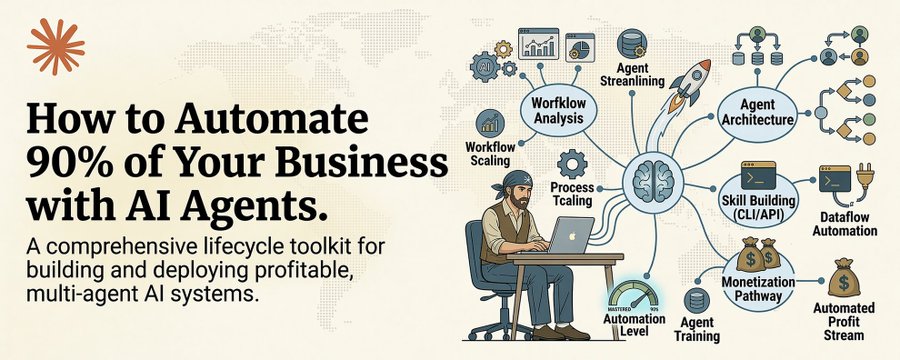
# How to Automate 90% of Your Business with Claude & AI Agents — The Complete Guide.
**作者**: Khairallah AL-Awady
**日期**: 2026-04-13T09:13:59.000Z
**来源**: [https://x.com/eng_khairallah1/status/2043618692899221719](https://x.com/eng_khairallah1/status/2043618692899221719)
---
Every business has the same problem.
Save this :)
90 percent of the work that keeps the business running is repetitive. Predictable. Follows the same steps every time. Email triage. Data entry. Report compilation. Invoice processing. Lead qualification. Customer responses. File organization. Meeting prep.
It is necessary work. It keeps the lights on. But it is not the work that grows the business. The work that grows the business - strategy, relationships, creative decisions, new opportunities - gets squeezed into whatever time remains after the repetitive work is done.
AI agents flip this ratio.
They handle the 90 percent of repetitive work so humans can spend their time on the 10 percent that actually creates value.
This is not a theoretical future. Businesses are doing this right now. Small teams running like large ones because AI agents handle the operational overhead that used to require full-time employees.
This course shows you how to identify, build, and deploy AI automations for your business. Not one automation. A system of automations that transforms how your entire operation works.
Phase 1: The Operations Audit (Where to Start)
Before you automate anything, you need to understand where your time actually goes. Not where you think it goes. Where it actually goes.
The Task Inventory
For one full week, every member of your team (including you) writes down every task they complete and how long it took. Not categories. Specific tasks.
"Responded to 12 customer emails - 45 minutes." "Updated CRM with notes from 3 sales calls - 20 minutes." "Compiled weekly KPI report from 4 data sources - 90 minutes." "Screened 25 resumes for marketing manager role - 60 minutes." "Organized incoming invoices and entered data into accounting system - 30 minutes."
After one week, you have a complete map of how time is spent in your business.
The Automation Score
Now score each task on three criteria:
Repeatable (1 to 5): Does this task follow the same steps each time? A 5 means the exact same process every time. A 1 means completely different every time.
Pattern-based (1 to 5): Does this task involve recognizing patterns and applying rules? A 5 means clear rules with consistent inputs. A 1 means it requires genuine creative judgment every time.
Time-consuming (1 to 5): How much time does this consume per week? A 5 means multiple hours. A 1 means minutes.
Multiply all three scores. Tasks scoring 75+ are your prime automation candidates. Tasks scoring under 30 should stay manual for now.
Most businesses find that 5 to 8 tasks are prime automation candidates. Start with the top 3 by score. These will deliver the most visible impact with the least implementation effort.
Phase 2: Build Your First Three Automations
Take your top three tasks from the audit and build an automation for each one. Here are the most common high-scoring tasks and exactly how to automate them.
Automation 1: Email Triage and Response
The manual process: Someone reads every incoming email, decides what it is about, routes it to the right person, and drafts responses for routine messages.
The automated process:
Build an AI agent that connects to your email via Gmail MCP or Microsoft 365 integration.
The agent reads each new email and classifies it:
For each category, define the exact action the agent takes. The key design principle: the agent handles routing and drafting, humans handle approving and sending. This keeps humans in the loop for anything customer-facing while eliminating the time spent reading, categorizing, and drafting.
Time saved: Two to three hours per day for a business receiving 50+ emails daily.
Automation 2: Report Generation
The manual process: Someone opens five different tools, exports data from each one, copies the numbers into a spreadsheet, creates charts, writes analysis, formats the report, and distributes it.
The automated process:
Build an AI agent with MCP connections to your data sources - your CRM, your analytics platform, your financial system, your project management tool.
The agent runs weekly on a schedule:
Step 1: Pull data from each connected source. Step 2: Process the raw data - calculate key metrics, compare to previous periods, identify trends. Step 3: Generate the report following your company's standard template. Step 4: Run a quality check - are all numbers consistent? Do trends make logical sense? Are there any anomalies that should be flagged? Step 5: Save the finished report to the shared drive and notify the distribution list.
Include a section in every automated report: "Anomalies and Flags" - anything the AI agent detected that looks unusual. A sudden spike in customer churn. A category of expenses that doubled. Revenue that dropped in a specific region. These flags ensure that the humans reviewing the report focus immediately on what matters.
Time saved: Two to four hours per report. For a business that produces weekly reports across multiple departments, this can save 10+ hours per week.
Automation 3: Lead Qualification
The manual process: A sales rep receives a new lead from the website contact form, researches the company, checks if they match your ideal customer profile, scores the lead, decides whether to pursue, and enters everything into the CRM.
The automated process:
Build an AI agent that monitors your lead intake source - a form, a CRM webhook, or an email alias.
When a new lead arrives:
Step 1: Extract the lead information - company name, contact person, stated need, company size, industry. Step 2: Research the company. Use web search tools to find company size, funding status, technology stack, recent news, and competitive landscape. Step 3: Score the lead against your Ideal Customer Profile criteria. You define these criteria in advance: minimum company size, target industries, budget indicators, technology fit. Step 4: Generate a lead brief: one-page summary of the company, the scoring breakdown, and a recommendation (pursue immediately, nurture, or pass). Step 5: Add the enriched lead data and brief to your CRM. Route to the appropriate sales rep based on territory or specialization.
Time saved: 15 to 20 minutes per lead. For a business processing 20 leads per day, that is five to seven hours of daily sales team time freed up for actual selling instead of research.
Phase 3: Infrastructure for Reliability
Automations that work in demos and break in production are worse than no automation at all. They create false confidence and waste the time of people who have to clean up after them.
Error handling is not optional.
Every automation needs a clear answer to these questions:
What happens when the email API is down? The agent saves unprocessed emails to a queue and retries every 30 minutes. If it fails three times, it sends an alert to the operations manager.
What happens when the data source returns unexpected data? The agent flags the anomaly, includes what it received, and generates the report with a clear warning rather than presenting potentially incorrect analysis as fact.
What happens when the lead research finds conflicting information? The agent includes both findings with a note highlighting the conflict and a recommendation to verify manually.
Every failure produces a clear, human-readable alert. Not a silent log entry. An actual notification to the person responsible for that automation.
Logging is not optional.
Log every action every automation takes. What it processed, what decisions it made, what it produced. When something goes wrong - and it will - logs are how you diagnose and fix the issue.
Without logs, you are debugging blind. With logs, you can reconstruct exactly what happened and why.
Phase 4: Measure the Impact
You need to prove that automations are delivering value, both to justify the investment and to identify where to improve.
Track three metrics for each automation:
Time saved per week. Measure this precisely. How many hours were spent on this task before automation? How many hours are spent now? The difference is your time savings.
Error rate. How often does the automation produce output that requires human correction? Track this weekly. The error rate should decrease over time as you refine the system. If it increases, something needs attention.
Cost per operation. What does it cost to run each automation cycle? API costs, hosting costs, tool costs. Compare this to the labor cost of doing the task manually. The ratio should be favorable - typically 5x to 20x cheaper with automation.
Review these metrics monthly. They tell you which automations are performing well, which need refinement, and where the next high-value automation opportunity is.
Phase 5: Scale Across the Business
Your first three automations are running reliably. Now expand.
Go back to your task inventory from Phase 1. The next three to five highest-scoring tasks are your next automation candidates. Build each one following the same process: design, implement, test with real data, deploy with monitoring, and measure impact.
Common expansion areas after the initial three:
Meeting preparation automation. Before every meeting, the agent compiles relevant background: previous meeting notes, project status, recent communications with the attendee, relevant data. A one-page briefing ready before you walk into the room.
Document processing pipeline. Incoming contracts, proposals, and agreements are automatically analyzed. Key terms extracted. Red flags identified. Summary generated. Comparison to standard terms highlighted.
Customer feedback analysis. Reviews, support tickets, and survey responses are automatically categorized, sentiment-analyzed, and compiled into weekly insight reports that highlight trending issues and opportunities.
Competitive monitoring. Track competitor websites, social media, job postings, and press releases for changes. Compile a weekly intelligence briefing highlighting what competitors are doing differently.
Each new automation follows the same pattern. The marginal effort decreases with each one because you reuse infrastructure - error handling patterns, logging systems, alert mechanisms, and deployment processes - from the automations you already built.
The Honest Limitations
AI automation is powerful but it is not magic. Acknowledge these limitations and design around them.
Automations cannot handle genuinely novel situations. A customer complaint about an issue that has never occurred before will not be handled well by an automation trained on known issues. Build escalation paths for anything the system has not seen before.
Quality requires ongoing refinement. Your automations will not be perfect on day one. They will improve over weeks and months as you review outputs, identify failure patterns, and update instructions. Budget 30 minutes per week per automation for maintenance and improvement.
Not everything should be automated. Some tasks require human judgment, empathy, creativity, or relationship awareness that AI cannot replicate. The goal is not to automate everything. The goal is to automate the tasks that consume time without requiring uniquely human qualities.
The Bottom Line
Every business has an 90/10 problem. 90 percent of the time is spent on repetitive operations. 10 percent is spent on the work that actually grows the business.
AI agents flip that ratio by handling the repetitive work autonomously, reliably, and at a fraction of the cost.
The path: audit your operations, identify the highest-impact automation opportunities, build three automations with proper error handling and monitoring, measure the impact, and expand.
The businesses that automate now will operate with a structural advantage that compounds every single month. Lower costs. Faster operations. Human talent focused on high-value work instead of data entry and email triage.
The tools exist. The infrastructure is mature. The ROI is proven.
The only question is how long you wait before your competitors do it first.
Follow me @eng_khairallah1 for more automation playbooks, AI systems design, and building guides for real businesses.
hope this was useful for you, Khairallah ❤️
## 相关链接
- [Khairallah AL-Awady](https://x.com/eng_khairallah1)
- [@eng_khairallah1](https://x.com/eng_khairallah1)
- [59K](https://x.com/eng_khairallah1/status/2043618692899221719/analytics)
- [@eng_khairallah1](https://x.com/@eng_khairallah1)
- [Upgrade to Premium](https://x.com/i/premium_sign_up)
- [5:13 PM · Apr 13, 2026](https://x.com/eng_khairallah1/status/2043618692899221719)
- [59.8K Views](https://x.com/eng_khairallah1/status/2043618692899221719/analytics)
- [View quotes](https://x.com/eng_khairallah1/status/2043618692899221719/quotes)
---
*导出时间: 2026/4/14 17:40:40*